Get all your news in one place.
100's of premium titles.
One app.
Start reading
The Economic Times
The Economic Times
Team Global

In 1960, two explorers descended nearly seven miles into the Mariana Trench and entered the deepest known place on Earth

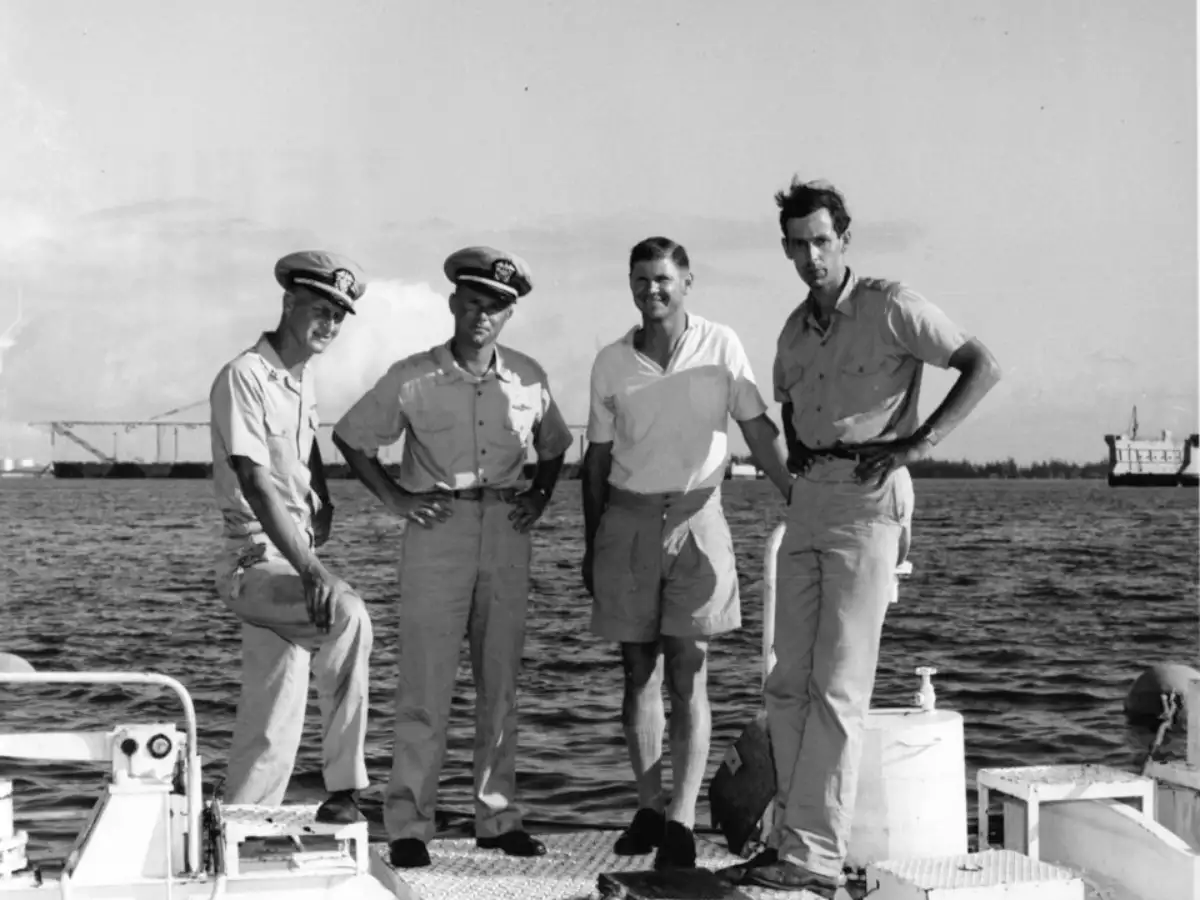
In January of 1960, oceanographer Jacques Piccard and U.S. Navy Lieutenant Don Walsh descended into the Mariana Trench aboard a specially designed deep-sea submersible called the Trieste. The objective was to reach Challenger Deep within the Mariana Trench, which is recognized as Earth’s deepest known underwater region. According to NOAA Ocean Exploration, Challenger Deep extends to almost 11 kilometers below the ocean's surface, equivalent to nearly seven miles. Pressure levels in such regions are extremely high and exceed more than a thousand times the normal atmospheric pressure at sea level.

The Trieste, on the other hand, was a unique type of submersible called a bathyscaphe that could explore the deep ocean floor. It was not like typical submarines, as it used gasoline to create a floating chamber, while its crew occupied a spherical cabin made of metal that could withstand high pressure. During their descent into the Mariana Trench, sunlight was no longer visible, and the explorers were exposed to extremely low temperatures in a virtually enclosed and isolated environment.

The ocean floor revealed a world almost completely cut off from sunlight

131152439

Once Piccard and Walsh reached the bottom of Challenger Deep on January 23, 1960, they found themselves in parts of the planet that had not been explored by people previously. According to the website of the U.S. Naval History and Heritage Command, the Trieste has managed to dive about 35,800 feet below sea level, which is the largest depth reached by any manned vehicle until then. It was hard to see clearly since the bathyscaphe stirred up sediment as it approached the surface. Despite the harsh conditions, there still appeared to be traces of life down there.

Exploration was made scientifically significant since it proved that it is possible to explore the planet and stay alive in the most extreme conditions in the seas on Earth. Exploration of the deeps was done only with the help of remote devices and measurements previously. Therefore, exploration became quite an achievement since man could see firsthand the deepest marine region in his lifetime. Further exploration of the area led to the Mariana Trench becoming crucial for studies of the geology and biology of the deep sea.

The mission permanently changed deep-sea exploration

The Trieste venture is one of the most significant milestones in oceanic exploration since it tested human engineering in an environment that was nearly as harsh as outer space itself. The primary issue facing human beings was extreme pressure. In Challenger Deep, water pressure reaches levels high enough to instantly destroy any regular submarine. This means that each part of the bathyscaphe had to be carefully engineered to function in an environment that differs from most other places on Earth.

This voyage also revolutionized science since it showed that despite being seemingly out of reach, life was still possible in some of the deepest points on Earth. As NOAA Ocean Exploration notes, one of the major milestones in oceanographic history is the voyage made by the Trieste, which proved to humans the possibility of investigating Earth’s deepest marine locations without any danger.

Sign up to read this article
Read news from 100's of titles, curated specifically for you.
Already a member? Sign in here
Related Stories
Top stories on inkl right now
Our Picks
Fourteen days free
Download the app
One app. One membership.
100+ trusted global sources.