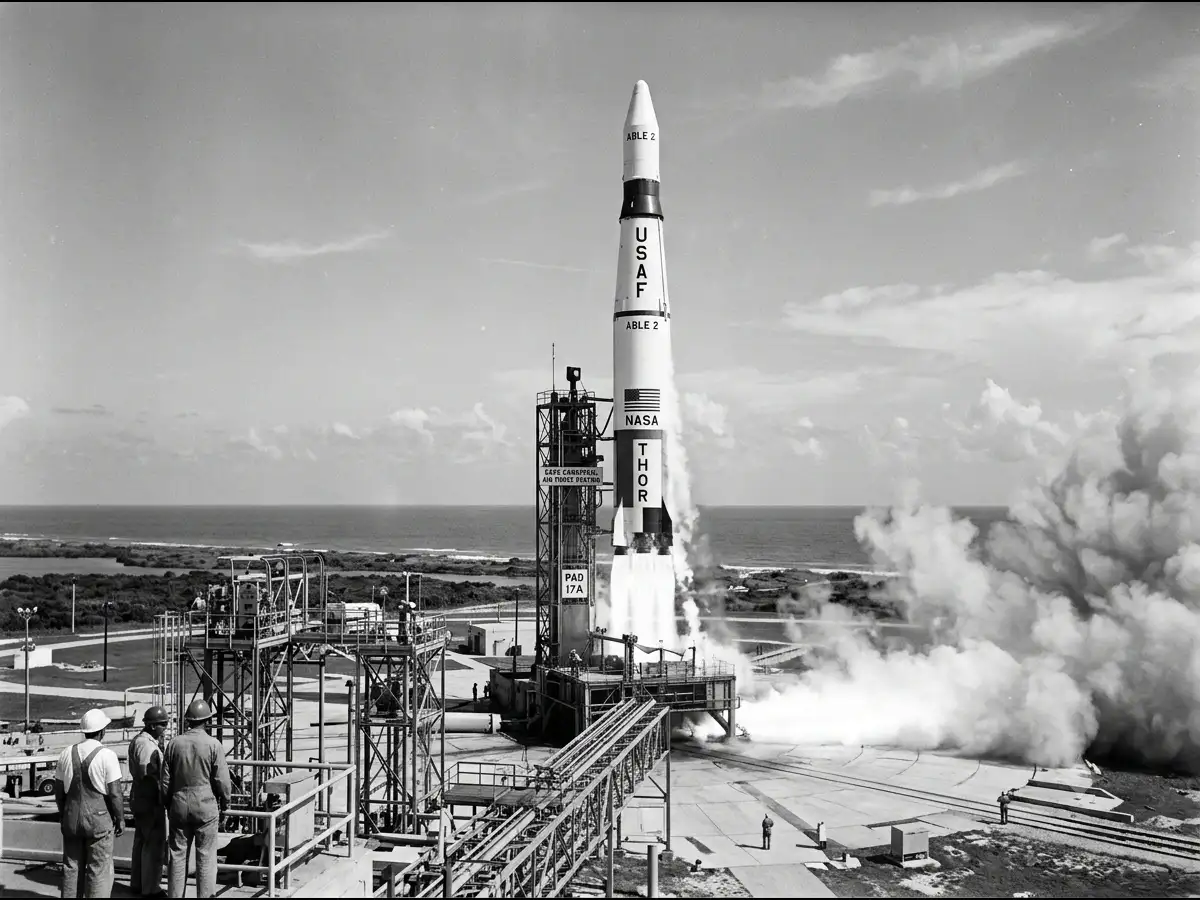
In 1958, NASA launched Able 2, later named Pioneer 1, as part of an early attempt by the United States to send a spacecraft toward the Moon. The mission was launched on October 11, 1958, from Cape Canaveral Air Force Station in Florida. The spacecraft was designed to study the Moon and gather information about the environment around Earth. It carried instruments to measure magnetic fields, radiation, micrometeoroid impacts and temperature. It also carried a television camera that was intended to help obtain an image of the lunar surface. The mission did not reach the Moon. A problem during the launch caused the second stage of the Thor rocket to shut down 10 seconds earlier than planned. The spacecraft therefore did not receive enough speed to escape Earth’s gravity.
Although the mission failed in its main objective, Pioneer 1 still returned scientific information. It reached an altitude of 71,303 miles, or about 114,750 kilometers, above Earth. The spacecraft also helped confirm the existence of the Van Allen Belts and provided information about the boundary of Earth’s geomagnetic cavity.