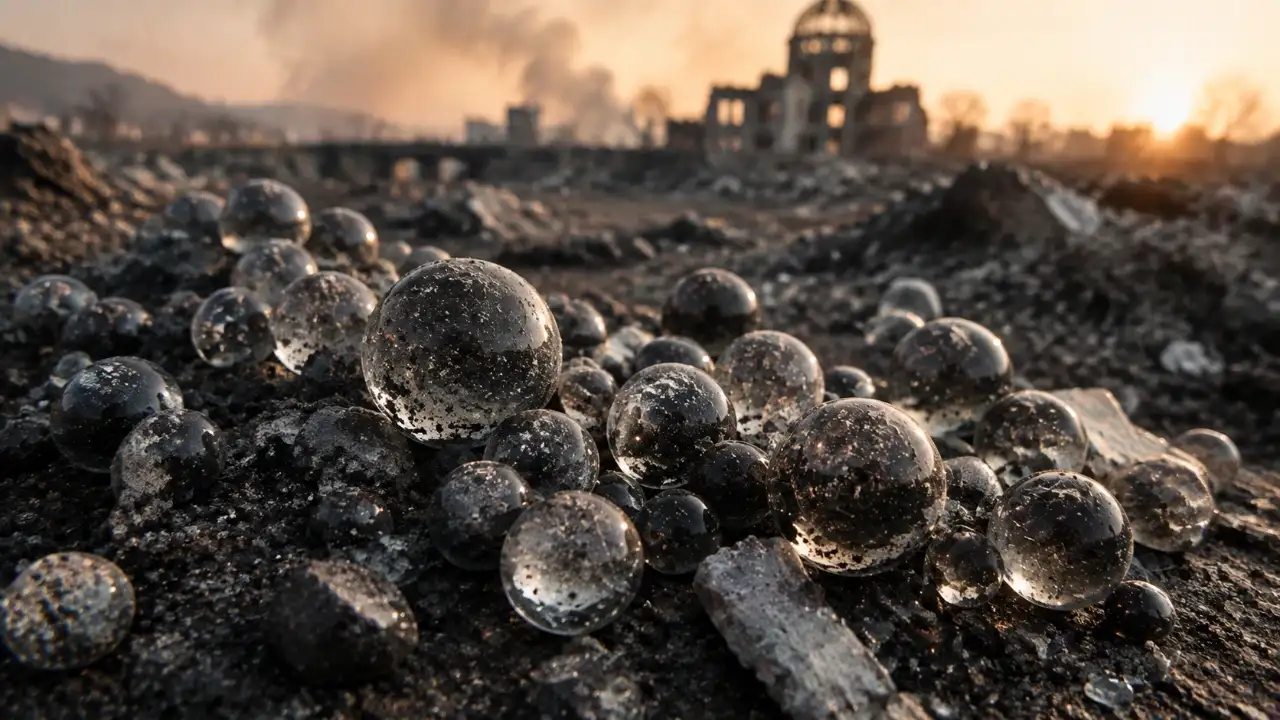
The physical aftermath of a major historical event can sometimes survive in unexpected forms. While the human consequences of the 1945 atomic bombing of Hiroshima remain central to its history, the explosion also produced extreme chemical and physical conditions that transformed ordinary materials in the surrounding environment. Decades later, scientists are still analyzing some of those materials to understand what happened during the brief moments of the blast.
Researchers have now investigated tiny glassy particles created in the explosion and found proof of an unusual multicomponent alloy with an earlier unreported crystal structure. The material was discovered inside one of the microscopic particles collected from the Hiroshima area. Its existence gives scientists an unusual opportunity to examine how matter behaves when exposed to extraordinary heat, rapid mixing and almost instantaneous cooling.