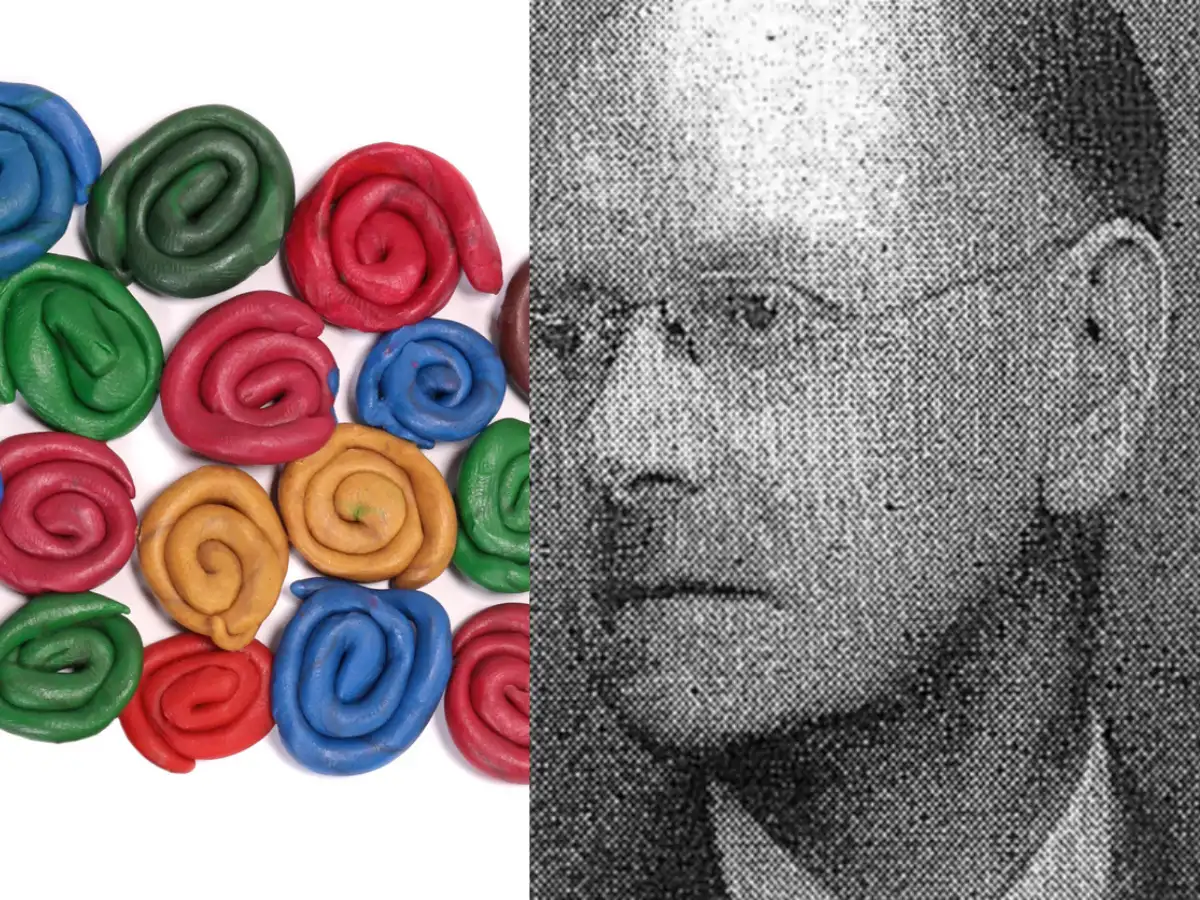
Some of the world's most famous inventions were never meant to exist. One of the best examples is Silly Putty, the stretchy, bouncy toy that entertained generations of children and adults alike.
What began as a serious wartime scientific project during World War II ended up becoming one of the most iconic toys of the 20th century. Instead of solving a major industrial problem, researchers accidentally created a strange substance that could stretch, bounce and even copy newspaper print.

Read more: Quote of the day by Carl Jung
Here's the fascinating story behind the accidental invention of Silly Putty.
How World War II Led To The Invention Of Silly Putty
During World War II, natural rubber became increasingly difficult to obtain. Rubber was a critical material used in military vehicles, tyres, equipment and countless wartime products.
Read more: Scientists warn this common food habit could be ageing your heart & brain faster
With supply chains disrupted, scientists across the world raced to develop synthetic alternatives.
Among them was engineer James Wright, who worked at General Electric's laboratory in the United States. His task was straightforward but challenging: create a material that could replace natural rubber.
The pressure was immense because industries desperately needed a substitute that could perform like real rubber under demanding conditions.
James Wright's Failed Rubber Experiment Changed History
While experimenting with different chemical combinations, Wright mixed silicone oil with boric acid.
The result was not what he expected.
Instead of producing a strong and durable rubber substitute, he created a strange substance that behaved unlike anything scientists had seen before.
The material could stretch dramatically when pulled slowly. However, when struck sharply, it bounced surprisingly well. It could also break apart under sudden force.
For Wright's original objective, the experiment was a failure. The material simply could not replace rubber in military applications.
Yet the unusual properties made it far too interesting to ignore.
What Is Silly Putty Made Of?
The unique behaviour of Silly Putty comes from a combination of silicone oil and boric acid.
This mixture creates a material that sits somewhere between a solid and a liquid.
When left undisturbed, it slowly flows and changes shape. When squeezed, stretched or bounced, it behaves more like a solid.
This unusual combination of properties fascinated scientists and engineers.
Even today, Silly Putty is often used to demonstrate basic concepts in materials science because of its distinctive behaviour.
Why Silly Putty Behaves So Strangely
One reason Silly Putty became so popular is that it seems to break the rules.
It can bounce like a rubber ball when dropped onto a hard surface. It can stretch into long strands when pulled gently. Yet if pulled quickly, it snaps apart.
The material also became famous for another unusual trick. It could lift and transfer ink from newspaper pages onto its surface.
These quirky characteristics helped transform a failed laboratory experiment into a toy that captured people's imagination.
Was James Wright The Only Inventor Of Silly Putty?
Although James Wright is often credited with creating Silly Putty, the full story is slightly more complex.
According to historical records highlighted by Carnegie Mellon University, similar silicone-based materials were being developed by other researchers around the same time.
One notable example was Earl Warrick at Dow Corning, who was also working with bouncing silicone polymers during the war years.
This does not diminish Wright's contribution. Instead, it shows how scientific discoveries often emerge from multiple researchers exploring similar ideas simultaneously.
The development of Silly Putty was part of a broader effort to solve wartime material shortages.
How A Failed Experiment Became A Best-Selling Toy
The turning point came when people outside scientific laboratories began interacting with the strange material.
Anyone who handled it immediately noticed its unusual properties. It was fun to stretch, bounce, twist and squeeze.
Toy manufacturers quickly recognised its commercial potential.
What had started as an unsuccessful engineering experiment suddenly found a completely different purpose. Instead of helping military production, it became a source of entertainment.
Consumers were fascinated by the material's odd behaviour, and demand quickly grew.
Why The Story Of Silly Putty Still Fascinates People Today
The story of Silly Putty remains popular because it highlights an important lesson about innovation.
Many people assume great inventions result from carefully planned success. In reality, some breakthroughs happen by accident.
Silly Putty demonstrates how curiosity and open-minded thinking can turn an apparent failure into something valuable.
If James Wright had simply discarded the unusual substance, one of the world's most beloved toys might never have existed.
The Legacy Of The Accidental Silly Putty Discovery
Decades after its invention, Silly Putty remains one of the most recognisable toys ever created.
Its journey from wartime laboratory experiment to global toy sensation continues to inspire scientists, inventors and entrepreneurs.
The invention serves as a reminder that failure is not always the end of a project. Sometimes a failed experiment reveals possibilities that nobody expected.
In the case of Silly Putty, a material that failed to solve a wartime rubber shortage ended up bouncing its way into popular culture and toy history.
That's what makes the story so remarkable: one accidental discovery transformed a laboratory mistake into a timeless success.
Inputs from TOI