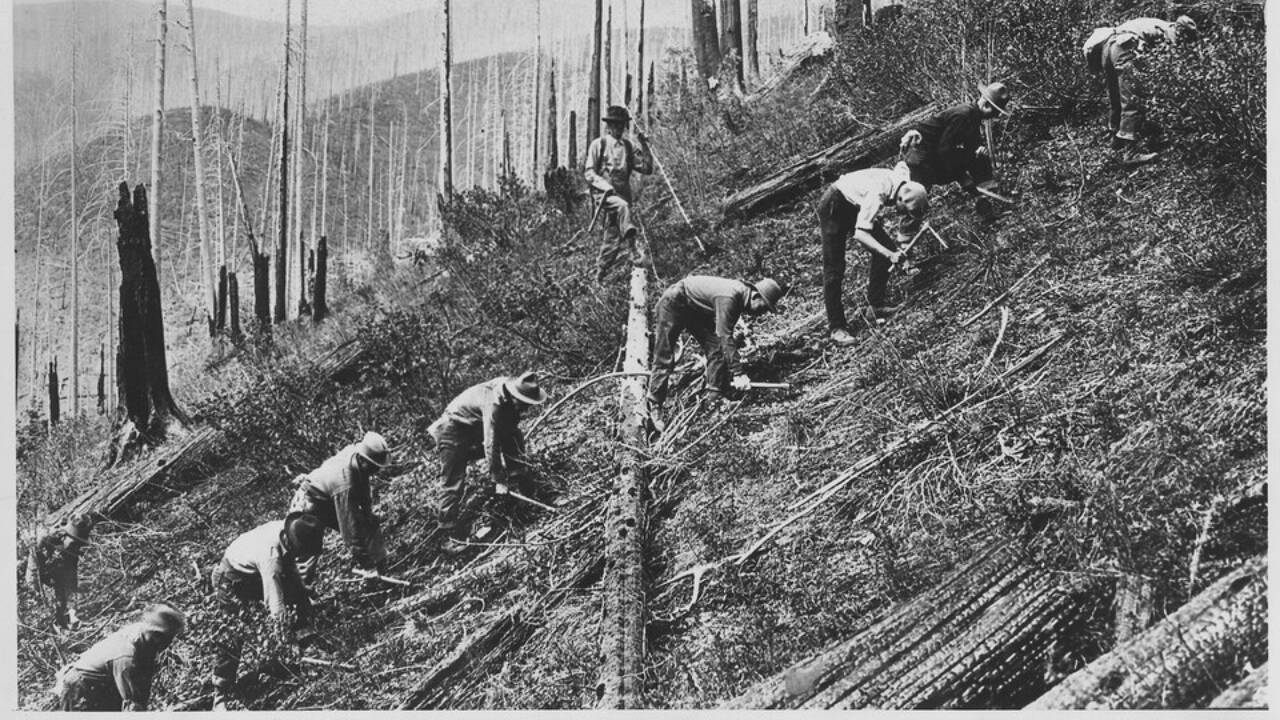
When the Great Depression left millions of Americans without any jobs, the United States responded to the crisis with a major conservation programme. In 1933, President Franklin D. Roosevelt created the Civilian Conservation Corps (CCC) as a part of his New Deal, which focused on recruiting unemployed young men to restore forests, fight soil erosion and develop public parks. According to the U.S. National Park Service (NPS), the programme, popularly nicknamed Roosevelt’s Tree Army, operated for nine years and enrolled more than three million men between 1933 and 1942. Notably, during this period, CCC workers planted three billion trees, protected 20 million acres from soil erosion and helped establish 800 state parks, leaving an environmental legacy that continues to shape the country’s landscapes today.
Get breaking news anytime, anywhere. Download the TOI app now!

Roosevelt’s Tree Army takes root
According to the National Park Service, Roosevelt proposed the CCC only days after taking office in March 1933. Therefore, young, unmarried men, initially between the ages of 18 and 25, were recruited into camps managed by the U.S. Army, with the Department of Agriculture and the Interior supervising the projects. Furthermore, the enrollees earned $30 a month, with $25 sent directly to their families, providing income during the Great Depression. It is worth noting that the eligibility expanded over time to include World War I veterans, local skilled workers, African American workers and Native Americans.
According to the National Park Service, the CCC’s work expanded beyond tree planting as the crews built roads, hiking trails, campgrounds, bridges, picnic shelters, fire lookout towers and park buildings across the United States. Additionally, they fought forest fires, restored damaged landscapes and carried out erosion-control measures that helped to stabilise farmland after the devastating Dust Bowl years. Notably, at individual parks, workers used native stone and timber to build facilities designed to blend with the surrounding landscape, and some are still in use today.
Tree Army planted three billion trees and brought a conservation revolution
According to the National Park Service, the initiative operated 4,500 camps across national forests, national parks and state parks. Notably, during its nine-year existence, workers planted three billion trees, constructed 28,000 miles of hiking trails, built 63,000 buildings and even helped to create and improve nearly 800 state parks. Additionally, the programme also protected 20 million acres from soil erosion through reforestation and land restoration projects, thus playing an important role in reshaping the country’s approach to conservation.
The National Park Service says some recruits arrived with little education or work experience and left with vocational skills, literacy training and practical knowledge of forestry and construction. Furthermore, the programme provided regular meals, medical care and structured employment during one of the nation’s most difficult economic crises. The Civilian Conservation Corps officially ended in 1942 as the country shifted its resources toward World War II, though its impact has endured. According to the CCC Legacy organisation , countless roads, campgrounds, trails, buildings and forest plantations created by the Tree Army remain in active use more than eight decades later. Many historians regard the CCC as a highly successful public works initiative, showing how environmental restoration and economic recovery can reinforce one another.