Get all your news in one place.
100's of premium titles.
One app.
Start reading
The Times of India
The Times of India
World
TOI World Desk

In 1910, an Ohio seamstress answered an ad for “plain sewing” and ended up helping build the Wright brothers' aeroplanes

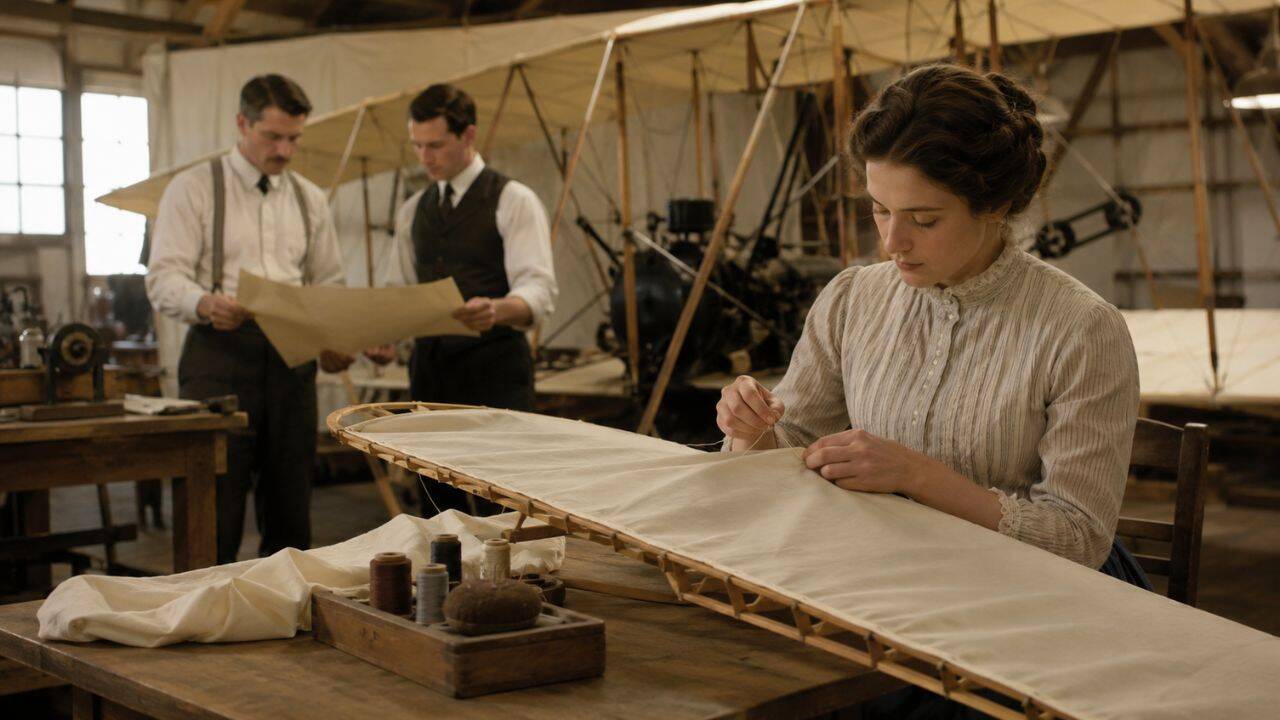
In 1910, Ida Holdgreve answered a small newspaper advertisement in Dayton, Ohio, looking for someone to do “plain sewing”. A dressmaker by trade, the 29-year-old had no idea the job would place her inside the newly established Wright brothers’ aircraft factory. The advertisement was reportedly meant to ask for “plane sewing”; work on the fabric coverings of aircraft being built by Orville and Wilbur Wright. Holdgreve learned to cut, stitch and stretch fabric over wooden frames, helping produce wings, rudders and other parts of the early flying machines. Her work later took her into wartime aircraft production, where she supervised other women sewing heavy canvas for military planes. Yet she would not fly herself until she was 88. By then, the seamstress who had quietly helped build some of America’s earliest aircraft had become an overlooked figure in aviation history.

Get breaking news anytime, anywhere. Download the TOI app now!

Ida Holdgreve joins the Wright brothers’ growing aircraft factory

Holdgreve had been born in Delphos, Ohio, in 1881, the sixth of nine children. She moved to Dayton in 1908 and worked as a dressmaker before the Wright brothers' factory began taking shape on the western edge of the city.

The factory was unlike the workshops most local residents knew. The Wright brothers had moved beyond experimenting with individual flying machines and were beginning to manufacture aircraft on a larger scale. Their buildings, rising among the cornfields, would become the Wright Company factory and one of the earliest dedicated airplane production sites in the United States.

Holdgreve joined the workforce at a time when women were still expected to occupy a fairly narrow range of jobs. Factory work was hardly the obvious destination for a young woman who had been trained in dressmaking. Yet the skills she already possessed translated surprisingly well.

Her new work involved sturdy aircraft fabric rather than dress material. She learned how to cut the cloth and stitch it accurately, then stretch it across parts of the aircraft frame. Wings, rudders and stabilisers all needed fabric coverings that could withstand the forces encountered in flight.

Duval LaChapelle, a mechanic who had worked with Wilbur Wright in France, provided Holdgreve with training for the specialised work. She had to learn the practical demands of aircraft construction while working alongside a growing industrial workforce.

Inside the Wright factory

The factory eventually employed as many as 80 people and produced around 120 aircraft across 13 models. The work was divided among different tasks, and Holdgreve occupied a small but necessary part of that process.

Photographs from the period show her at her sewing machine, surrounded by the tools and materials of the new industry. Her corner of the building would not have looked much like a traditional dressmaking room. Large pieces of fabric were being prepared for aircraft rather than garments, and the finished material would become part of machines designed to leave the ground.

There was also little room for mistakes. Aircraft fabric had to be properly fitted and secured. Holdgreve later recalled that when an aircraft was damaged, she sometimes had to repair the holes in its covering.

The work brought her into contact with both Wright brothers. She remembered them as pleasant despite the demands of running the company. Their attention, however, was increasingly divided by the difficulties of turning experimental aviation into a functioning business.

Reportedly, that period changed sharply in 1912. Wilbur Wright became ill with typhoid fever while travelling on business in Boston and died that May, aged 45.

After Wilbur Wright’s death

Orville was left to manage the company without his brother. The loss affected both the business and the man who had shared so much of its development with Wilbur. The company struggled with its direction and eventually changed hands. Holdgreve, meanwhile, remained in the aircraft industry.

In 1917, Dayton businessman Edward Deeds helped establish the Dayton-Wright Airplane Company. Holdgreve moved to its main plant in Moraine, Ohio, where her responsibilities increased. Instead of working alone at a sewing machine, she supervised other women working on aircraft fabric.

The material had changed too. The earlier aircraft had used lighter fabric, while the newer machines required heavier canvas. Holdgreve later described herself as a forewoman overseeing girls who were sewing the material used on the stronger aircraft. By then, the work had become part of a much larger manufacturing operation.

Ida Holdgreve becomes a key figure in wartime aircraft production

The United States' entry into the First World War brought an enormous demand for aircraft. Dayton-Wright became one of the major producers of the DH-4, a two-seat biplane used for reconnaissance and bombing missions. The aircraft was built largely from wood, fabric and metal fittings, with its fabric covering forming an essential part of the structure. It was also the only American-built aircraft to see combat during the war.

For Holdgreve and the women working under her, aircraft production meant adapting traditional sewing skills to industrial requirements. Their work did not involve designing engines or flying aircraft, but the machines could not be completed without the fabric components being properly prepared and fitted.

Holdgreve's role has sometimes been compared with the later image of women who entered industrial work during the Second World War. The comparison came decades later, when aviation historian and author Tim Gaffney described her as a kind of “Rosie the Riveter” before that famous wartime figure existed.

Ida Holdgreve returns to sewing after the war ends

When the First World War ended, Holdgreve left aircraft manufacturing. She returned to sewing, taking a position making draperies at a Dayton department store. There was an unusual connection with the place. The same store had supplied the Wright brothers with muslin for the covering of their 1903 Flyer.

Holdgreve's career in aviation therefore ended almost where it had begun: with fabric and a sewing machine. She later admitted that she had not understood at the time how unusual her work would eventually become. For decades, little public attention followed. She remained in Dayton and eventually stopped working at the age of 71 to care for an ill sister. She had never married and had no children of her own.

The woman who helped sew early aircraft finally flew at 88

Then came 1969, Holdgreve was 88 when she boarded an aircraft for the first time. The flight took place in November, more than half a century after she had helped sew fabric onto some of America's early aircraft. She wore spectacles, gloves, a heavy coat and a black Cossack-style hat for the flight. Sitting in the passenger compartment of an Aero Commander, she looked out at the clouds below. Her description was characteristically practical. The clouds, she said, looked like wool.

The flight attracted attention well beyond Dayton. Newspapers picked up the story of the elderly seamstress who had worked on aircraft associated with the Wright brothers but had waited until she was 88 to fly herself. Holdgreve was less impressed by the publicity than everyone else seemed to be. She said she had not expected people to make such a fuss. She simply wanted to fly.

A forgotten worker comes back into the story

Holdgreve died in 1977, aged 95, and was buried in Dayton's Calvary Cemetery. For many years, the Wright brothers' story remained centred on the brothers themselves. Their factory workers were far less familiar, even though manufacturing an aircraft required considerably more than the ideas of its designers.

That began to change in the 21st century. In 2014, the National Aviation Heritage Alliance and Wright State University Libraries' Special Collections and Archives launched the Wright Factory Families Project, prompted in part by the work of author Tim Gaffney.

The project sought to identify and document the people who had worked at the Wright Company factory and to connect those workers with their families and descendants. Holdgreve's relatives already knew about her connection with the Wright brothers. They had simply never regarded it as something that needed much attention.

Sign up to read this article
Read news from 100's of titles, curated specifically for you.
Already a member? Sign in here
Related Stories
Top stories on inkl right now
One subscription that gives you access to news from hundreds of sites
Already a member? Sign in here
Our Picks
Fourteen days free
Download the app
One app. One membership.
100+ trusted global sources.