Get all your news in one place.
100's of premium titles.
One app.
Start reading
The Economic Times
The Economic Times
Trending Desk

In 1889, British engineers built a bridge where the Ganga Canal flows above a river. This cement-less marvel in UP still works after 130 years

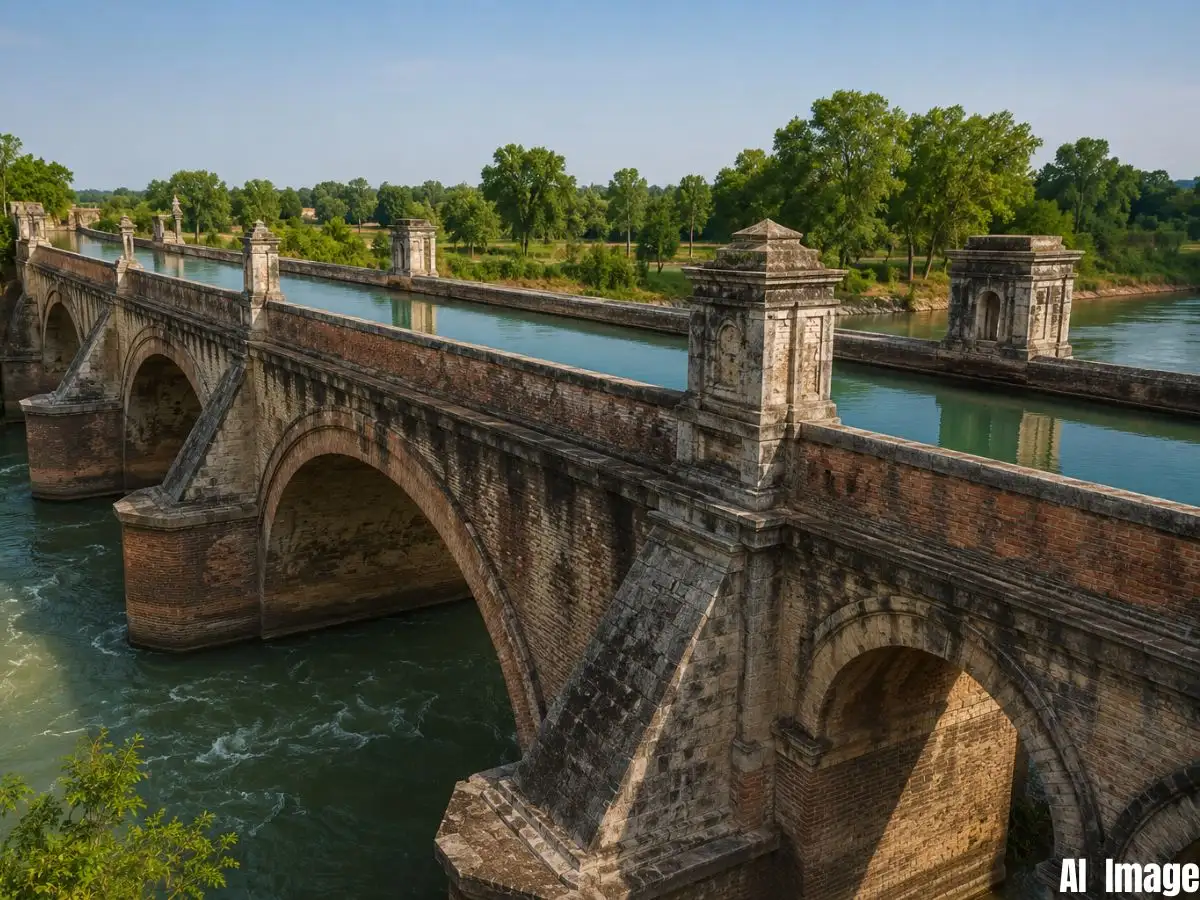
Tucked away in Kasganj district in Uttar Pradesh, the Nadrai Aqueduct has no cement, no steel, and no modern machinery holding it up, yet it has been carrying the Ganga Canal clear over the Kali River since the 19th century, and it's still doing the job today.

There's a bridge in Uttar Pradesh that leaves people scratching their heads the moment they see it. A river flows beneath it. A canal flows on top of it. And it has been doing exactly this, without a single bag of cement or a rod of steel, for well over 130 years. Locals know it by a couple of other names too, "Jhaal Ka Pul" and "Angrezi Pul," or the English Bridge, a nod to the colonial engineers who built it.

A river runs under it, a canal runs over it

Most bridges exist to carry people or vehicles across water. The Nadrai Aqueduct flips that idea on its head. Below its arches flows the Kali River, a tributary of the Ganga. Above it, the lower Ganga Canal glides right over the river without the two ever mixing, a rare meeting of nature and engineering that visitors describe as oddly soothing to watch.

Also Read: In 1997, Dharmendra Pradhan protested against paper leak outside Odisha Secretariat as a student leader and was beaten

It's this dual purpose that makes the structure so special: it channels canal water clear across the river while also letting locals cross from one bank to the other, all in one design.

Built without cement or steel, using lentil water and jaggery

Here's the part that stuns most people: construction ran from 1885 to 1889 under British rule, and the builders had neither cement nor iron rebar at their disposal.

Instead, the aqueduct was raised using traditional binding materials, lime, jaggery (gur), gram, and even water boiled with arhar dal (pigeon pea), mixed to create a mortar strong enough to hold more than 80 million bricks in place. Nearly 11 million cubic feet of masonry went into the project, all of it engineered and manufactured in-house by the irrigation department.

The project was overseen by Col. Sir W.A.H. Greathed, chief engineer of the irrigation department under the colonial government's north-western frontier administration. It took four years to complete, wrapping up on March 3, 1889, at a reported cost of Rs 4.18 crore.

The numbers behind the Nadrai Pul Marvel

  • 15 arches spanning more than 1,000 feet
  • A structure roughly 346 metres long and about 49.5 metres wide, with individual sections around 19.39 metres across
  • Foundation pillars built entirely of brick, sunk nearly 20 feet below the riverbed to support the arches, no concrete involved
  • Originally designed to discharge 4,100 cusecs of canal water; it now handles more than 8,500 cusecs

Over the decades, the Kali River itself has shrunk considerably, so much that its water level rarely rises past 30 feet from the base of the aqueduct today.

Still doing its job, generations later

More than 130 years after it was built, the Nadrai Aqueduct isn't just a tourist curiosity, it's still hard at work. It remains the vital link carrying Ganga water onward to the districts of Etah, Etawah, and Mainpuri, irrigating farmland across the region exactly as it was designed to do in the 1880s.

For a structure with no steel, no cement, and no modern machinery behind it, that's a remarkable track record, and a reminder of just how far traditional engineering could go, long before concrete became king.

Sign up to read this article
Read news from 100's of titles, curated specifically for you.
Already a member? Sign in here
Related Stories
Top stories on inkl right now
Our Picks
Fourteen days free
Download the app
One app. One membership.
100+ trusted global sources.