Get all your news in one place.
100's of premium titles.
One app.
Start reading
The Economic Times
The Economic Times
Maitreyee Thakkar

In 1861, seven Southern states seceded, Lincoln had taken office and Fort Sumter in Charleston Harbor set the stage for the deadliest war in American history

In April 1861, the United States was approaching a breaking point. Seven Southern states had already announced that they were leaving the country, a separate government had been established, and President Abraham Lincoln was refusing to accept the breakup of the Union. In Charleston Harbor, South Carolina, a small group of US soldiers was occupying a federal fort claimed by the new Confederate government. What happened there would turn a political crisis into a war.

To understand Fort Sumter, it is important to understand the dispute that had been tearing the United States apart for decades: slavery.

The Northern and Southern states had different economies and increasingly different political interests. Slavery was central to the agricultural economy of much of the South, particularly the production of cotton. Millions of African Americans were enslaved, while the institution was increasingly opposed by many people in the North and by the growing abolitionist movement.

According to the National Archives, tensions over slavery, its expansion and the political power of slaveholding states contributed directly to the secession crisis. The election of Lincoln in November 1860 became the immediate trigger. Lincoln opposed the expansion of slavery into US territories, and many Southern leaders viewed his election as a threat to the institution and to their political interests.

Seven states leave the United States

South Carolina was the first state to secede, declaring its withdrawal from the Union in December 1860. Mississippi, Florida, Alabama, Georgia, Louisiana and Texas followed before Lincoln's inauguration in March 1861.

These states did not simply become independent countries individually, rather they joined together to establish the Confederate States of America, commonly called the Confederacy. They formed their own government and selected Jefferson Davis as president.

The states that remained loyal to the existing US government became known as the Union.

So, in simple terms, by early 1861 there were two competing claims: Lincoln's government said the United States was still one country, while the Confederacy argued that the seceded states had the right to leave and govern themselves. The National Park Service describes Fort Sumter as one of the most important flashpoints in this confrontation.

Why did Fort Sumter matter?

Fort Sumter was a US Army fort built on a small artificial island at the entrance to Charleston Harbor. Charleston was in South Carolina, which had already seceded. That created an obvious problem.

The soldiers inside the fort were still serving the United States government, but the surrounding territory was now controlled by South Carolina and, increasingly, the Confederacy.

Major Robert Anderson commanded the Union garrison. Concerned that his position at Fort Moultrie was vulnerable, Anderson moved his troops to the unfinished but more defensible Fort Sumter in December 1860.

For the Confederacy, the continued presence of US troops inside Charleston Harbor represented federal authority on territory it claimed. For Lincoln's government, abandoning the fort could effectively mean surrendering a federal installation without a fight.

The supply problem

Anderson's garrison was small and increasingly short of food and other necessities. Lincoln faced a difficult choice. Sending a heavily armed force could be interpreted as an invasion by the Confederacy. But simply allowing the soldiers to run out of supplies or surrender would weaken the federal government's position.

According to the Library of Congress, Lincoln ultimately decided to send an expedition to resupply the fort, while informing South Carolina authorities that it was intended to provide provisions rather than reinforce the garrison with additional combat troops. The Confederacy nevertheless demanded that Anderson surrender, which he refused.

Confederate guns open fire

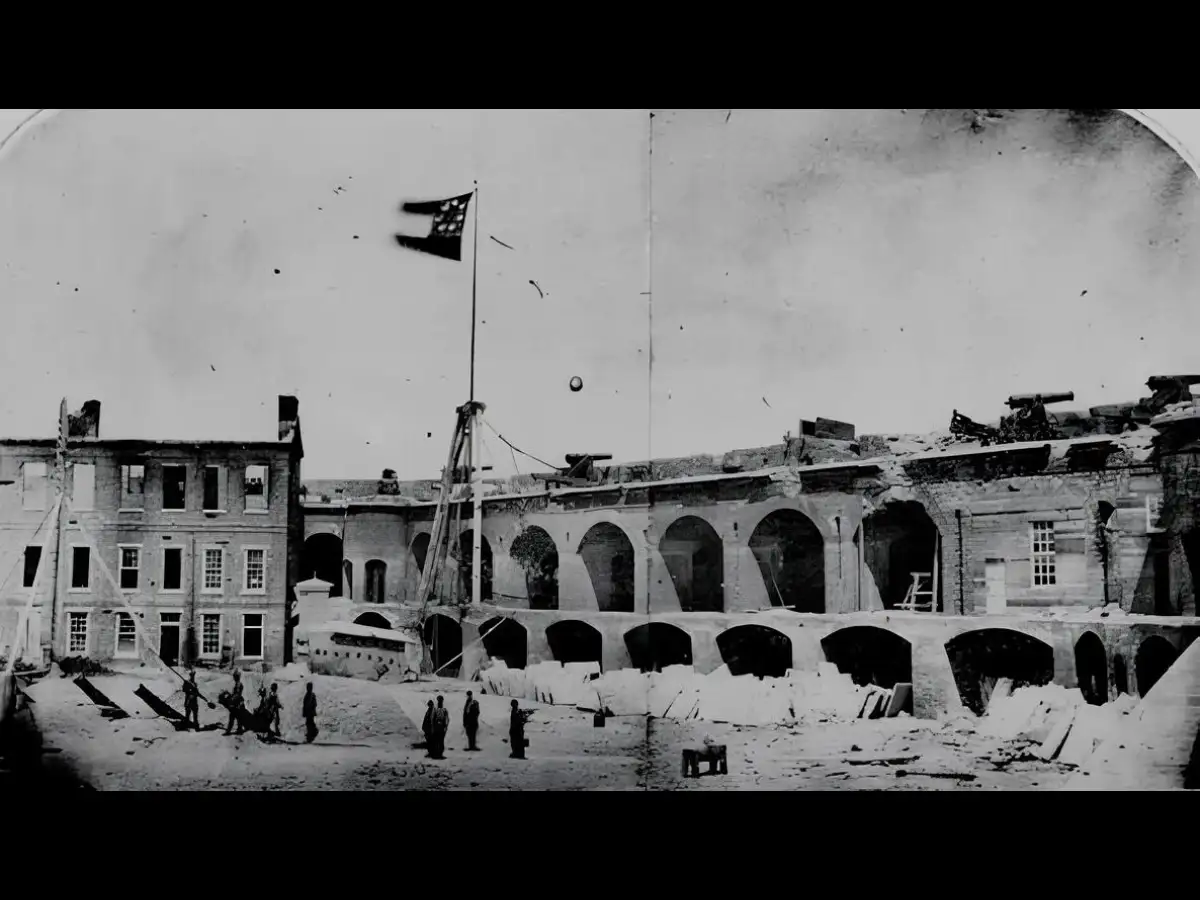
On April 12, 1861, Confederate artillery under General P.G.T. Beauregard began firing on Fort Sumter. The bombardment started before dawn and continued for approximately 34 hours, according to the National Park Service. Confederate batteries fired from positions around Charleston Harbor, while Union soldiers inside the fort returned fire.

The objective was not to destroy every soldier inside but to force Anderson to surrender and leave the fort.

The fort suffered extensive damage and fires broke out inside. With his men exhausted, his supplies running low and the installation badly damaged, Anderson agreed to evacuate on April 13. The Union troops left the following day.

How many people died?

The National Park Service records that no soldiers were killed during the main bombardment. Two Union soldiers died during the evacuation ceremony when an accidental explosion occurred while the departing troops were firing a ceremonial salute. Several others were wounded.

The relatively small number of casualties can be misleading. Fort Sumter was important not because it was one of the Civil War's bloodiest battles, but because it crossed the line from political confrontation into armed conflict.

The war spreads

After Fort Sumter surrendered, Lincoln called for 75,000 volunteers to help suppress the rebellion. That decision dramatically changed the situation with Virginia, Arkansas, Tennessee and North Carolina subsequently joining the Confederacy. The conflict was no longer limited to the seven states that had initially seceded.

The United States was now at war with itself. The fighting would continue until 1865, producing enormous casualties and eventually transforming the conflict from a struggle primarily over preserving the Union into a war that also resulted in the destruction of slavery.

Sign up to read this article
Read news from 100's of titles, curated specifically for you.
Already a member? Sign in here
Related Stories
Top stories on inkl right now
One subscription that gives you access to news from hundreds of sites
Already a member? Sign in here
Our Picks
Fourteen days free
Download the app
One app. One membership.
100+ trusted global sources.