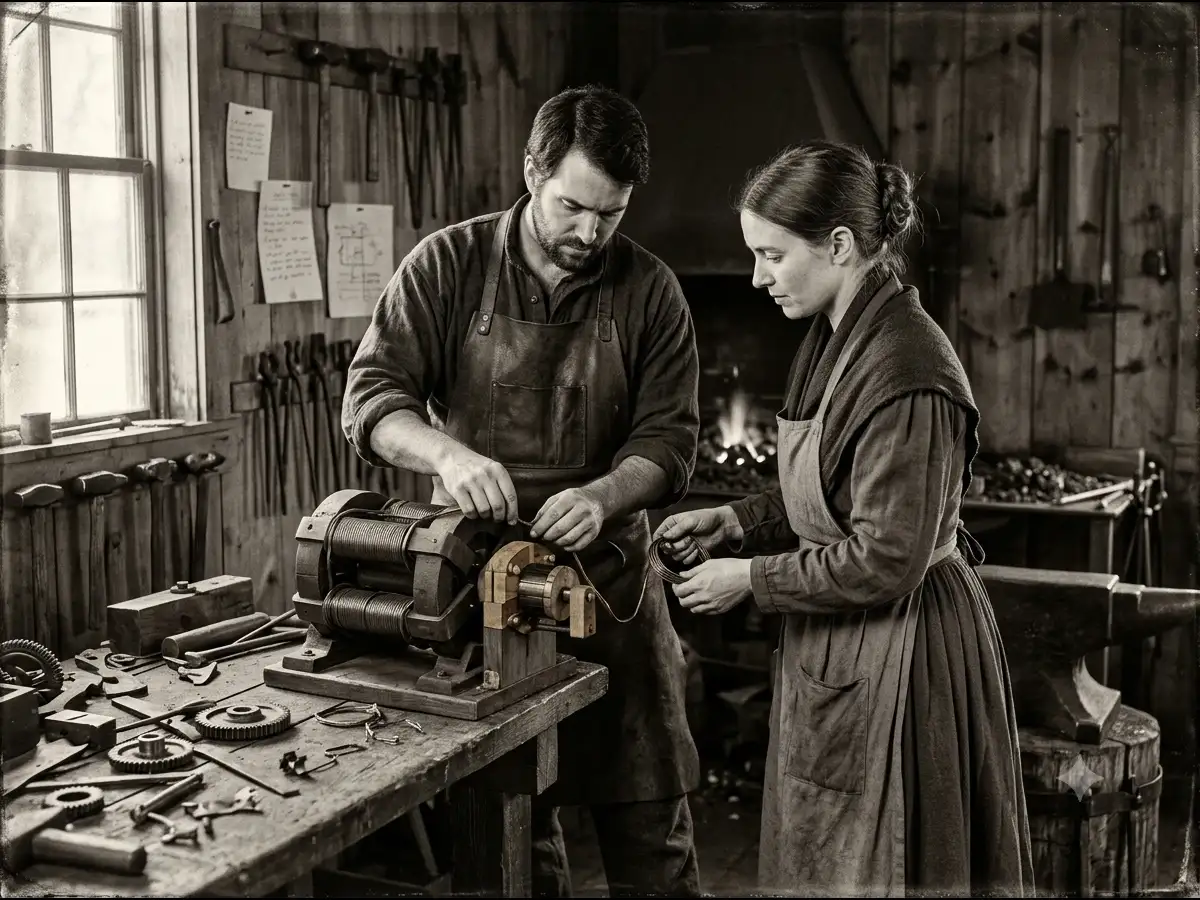
In 1834, an American blacksmith along with his wife built the first practical DC electric motor, marking an important point in the history of electric motors and electrical machinery. The American blacksmith was Thomas Davenport, who came from Vermont. His wife, Emily Davenport, also helped with the development of the machine. Davenport built his motor at a time when scientists and inventors were studying the connection between electricity and magnetism. His work showed that electricity could be used to create continuous rotary motion. This was different from demonstrations that only showed short or limited movement.
The machine used a galvanic battery as its power source. It used wire coils, iron cores, an armature and a primitive commutator. Together, these parts allowed electrical energy to produce mechanical movement. Davenport later received a US patent for his invention. On February 25, 1837, he received U.S. Patent No. 132 for what was described as Improvements in propelling machinery by magnetism and electro-magnetism.