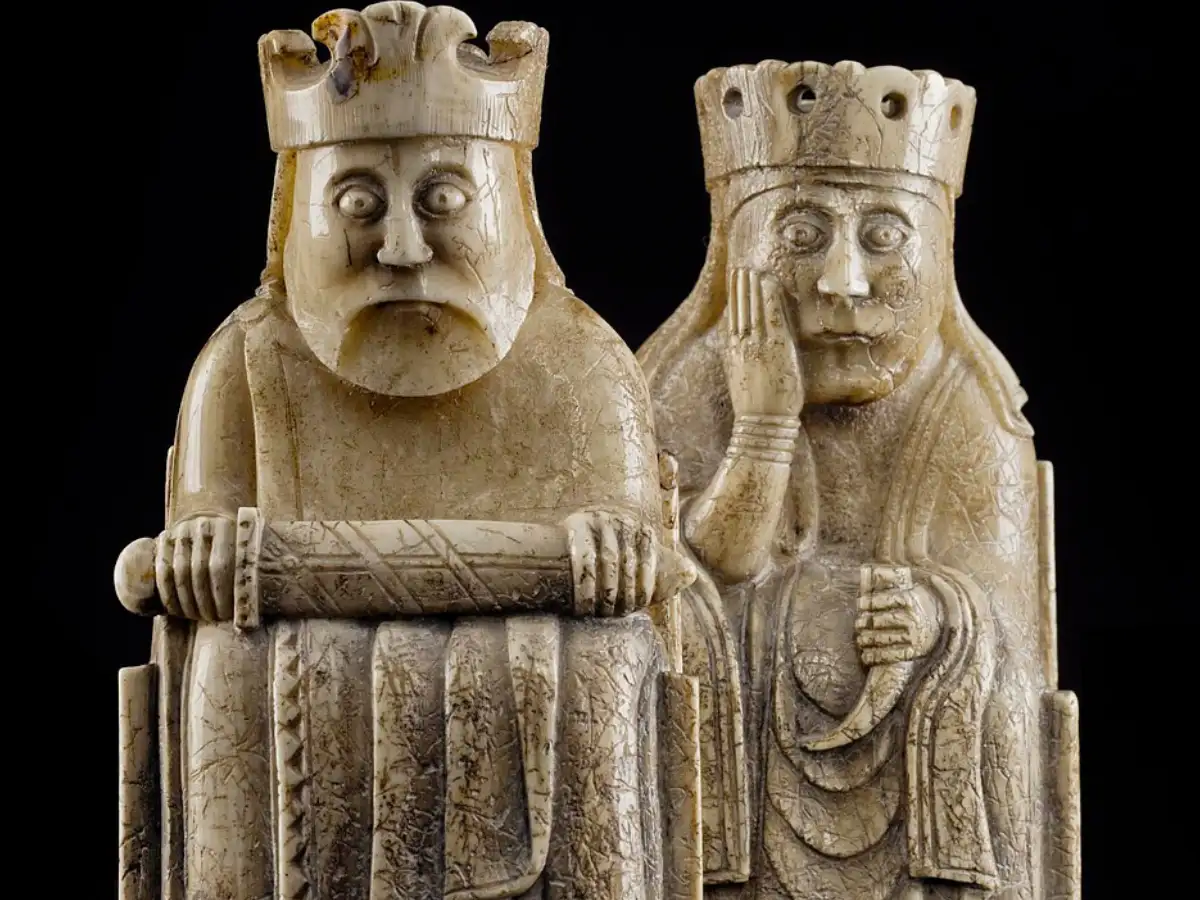
Picture this: it’s 1831. A man digging into a sandbank on the Isle of Lewis, a windswept Scottish island most people today couldn’t find on a map. He was not an archaeologist, nor was he on a dig. He was just digging, and then ivory-carved figures started falling out of the sand.
No dramatic fanfare. No expert team. Just a man, a sandbank, and one of the most important medieval finds in British history.

The objects he uncovered, now celebrated as the Lewis Chessmen, are like chess pieces from a fever dream, with wide-eyed bishops, knights clutching swords, and queens resting their heads on their hands in what can only be described as extreme existential fatigue. They are interesting, but it is not their appearance that makes them so remarkable; it’s what they tell us about a complicated, globe-spanning economy that most of us never learned about in school.
These weren't just chess pieces; they were status symbols
This is the thing that is often missed about medieval Europe: it was not a loose patchwork of isolated kingdoms. It was a globalized economy in its own way, and luxury goods traveled it like iPhones travel supply chains today.
The Lewis Chessmen are crafted from walrus ivory. Not bone, not wood, walrus ivory, one of the most prized and expensive materials in the medieval world for centuries. It was like the rare earth minerals of the time, which only the rich could afford what was made from them.
Cambridge University research into Norse walrus ivory shows that this material was well within elite exchange networks associated with Norse trading routes across the North Atlantic. This meant that the chess pieces found on a remote Scottish shoreline had been part of a supply chain that stretched from the Arctic to the workshops of skilled craftsmen, with Norse traders at every step of the way.
According to the research published in Quaternary Science Reviews, nearly all the walrus ivory found in medieval Europe came from Greenland. There weren’t just Norse communities scraping by on the edge of the world. They were running an extraction industry feeding luxury markets thousands of miles away. Hunters took walrus teeth. Traders carried them across the North Atlantic. Then they were made into objects by craftsmen, like the Lewis Chessmen.
It’s an entire economic ecosystem, and it lasted for centuries before resource depletion began to alter the trade routes, a cautionary tale that sounds all too familiar today.
How did they end up buried in a sandbank
Nobody knows for certain. They were likely being transported or stored, perhaps as inventory for a merchant, when they got buried on that Lewis shore. We don’t know if it’s a shipwreck, a quick hiding place, or just a mistake.
What we do know is that their graves held them. The sand had preserved ivory that might have rotted away, been sold off in pieces, or just disappeared from history. Getting lost was probably what saved them, in a strange twist of fate.
What a chess set reveals about power and trade
For American audiences accustomed to thinking of economic power in the terms of tech titans and international shipping lanes, the Lewis Chessmen provide a surprisingly relatable parallel. Resource scarcity, long-distance logistics, and luxury branding were also features of the medieval economies, with Norse networks at the helm.
They weren't just chess pieces; they provided access to exotic resources and distant trade routes.
The sandbank, discovered by accident in 1831, turned out to be more than a site of beautiful carvings. It had a secret map of medieval movement, wealth, and connections, carved in walrus ivory, buried in Scottish sand, waiting for almost 700 years to be found.