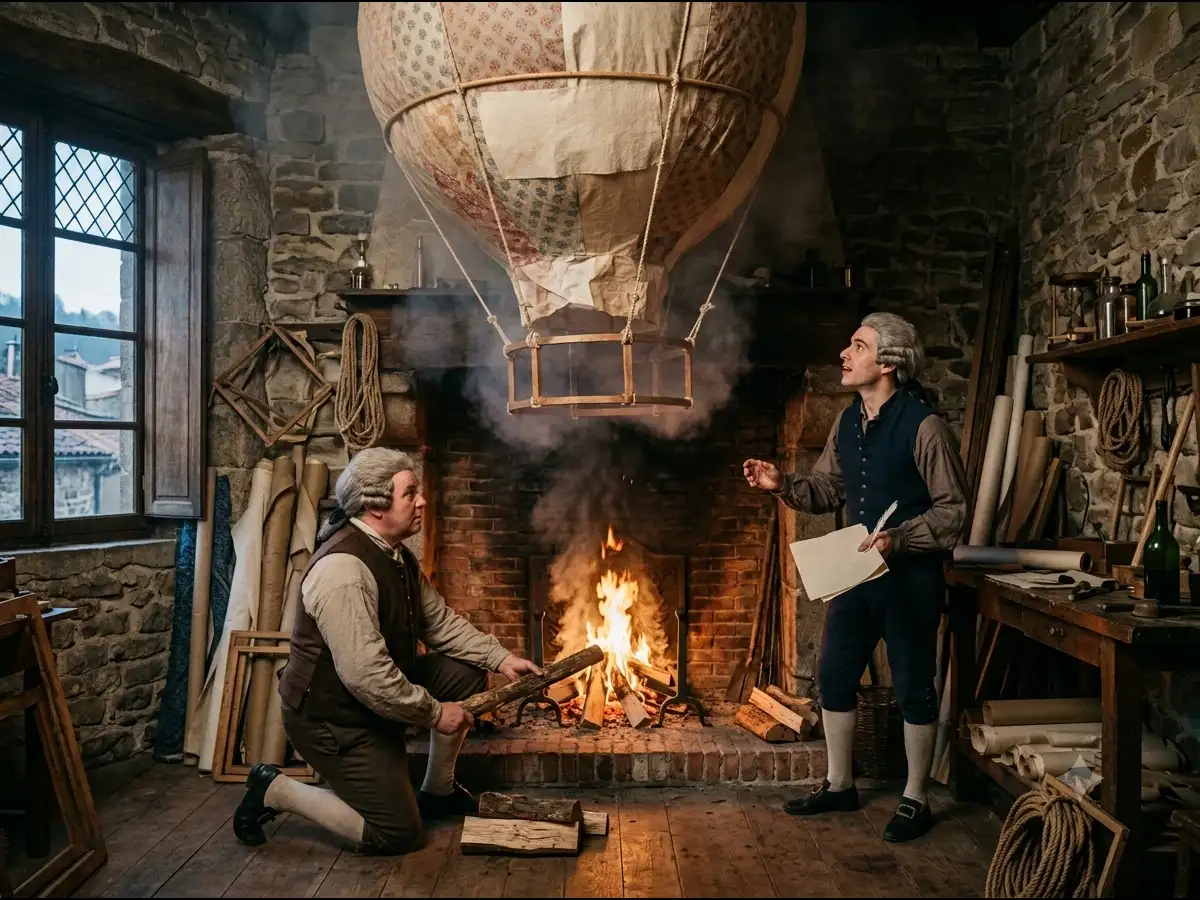
In 1783, two French brothers while conducting indoor experiments in Annonay, France after getting inspired by watching smoke rise and clothes billow over a fire invented the world's first practical hot air balloon. Joseph-Michel and Jacques-Étienne Montgolfier developed what became known as the globe aérostatique, or montgolfière. Their work became part of the early history of aviation and showed that heated air could be used to lift an object from the ground. The brothers did not begin with a plan for a passenger aircraft. Their work developed through experiments with air, smoke, paper and fabric. They observed that smoke moved upward and that material placed above a fire could rise. These observations led them to test whether a large enclosed structure could also move upward when filled with heated air.