Get all your news in one place.
100’s of premium titles.
One app.
Start reading
The Times of India
The Times of India
National
TIMESOFINDIA.COM

IMD issues yellow alert for Delhi; expect heavy downpour

NEW DELHI: The India Meteorological Department on Monday issued a 'yellow alert' for the national capital Delhi while the Yamuna River, which was flowing above warning level for hours, crossed the danger mark of 205.33 metres at 5 pm on Monday, the latest data from the flood control department said.

Moreover, Delhi Minister Saurabh Bharadwaj stated that the government is on alert mode and that is fully prepared to control the situation after the administration issued a flood alert following the release of a significant amount of water, totaling over one lakh cusecs, into the Yamuna River from the Hathnikund barrage by Haryana. Additionally, at 1 pm on Monday, 1,90,837 cusecs of water was released from the same barrage.

Roads in several parts of the capital were submerged in knee-deep water as it was inundated with 153 millimetres of rain, the highest precipitation in a single day in July in 40 years.

"Delhi government is on full alert. As the water will go above 206 metres, we will start shifting people, living on the banks. The process of taking them safely to the relief camp will be started. Earlier we were feeling that the water level would cross 205 meters on June 11, but it has crossed 205 meters today itself because more water is being released from Haryana," he told ANI.

According to the flood bulletin, the water level at the Old Railway Bridge increased 205.4 metres at 5 pm on Monday.

The water level in Yamuna is rising continuously as Haryana released more water into the river from the Hathnikund barrage amid rains across northwest India including the national capital.

IMD further stated that Delhi witnessed 16 cm ofrainfall over the national capital after 41 years.

Speaking with ANI, IMD Senior Scientist Dr Soma Sen Roy said, "The interaction zone is being persisting for the last 3-4 days and the monsoon trough was earlier dipping into eastern and Bay of Bengal. The monsoon eastern has moved away from the Bay of Bengal, moisture from Bay of Bengal has seized, but from the Arabian Sea moisture has started to flow because a low-pressure system has formed. As this interaction is not a very common phenomenon, but when a westerly system and an easterly system interact and this interaction is relatively less common, but because of that after 41 years we have got around 16cm rainfall and on Sunday, we got more than 10cm rainfall over Delhi. Particularly for today also, we have given up to 12cm rainfall. It might be more. We are monitoring and we will keep you informed."

There is a yellow alert for Delhi today and if necessary we will upgrade the alert level as well as the rainfall warning based on the main region of interaction, Roy added.

On warning, Roy said, "For Delhi, we are issuing alerts at subdivision level or state level. From our meteorological centres, district-level warnings are being issued for the districts which are likely to be affected by flash floods, landslides, heavy rain and thunderstorm'.

Speaking about if it's common to witness such heavy rainfall that Delhi has been experiencing during monsoon, Roy said, "Such rainfall may not have happened in Delhi, but it has happened in the past. It is not a very uncommon feature of monsoon whether easterly system or westerly system interact. Only this time it has happened after 41 years over Delhi. So, we are seeing this kind of intense spell over Delhi. If you remember, in 2013, the Uttarakhand episode, there was a low pressure system which moved from the Bay of Bengal and there was much deeper moisture coming in and that also interacted with westerly trough."

The Delhi Traffic Police issued a situation alert of water logging at several places, uprooting of trees, underpasses were inundated such as under the Minto bridge, the Pragati Maidan tunnel and the Kalindi Kunj underpass were flooded.

Roy also issued a warning for diseases and asked people to remain cautious and not to be adventurous and stay protected, follow the forecast.

Earlier today, Delhi Chief Minister Arvind Kejriwal said that there is no flood threat in Delhi due to the rise in water level of Yamuna, following two days of heavy rain in the national capital and adjoining areas.

Waterlogging issues were also observed in diplomatic enclaves such as Chanakyapuri, Kaka Nagar, Bharti Nagar, and other prominent roads and colonies under the jurisdiction of the NDMC.

Delhi Minister Saurabh Bharadwaj said that the government is in alert mode and that is fully prepared to control the situation."Delhi government is on full alert. As the water will go above 206 metres, we will start shifting people, living on the banks. The process of taking them safely to the relief camp will be started. Earlier we were feeling that the water level would cross 205 meters on June 11, but it has crossed 205 meters today itself because more water is being released from Haryana," he told ANI.

Earlier in the day, Delhi Chief Minister Arvind Kejriwal said that there is no flood threat in Delhi due to the rise in the water level of Yamuna, following two days of heavy rain in the national capital and adjoining areas.

He also urged all political parties to refrain from blame games stating that it was not the time to "point fingers" at each other."A flood-like situation unlikely to arise in Delhi. Government is prepared to deal with any situation," he said addressing a press conference here after a meeting to review the city's handling of the heavy rainfall

.Kejriwal said, "It is not the time to point fingers and single out anybody." He added that evacuation of people from low-lying areas around Yamuna will commence once the river breaches the 206-metre mark.The IMD has issued an orange alert for today in the national capital.

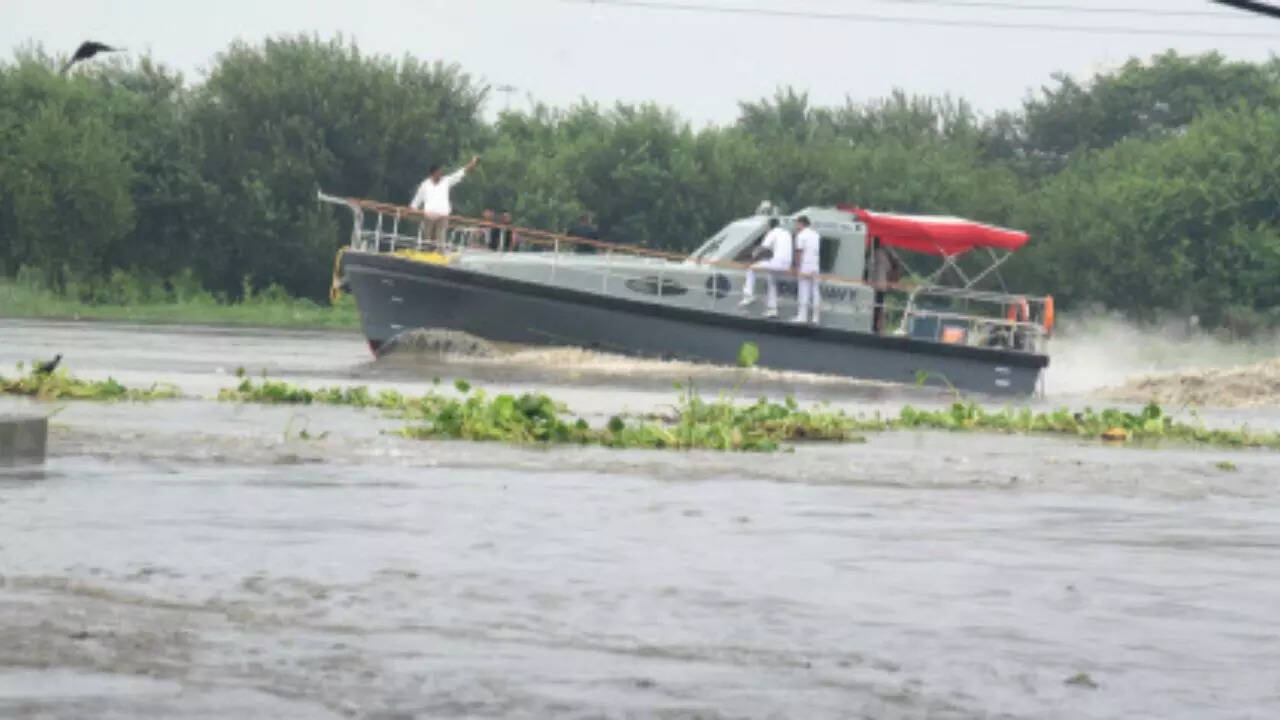
Ahead of the review meeting today Delhi's Public Works Department (PWD) minister Atishi inspected the Yamuna River's water level.

The national capital recorded 153 mm of rainfall in 24 hours ending at 8:30 am on Sunday, the highest in a single day in July since 1982, the India Meteorological Department (IMD) said.

Several parts of northwest India witnessed a heavy spell of rain with Delhi shattering a 41-year record on Sunday, IMD said.

Incessant rain triples cases of typhoid, throat infection in Delhi

NEW DELHI: The incessant rainfall over the weekend has led to a spurt in typhoid and upper respiratory infection cases among people, with experts identifying the elderly and the teenagers as the most vulnerable age groups. Delhi recorded 153 mm of rain in 24 hours ending 8.30 am on Sunday, the highest in a single day in July since 1982. The national capital recorded 107 mm of precipitation till 8.30 am on Monday.

According to Dr Rajeev Gupta, an expert in internal medicine and a director at C K Birla Hospital, there has been a sharp increase in patients troubled by typhoid and jaundice alongside upper respiratory infections.

According to him, the number of patients has tripled with mostly children and the elderly being affected.

"Overflowing sewage is one of the biggest areas of concern. The government needs to focus on this issue as water is getting more contaminated during the rain," he stressed.

Concurring with Gupta over the age group of patients, Dr Anukalp Prakash, Lead Consultant, Gastroenterology, CK Birla Hospital, Gurugram stressed that drinking water is a major source of infections of the intestine and is the only cause of Hepatitis A and E.

"The age group which is more prone to such seasonal diseases are children below 15 to 16 years and others are senior citizens and elderly patients above 55 to 60 years as the immunity of these is little low as compared to other age groups. Also, people who are diabetic, have high BP, and cardiac diseases are prone to such diseases," he said.

Doctors predicted that the spurt could last the next two to three weeks.

According to Dr Saibal Chakravorty, senior Consultant, Internal Medicine, Metro Hospitals & Heart Institute, Noida said "we do expect to see an increase in the number of patients" in coming weeks.

"The patients at the moment are mostly those suffering from viral infections related to the rainfall, change in temperature, but apart from that we also have seen some cases of gastroenteritis, diarrhoea coming to the hospital.

"Many of the patients are quite sick and they are dehydrated. Apart from that, we have not yet seen cases which are vector-borne diseases like dengue fever, malaria, which are expected to increase," he said.

Experts advised people to frequently wash their hands, make sure their food is fresh and properly cooked and purify their water with either purifying tablets or boiling.

Waterborne diseases are not the only concern as "diseases with an incubation period of 15-20 days, will start appearing within a month," said Dr Anubhav Jain, a gastroenterologist from Paras Health.

"As the rain continues, water ponds and still water will cause more mosquitoes to breed which will lead to more vector-borne diseases like dengue and malaria," he said. Dr Sundari Srikant, senior consultant, Internal Medicine, Marengo Asia Hospitals, Faridabad urged people to avoid street food during the season for their being more prone to getting contaminated.

"If one has to go out and eat, go to hygienic places and restaurants which can minimise risk of contamination. Don't consume sugarcane and other juices from outside and avoid eating cut fruits during this season," she said.

(With agencies inputs)

Sign up to read this article
Read news from 100’s of titles, curated specifically for you.
Already a member? Sign in here
Related Stories
Top stories on inkl right now
One subscription that gives you access to news from hundreds of sites
Already a member? Sign in here
Our Picks
Fourteen days free
Download the app
One app. One membership.
100+ trusted global sources.