Get all your news in one place.
100's of premium titles.
One app.
Start reading
Digital Camera World
Mike Harris

I’m a photography educator who disregarded Micro Four Thirds for wildlife photography. I don’t mind admitting when I’m wrong

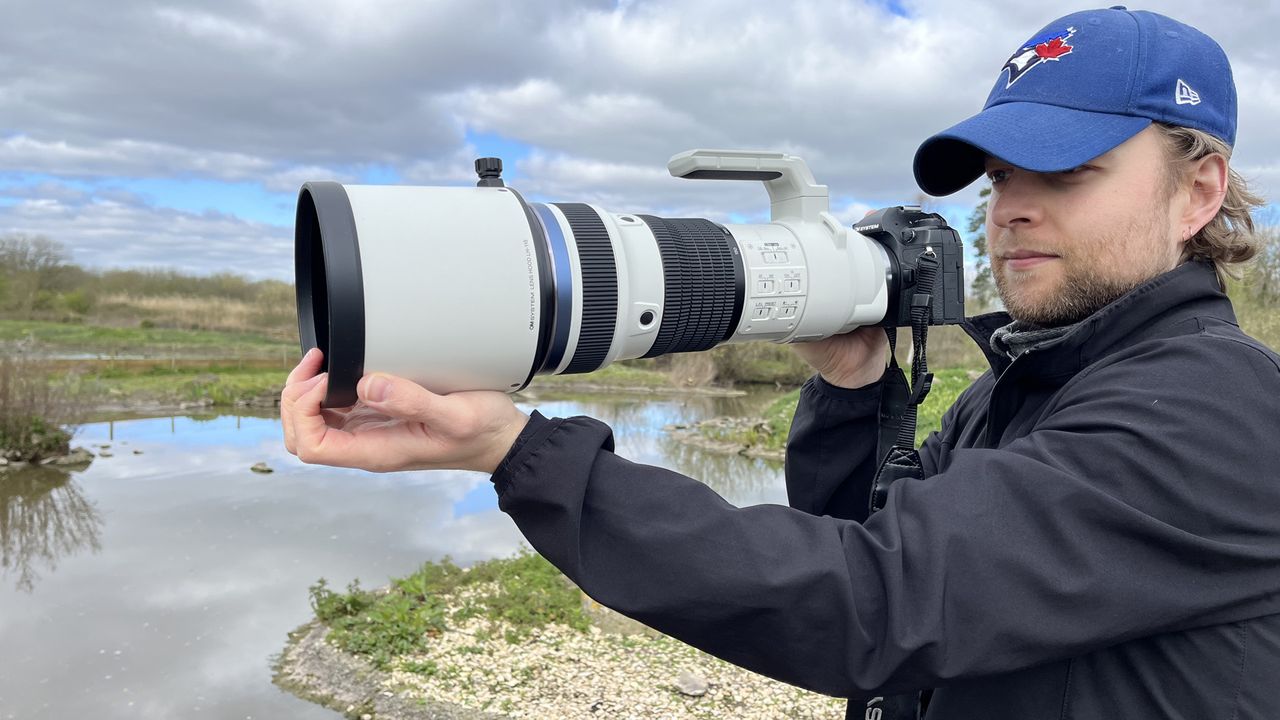
Mike Harris holding OM System M.Zuiko 150-400mm f/4.5 TC1.25x IS PRO at Slimbridge Wetland Centre .

At the beginning of the year, I set the cat firmly among the pigeons when I claimed that I only recommend the ‘Big Three’ camera brands for serious wildlife photography: Canon, Nikon and Sony. As you can imagine, Micro Four Thirds camera (MFT) photographers were not happy.

So, Luke from OM System got in touch with me and offered to lend me some kit so I could put my money where my mouth was. Cue the arrival of the flagship OM System OM-1 Mark II and the mighty ‘Big White’ M.Zuiko 150-400mm f/4.5 TC1.25X IS Pro, as well as the M.Zuiko Digital ED 100-400mm f/5.0-6.3 IS and M.Zuiko Digital ED 40-150mm f/2.8 PRO. Lucky me!
Determined to put the kit through its paces, I headed off to wetland wildlife reserve WWT Slimbridge and the Hawk Conservancy Trust in a bid to photograph some of the most challenging wildlife subjects on Earth: birds. So, read on to find out why I hold my hand up and admit that I was so very, very wrong about MFT. Just don’t expect a puff piece – I’m not ready to give up my full-frame kit just yet…

Wildlife photography weight saving

(Image credit: Future)

MFT is renowned for the small size and light weight of its cameras and lenses. But in my review of the ‘Big White’ 150-400mm f/4.5, I called it a bit of an oxymoron. That’s because it’s a 12.4in long, 1,875g behemoth. Still, compare it to a full-frame 600mm f/4 lens and it’s a minnow. It’s also the largest MFT lens on the market, aimed squarely at sports and wildlife professionals.

The M.Zuiko Digital ED 100-400mm f/5.0-6.3 IS is just eight inches long and 1,102g, with the M.Zuiko Digital ED 40-150mm f/2.8 PRO measuring 6.3in and weighing 880g. To put that into perspective, every MFT lens on the market (even the ‘Big White’) is smaller and lighter than the Nikon Z 180-600mm f/5.6-6.3 VR. And while the OM System OM-1 Mark II is very small and light for a flagship camera, it’s not so prominent that longer lenses feel unbalanced, which is a good thing in my book.

(Image credit: Future)

I’m no stranger to heavy kit. I’ve owned a Nikon D800, Nikon D850 and Nikon Z8, and as I get older and my back becomes more temperamental, the weight of my kit is something I’m becoming more and more aware of. Most camera gear seems manageable when you pluck it off the shelf in an air-conditioned store and wave it around for a few minutes. You’ve got to imagine yourself in blistering heat, trudging your way up a gravel track to get to that secluded hide. Or standing on a cliff-top, capturing pan after pan of soaring seabirds.

And indeed, while walking around with my OM System kit, I couldn’t quite believe that I was packing two super-telephoto and one telephoto lens, plus a flagship camera. My own personal Nikon Z 180-600mm f/5.6-6.3 VR is so long, a lot of camera bags are too small for me to pack it with a camera attached. No such problem here. For hide photography I do prefer to use some kind of support, be it a tripod, monopod, or beanbag, but the M.Zuiko Digital ED 100-400mm f/5.0-6.3 IS, especially, is an absolute joy to stroll around with.

Sparrow hawk at Slimbridge Wetland Centre (Image credit: Future / Mike Harris)

Even the ‘Big White’ is easy to cart about. And doing so netted me my favorite image of this little project. I was leaving a hide, ‘Big White’ in hand, when a sparrowhawk landed in a tree, right in front of me (above). I couldn’t believe my luck! I simply raised the M.Zuiko 150-400mm f/4.5 TC1.25X IS Pro, took full advantage of its huge 800mm effective focal length and squeezed off a burst. No cropping needed.

If you’re physically unable to lug around heavy kit, know that it will impact your enjoyment, or even become a wildlife photography barrier, you simply cannot put a price on MFT’s weight-saving properties. However, it comes with a bit of a caveat: image quality.

How good is MFT image quality?

Hawk landing on mound at Hawk Conservancy Trust, Hampshire (Image credit: Future / Mike Harris)

At the epicentre of MFT’s weight-saving strategy is its 4/3 sensor, which measures 17.3 × 13mm, roughly half the dimensions of a full-frame sensor (36 × 24mm) and roughly ¼ of the surface area, while also being smaller than an APS-C sensor (23.5 x 15.6mm).

This results in what tends to be a combination of lower resolutions and smaller photosites resulting in more noticeable noise, which means MFT images tend not to hold up to extreme cropping as well as their APS-C and full-frame counterparts. The flip side is that 2x crop factor, which means you’re effectively doubling your lens’s given focal length. In practice, this is often a big advantage, but there's one situation where it's more of a hindrance. Let me explain…

Red kites (Image credit: Future / Mike Harris)

So, the big plus point here is that you can fill the frame with your subject, while standing further back. This means you’re less likely to stress or scare wildlife, or better your chances when restricted to a hide. But, this advantage is curtailed somewhat because it leaves you far less room for cropping.

A lot of photographers will tell you to get it right in camera. It’s sound advice, but doesn’t always work out in practice. Wildlife and sports photographers, in particular, often rely upon cropping simply because they cannot get close enough to the subject. This levels the playing field somewhat when it comes to high-resolution full-frame cameras that can be cropped significantly.

If you’re shooting at 400mm on a full-frame camera, you can crop to the point that you can end up with a similar field of view as an MFT camera (800mm), but a 45.7MP or 60MP sensor will still leave you with less resolution than a 20.4MP MFT sensor. However, the margins are fine and the advantage with extensive cropping is that you get more control over your composition. If you’re capturing slower wildlife or wildlife portraits then I think getting it right in camera is definitely what you should be aiming for and in this context the extended reach of an MFT setup can work to your advantage.

But I spent a lot of time capturing birds in flight during the Hawk Conservancy Trust’s excellent flying displays and what I found out was that even though I could get much closer to the subjects using my OM System camera, I was missing more shots. The reason is simple, the larger the subject is in the frame, the less room you have for error.

When the subject is an erratic bird, you really do need to pull back slightly to give yourself some wiggle room and help prevent unintentionally cropped wing tips, beaks, etc. So, while MFT gives you the advantage when capturing portraits or slower subjects, a high-resolution full-frame camera wins for extreme action such as birds in flight.

OM System OM-1 Mark II: Suitable for wildlife?

(Image credit: Future)

I really enjoyed using the OM System OM-1 Mark II. After all, Digital Camera World’s resident MFT fanatic, James Artaius, awarded it five stars in his review. For starters, it’s a fantastic price. It’s an expensive camera, but you can find it for under $2,000 / £2,000, which is enthusiast-camera prices for flagship technology. What really surprised me, though, is the camera’s ergonomics.

I’m going to go out on a limb here and say that the OM-1 Mark II is the most comfortable camera I’ve ever had the pleasure of using. The grip feels just right, your thumb naturally rests on the ISO button and your left hand is free to alter the AF mode or burst speed without ever moving your eye away from the viewfinder. I was using my Nikon Z8 on the day to compare and the OM-1’s AF isn’t as good as the Nikon’s, but you’re talking about a more expensive, larger and heavier camera.

Do I still recommend ONLY the ‘Big Three’ for wildlife photography?

(Image credit: Future)

I guess I’m recommending the ‘Big Four’ for wildlife photography now. ‘Big Five’ if you include Panasonic’s wildlife-worthy Lumix G9 II. I still stand by my original article in that if someone were looking for the very best wildlife photography setup money can buy, I’d lead them down the full-frame route. But if budget or your back is a concern or if you’re a hobbyist who really doesn’t need to be buying the cream of the pro-grade crop, then Micro Four Thirds is not only a solution, its unique advantages mean that it’s not even a sub-par option. It’s just a different option.

My feeling is that it really comes into its own when photographing almost any wildlife that isn’t birds in flight. The extended reach increases your chances of getting it right in camera, making it a fantastic system for wildlife reserve trips or safaris. However, I still think the ability to widen your framing and crop in post is the better choice when capturing birds in flight.

But that’s what’s great about the photography industry today; there really is a system for everyone. So don’t let me or anyone else tell you that Micro Four Thirds isn’t an ideal fit for wildlife photography. If it meets your budget and saves your back, it’s the system for you. Right then, Fujifilm photographers. Come at me!

You might also like...

If you're interested in capturing better animal pics, here are my top 10 tips for wildlife photography from birds in flight to insect close-ups. Ethics are a huge part of wildlife photography: I’ve attended baited wildlife photography workshops – is it ever okay to bait or should you always patiently wait? Photographer chases owl around field and refuses to stop. This is why we need to talk more about wildlife photography ethics.

Sign up to read this article
Read news from 100's of titles, curated specifically for you.
Already a member? Sign in here
Related Stories
Top stories on inkl right now
One subscription that gives you access to news from hundreds of sites
Already a member? Sign in here
Our Picks
Fourteen days free
Download the app
One app. One membership.
100+ trusted global sources.