
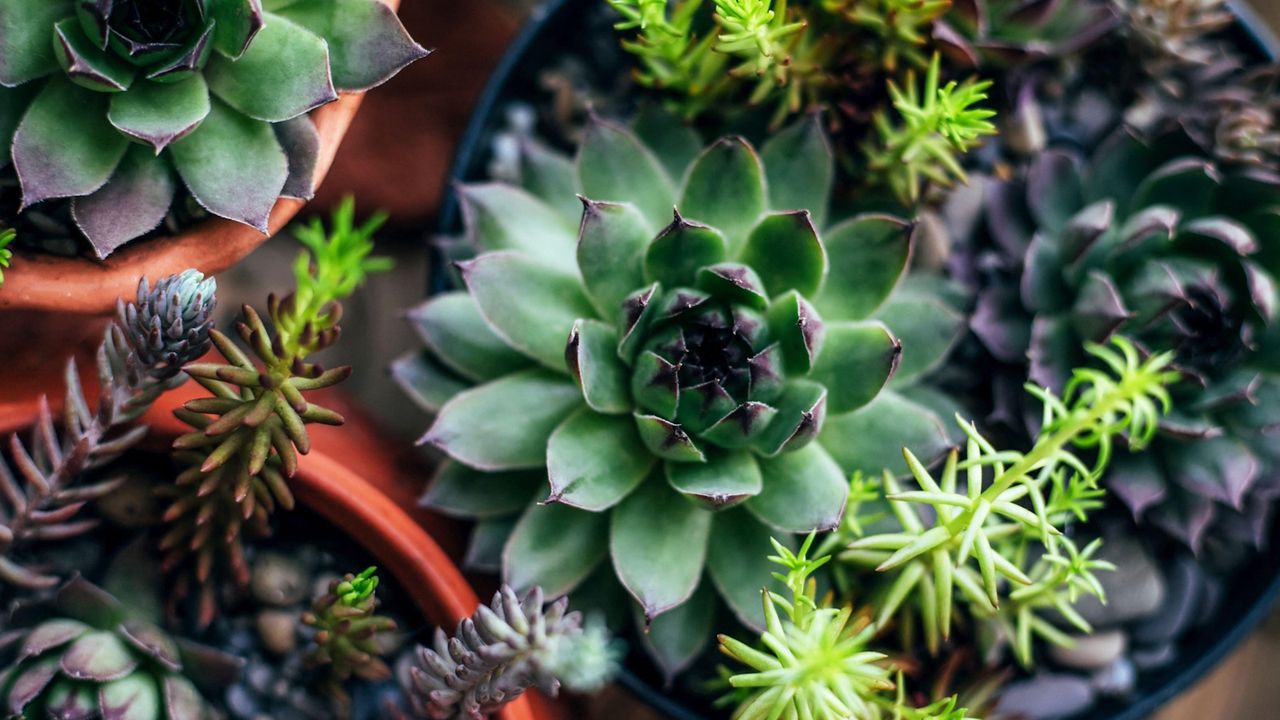
Succulents are one of the most collectible houseplants, coming in lots of different colors and shapes. But, you should take note if you spot your succulents changing color as it often indicates the plant is being stressed. Though this isn't always the case, with some succulents changing hue as they mature.
Nevertheless, it's always worth checking in with succulent care if you do notice a change, so you can make the necessary adjustments and stop the problem from worsening. From too much light to temperature fluctuations, succulents changing color can indicate many issues.

But, it isn't necessarily anything to worry about, as succulent mistakes can quickly be put right. Here, houseplant experts share three common causes of succulents changing color and what to do to rectify them.

What Causes Succulents to Change Color?
It should be noted that succulents often darken in color as they mature, especially as they become more capable of handling environmental stresses. However, if you notice yellowing or 'blushing' in red and purple hues, it's often a sign that something needs to change in the growing environment.
1. Yellow – Improper Watering

When succulents turn yellow, you should reconsider how you water your succulents.
'Overwatering can cause succulent leaves to change color, often to yellow. This is usually an indication of leaf rot and root rot,' says Julie Bawden-Davis, indoor plant expert at Healthy Houseplants.
A second sign that this is the issue is succulent foliage being soft and mushy, as well as soil being soggy.
To help it recover, prune away discolored succulent foliage (with these houseplant snips from Amazon) and let the succulent soil dry out.
You should then use a soil moisture meter (from Amazon) to check your succulent's soil before watering going forward. It should dry out entirely in between, as succulents store water in their leaves and can cope with short periods of drought.
At the same time, you shouldn't let succulents sit in drought for too long, as it can cause foliage to turn brown and crisp up.
2. Red and Purple – Improper Lighting and Temperature

If your succulents are changing color by turning red or purple, it's known as 'blushing' and is a stress response to improper lighting and temperature.
'As the amount of daylight hours lesson in winter, and temperatures cool, the plant slows in its production of chlorophyll, making it more susceptible to intense winter sun,' explains plant expert Lee Miller.
'In response, the plant protects itself by producing pigments called anthocyanins as a natural sunscreen, causing the colors of its foliage to shift to hues of red, purple, or orange,' she explains.
The process is known as chromoplasticity. For many hardy and mature succulents, it isn't a problem, and they'll outgrow it as lighting and temperature return to optimal conditions.
But, for younger succulents, it can make them weaker and slowly kill them off.
And it's not just in winter, some succulents that prefer indirect sun will turn red during the warmer seasons. This is often what causes a jade plant to turn red.
The best thing to do is adjust the lighting, for example, by moving succulents away from a south-facing windowsill, and use methods to keep houseplants warm in winter. You can use a seedling heat mat (from Amazon) to boost warmth, for example.
3. Loss of Variegation – Insufficient Light

If your succulent is changing color and losing its variegation, it indicates insufficient light.
For example, Echeveria 'Dusty Rose' can go from its iconic purple color to green if growing in lower light.
'Often leaves will become greener, and a deeper green. This is because they will increase chlorophyll production as a survival mechanism,' Julie explains.
Too much water can also contribute to this, as the succulents redirect energy to boost chlorophyll and maximize essential processes like photosynthesis.
In this case, you can restore indoor variegated foliage by relocating your succulents somewhere brighter (and reducing watering).
If needed, you can turn to winter houseplant care hacks, such as using a grow light (like this grow light from Amazon) when daylight hours are limited.
FAQs
Do Discolored Succulent Leaves Turn Green Again?
While leaves that have already discolored won't return to their original color, adjusting the growing environment for your succulent will encourage healthy new foliage growth. Most notably, bright light, warm temperatures, and the right water levels are important for this.
You may also find color changes happen to the houseplants you didn't realize are succulents if you're not providing the right care for them. For this reason, it's important to research the exact care your specific plant needs when you first bring it home.
Shop Succulent Essentials
This fertilizer is specially formulated to support succulent growth. Dilute with water to apply.
This shallow, handmade ceramic planter is ideal for succulent roots. It also has drainage holes to aid moisture management.
This set of 12 houseplant tools has everything you need to repot plants, aerate soil, clean leaves, and more. It comes with a canvas storage bag.
This beautiful duo has everything to water houseplants. The watering can has a detachable spout.