Get all your news in one place.
100's of premium titles.
One app.
Start reading
Kiplinger
Kiplinger
Business
Dan Burrows

If You'd Put $1,000 Into Oracle Stock 20 Years Ago, Here's What You'd Have Today

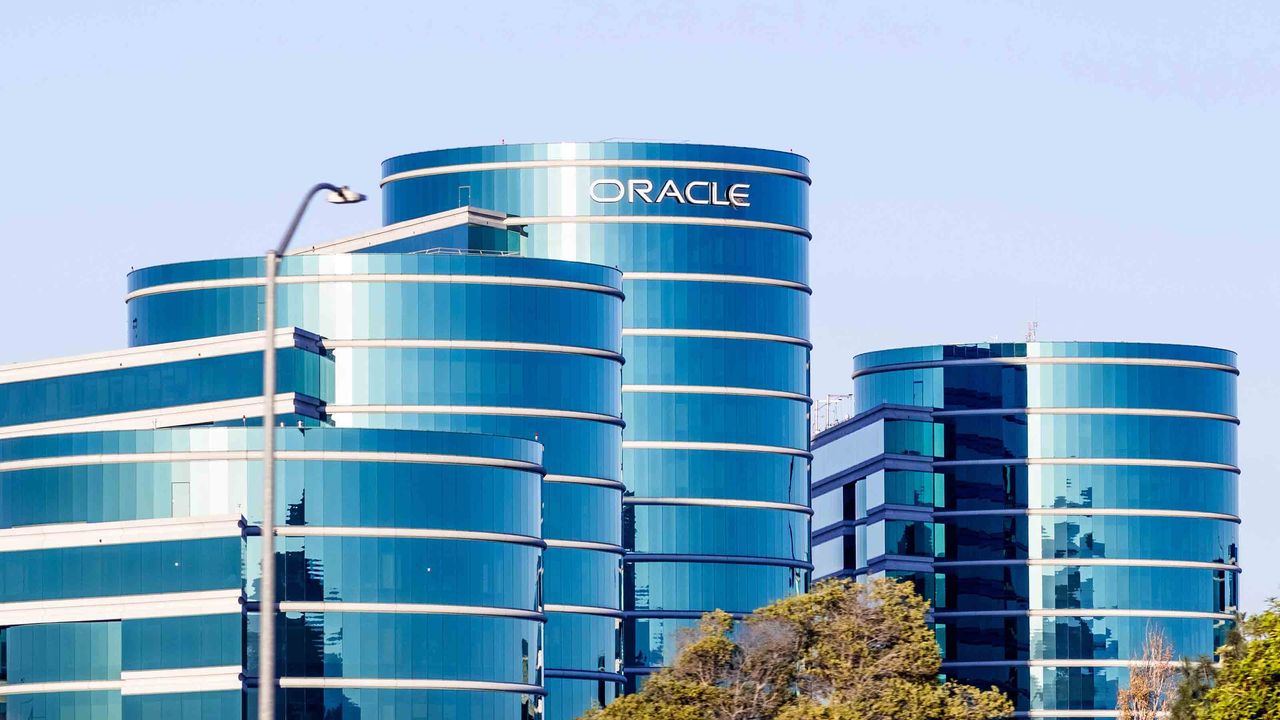
A photo of an Oracle building.

What the promise of artificial intelligence (AI) giveth, fears of overspending on AI taketh away. Case in point: Oracle (ORCL).

Shares in the mega-cap tech name have lost more than half their value since hitting an all-time closing high in September 2025, shedding about $500 billion in market cap in the process. That's roughly the equivalent to the market values of Dow Jones stocks UnitedHealth Group (UNH) and Goldman Sachs (GS) combined.
But as brutal as ORCL stock's recent history has been, long-time shareholders should be quite happy with their returns. Even after this latest plunge, Oracle stock has been a market-beating machine for ages.

Founded in the late 1970s, Oracle really hit its stride during the dot-com boom when it became dominant in database management systems. After the bubble burst, the company pursued an aggressive policy of acquisitions, scooping up software and hardware firms such as PeopleSoft and Sun Microsystems.

Oracle's voracious appetite transformed the company into what's known as a full-stack provider, offering enterprise customers everything from software and middleware to databases and hardware. But the acquisitions were also very expensive, pressuring margins at a time when year-over-year revenue growth was hard to come by.

Happily for Oracle shareholders, the company pivoted toward cloud computing. Undaunted by competition from the likes of Amazon.com's (AMZN) Amazon Web Services, Microsoft's (MSFT) Azure and Alphabet's (GOOGL) Google Cloud, Oracle launched Oracle Cloud Infrastructure (OCI) to provide cloud-based services for a range of enterprise needs.

When AI exploded on the scene at the end of 2022, Oracle was well positioned to take advantage of the industry's insatiable demand for computing power.

Today, Oracle has a $455 billion pipeline of contracts to supply computing power for AI. Indeed, the tech stock practically went vertical in September 2025 after the enterprise database and cloud-services provider signed a massive deal with OpenAI. The latter, which is best known for ChatGPT, agreed to buy $300 billion in computing power from Oracle over five years.

"Oracle management has assembled the newest and one of the most formidable hyperscaler companies in the worldwide enterprise market," writes Oppenheimer analyst Brian Schwartz, who rates shares at Outperform (the equivalent of Buy). "We see Oracle as a long-term beneficiary of the software industry secular trends driving revenue growth and operating leverage for the company."

Joining the AI gold rush allowed ORCL stock to gain 70% through the first nine months of 2025, adding about $400 billion in market cap in the process.

And then the bottom fell out.

Massive spending on its AI build-out (Oracle targeted $50 billion in capital expenditures for fiscal 2026), negative free cash flow and more than $100 billion in debt caused sentiment on the name to change right quick.

The bottom line on Oracle stock?

But then, the "legacy tech company" label is something Oracle has been struggling to shake off for years. A middle-aged tech firm couldn't really compete for attention when the Magnificent 7 got all the glory as AI plays.

And yet ORCL stock has done very well by shareholders for a very long time.

Over its entire life as a publicly traded company, ORCL generated an annualized total return (price change plus dividends) of 17.3%. That clobbers the S&P 500's return of 10.7% over the same time frame.

And as for the past two decades? Oracle stock has been a buy-and-hold winner.

(Image credit: YCharts)

Have a look at the above chart and you'll see that if you invested $1,000 in Oracle stock 20 years ago, today your stake would be worth about $15,000 – good for an annualized total return of 14.4%.

The same amount invested in the S&P 500 would theoretically be worth about $7,800 today, or an annualized total return of 10.7%.

Wall Street likes Oracle's chance of maintaining its market-beating ways. Of the 43 analysts covering ORCL stock surveyed by S&P Global Market Intelligence, 26 call it a Strong Buy, six say Buy, 10 rate it at Hold and one says Strong Sell.

That works out to a consensus recommendation of Buy, with strong conviction to boot.

More Stocks of the Past 20 Years

Sign up to read this article
Read news from 100's of titles, curated specifically for you.
Already a member? Sign in here
Related Stories
Top stories on inkl right now
One subscription that gives you access to news from hundreds of sites
Already a member? Sign in here
Our Picks
Fourteen days free
Download the app
One app. One membership.
100+ trusted global sources.