
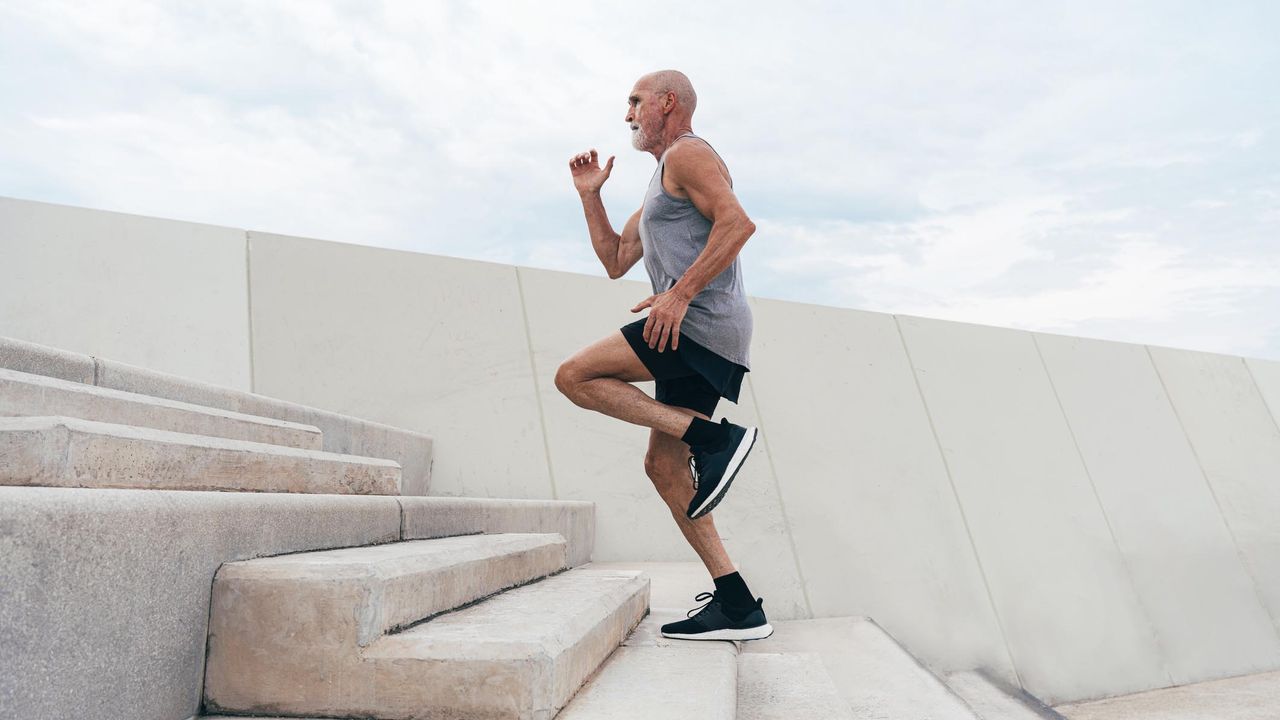
The step-up is a powerhouse move that mimics one of the most basic movements most of us do every single day — climbing stairs and walking up hill. Unlike squats, the step-up is a single-leg exercise that forces you to lift each leg independently. Because of this, it can help identify any strength gaps between your left and right sides, helping you work on your weaker side to prevent injuries.
The exercise is also a fantastic one for activating your glutes and the muscle on the inside of your knee, which ensures your kneecap tracks correctly. Strengthening these muscles can help protect your knees from injuries and reduce your risk of knee pain. You’ll also be working on your core and overall balance and stability.

What is the test?
The Senior Fitness Test Kit aims to help seniors assess their fitness and identify where they might need to improve to boost their longevity. The test assesses your overall fitness and involves common activities such as standing up from a chair, walking, lifting, bending, and stretching.
One of the tests is the step-up. You won’t actually be stepping up on a block, but you’ll be marching on the spot, lifting one knee, then the other. All you’ll need is a stopwatch and the brain power to count as you march. The test lasts for two minutes, so you might want to enlist the help of someone else to count as you go.

For the test, you’ll need to stand next to a wall and make a mark in line with your hip. This is the level you’ll need to lift your hip to as you march. From here, set a timer for two minutes, engage your core, thinking about sucking your belly button into your spine, and balance on one leg as you lift the knee of the other leg up to reach the line you made on the wall, keeping a 90-degree bend in your knee. Hold onto a chair or wall for support.
Only count the number of reps on the right leg. Complete as many reps as you can in the two minutes.
Men's results
Age |
Below average |
Average |
Above average |
60-64 |
Less than 87 |
87-115 |
More than 115 |
65-69 |
Less than 86 |
86-116 |
More than 116 |
70-74 |
Less than 80 |
80-110 |
More than 110 |
75-79 |
Less than 73 |
73-109 |
More than 109 |
80-84 |
Less than 71 |
71-103 |
More than 103 |
85-89 |
Less than 59 |
59-91 |
More than 91 |
90-94 |
Less than 52 |
52-86 |
More than 86 |
Women's results
Age |
Below average |
Average |
Above average |
60-64 |
Less than 75 |
75-107 |
More than 107 |
65-69 |
Less than 73 |
73-107 |
More than 107 |
70-74 |
Less than 68 |
68-101 |
More than 101 |
75-79 |
Less than 68 |
68-100 |
More than 100 |
80-84 |
Less than 60 |
60-91 |
More than 91 |
85-89 |
Less than 55 |
55-85 |
More than 85 |
90-94 |
Less than 44 |
44-72 |
More than 72 |
If you’re not quite where you want to be, it’s time to work on your lower body strength. As well as practicing the marches, add bodyweight squats and lunges to your strength training routine a few times a week. Over time, increase the number of reps you do, or add a set of the best adjustable dumbbells to increase the resistance on your lower body.
More from Tom's Guide
- Not sit-ups, planks, or crunches: I do this simple Pilates exercise every single day to build a strong and stable core and work on my hip flexor mobility
- Not sit-ups or lunges — I use this simple Pilates exercise to sculpt strong obliques, inner thighs and hip stabilizers
- 'I’m a Pilates instructor, and I recommend these 5 core exercises to help older clients build strength and improve posture'







