
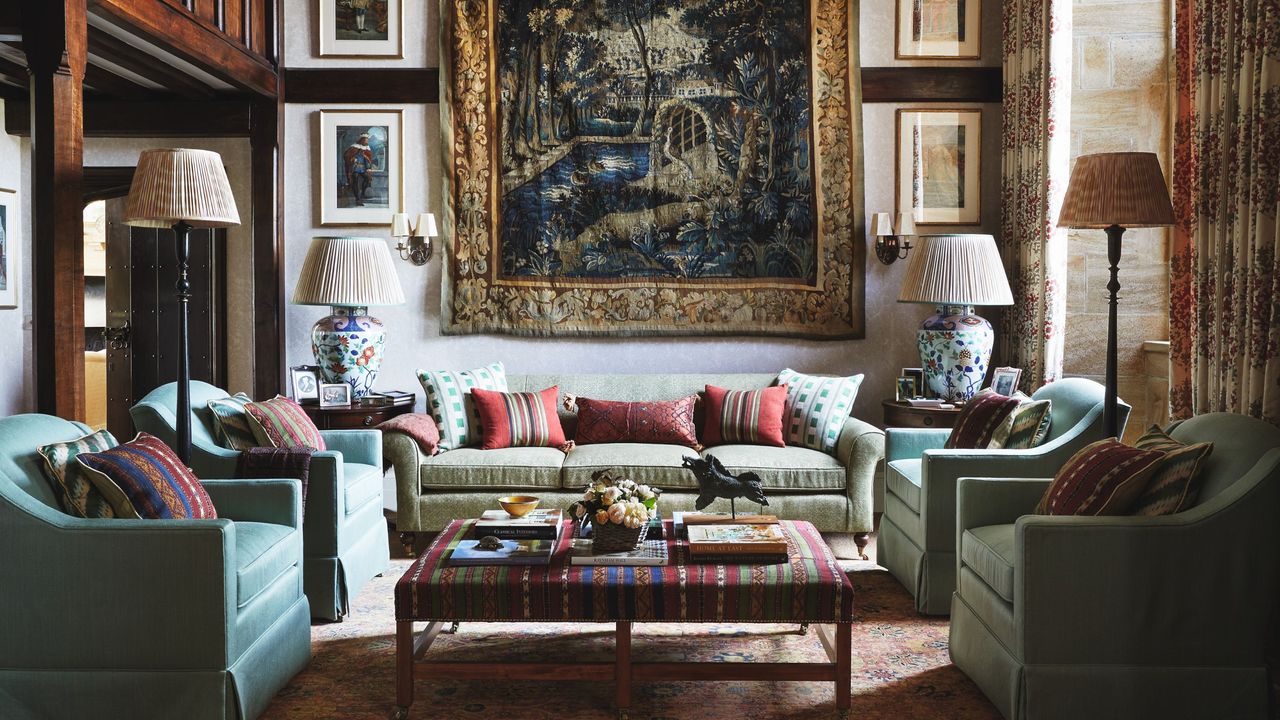
'Rich in character but gentle in tone,’ is how designer Henriette von Stockhausen of VSP Interiors describes the aesthetic of this Jacobean country house design tucked in a Devon valley.
Walking into its double-height, apex-roofed entrance hall, it’s hard to imagine that it once housed mismatched furniture sequestered from a local hotel or that the pale pink walls of the dining room had been damaged by a leak, while the exterior stone had blackened over the decades.

Now, the vast scale of the once chilly entryway has been humanized via thick drapes, squishy seating, and a mellow-toned tapestry, hung to draw the eye downwards towards the convivial seating arrangement.
‘In many ways, getting that entrance hall right allowed the whole house to unfold,’ says Henriette, whose decades-long experience with country homes has given her a keen eye for scale. ‘Not only does everything else lead off it, but it’s really the first opportunity to set the tone for the rest of the house.’

The building is a cherished residence, tended with care over many years. Naturally, this brought a sense of sentiment to the renovation, suggests Henriette, who felt a strong resonance with the project’s overall sensibility. ‘It hadn’t really been touched since the 1980s.'
'But the setting is very romantic; being in a valley, it feels as though the landscape is giving the house a hug, and instead of formal gardens, there are rolling hills in the distance. So, we wanted to take our cue from that sense of nothing being too forced. The interiors pay homage to a classic country setting but without too many frills or trims.’
This shared design language enabled Henriette to rework these schemes from top to bottom, including new plumbing and electrical work.
The 17th-century manor house, once owned by Sir Walter Raleigh, and noted for its stone-mullioned windows, couldn’t be altered structurally, but it could be brought back to life.

‘There was a love for strong colors on one side, but a preference for a quietly elegant palette of neutrals on the other,’ shares Henriette. ‘So we had to strike a balance. Bold hues found their way into the bathroom and the library, while delicate tones and soft patterns characterize the rest of the spaces.’
A nuanced combination of blues, gentle pinks, caramels, and terracotta allows the architecture to breathe, while complementing the honeyed tones of the stone. Even so, the renovation still required Henriette to gently shepherd her clients out of their comfort zone.

‘At first, there was much resistance to the idea of wallpaper,’ says Henriette. ‘And also, to drapes in the entrance hall, because they had never considered decorating it as a room in its own right.'
'But by the end of the project, we had papered nearly every wall. I think it’s essential in a house like this, where plain painted walls just wouldn’t cut it, unless you have a vast art collection to add interest.’

The key was to opt for small-scale pattern so discreet that it introduced texture and tone almost subliminally, an approach that worked particularly well in bedrooms and bathrooms. An exception is the dining room, where a wallpaper featuring a fantastical naturalist landscape adds both confidence and scale.
‘It works because it feels very enveloping,’ says Henriette. ‘Plus, it’s an artwork in itself.’

Throughout, antique rugs and fabrics, auction house furniture finds, and woodwork in chalky finishes combine to make this home feel evolved rather than decorated.
Contemporary touches, such as modern artwork, create a quietly confident dialogue between old and new.

‘It was about bringing out the best of this home, throwing original details like the ebonised beams into relief,’ says Henriette.
‘My biggest tip in cases like these is always to scale up. It’s really the opposite of what Coco Chanel once said about removing just one accessory before leaving the house. If in doubt, I always say “add”. Larger spaces can cope brilliantly with a “more is more” approach.’
The result is a home that gently reimagines the nostalgia of its past while looking to the future. Comfort has been reinstated, schemes have been updated, and warmth – both literal and metaphorical – reintroduced. Its latest chapter is finally ready to be written.