When I hear amateurs golfers talk about their over the top swing or the destructive impact that hitting a slice is having on their game, I am struck with a stress-induced flashback of being in the trenches with these issues myself.
Learning how to stop coming over the top and curing a slice is a journey I have been on for some time now, forming a common theme in my winter golf rebuild through my range sessions and golf-specific fitness exercises.

In fact, one of the big reasons I am now able to hit driver over 240 yards (as a 22-handicapper) is because I am making rapid progress towards eradicating these common faults.
But, while it's all well and good things turning around for me, how do we help you to get moving on your own pursuit of progress?
Arriving at the range without a clear plan is a waste of time - and one of the seven things never to do at the driving range - so we asked one of our experts to prescribe the perfect fix in the form of 3 simple drills that you can use straight away.
Below, PGA Pro and Top 50 Coach expertly explains how to conduct them and offers an insight into how they can help you play better golf in 2026...
3 Drills To Cure Your Over The Top Swing And Banish A Slice
1. Swing with purpose
When club golfers get too steep or come over the top, the hands come off their path, pushing the arms and clubhead outwards. The brain then tries to ‘rescue’ it, leading to some of the most common swing faults that golfers have.
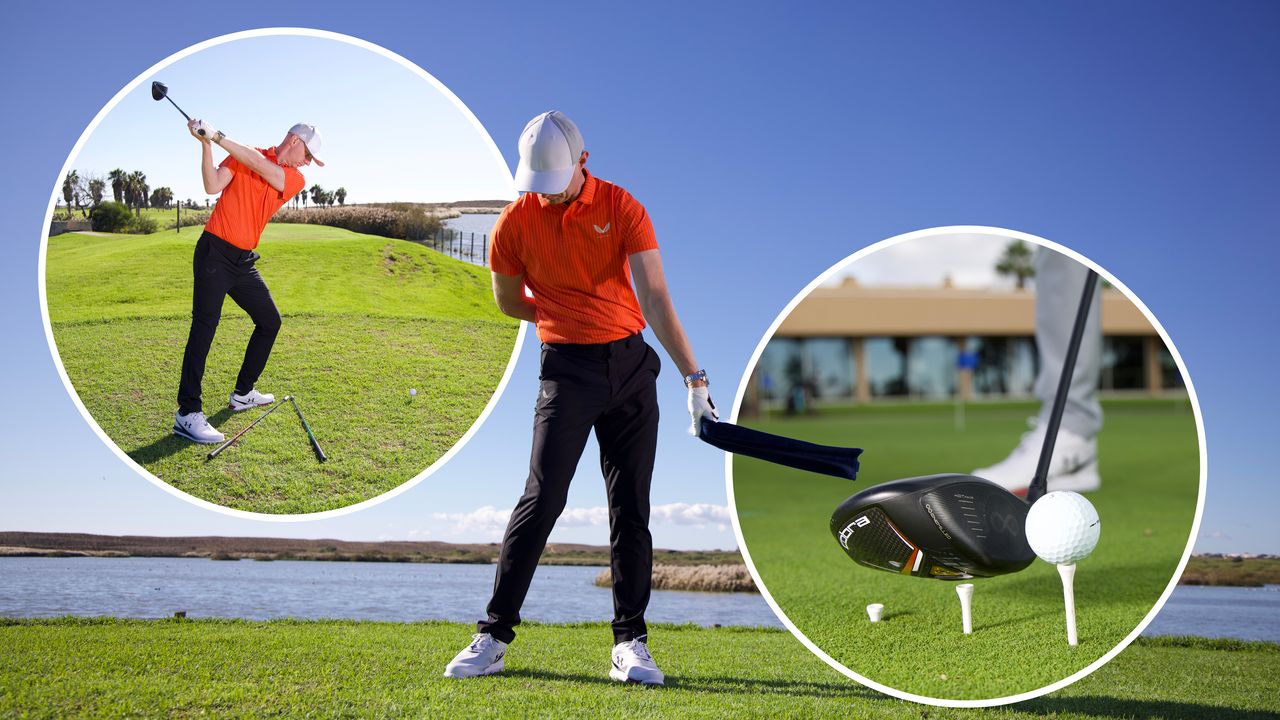
This drill using a towel is a great way to get you swinging your arms with purpose, directly at your target in more of a straight line.
Do it against a wall at home (make sure you stand far enough away from the wall!), with the towel in your lead hand and your trail hand behind your back.

Start at address and focus on swinging the arm with speed, but stop quickly when your lead arm reaches the position in the image above, which is more vertical.
This will make the towel whip against the wall, which would translate to a better strike with the driver. If the towel flicks up softly, things have broken down somewhere, so reset and start again.
2. Bowler Drill
This drill provides a feeling of getting the arms to move around the body in a more effective way - getting your swing on plane. The majority of golfers who slice it do not move their arms correctly around their torso, which leads to a loss of energy and subsequently distance.

Pulling your trail foot back to the position shown in the image above will encourage the hands and arms to move in and around you earlier, and more behind you at the top of the backswing.
Ensure you keep your trail foot in this position throughout the swing. The good thing about the bowler drill (think ten-pin bowling) is that it takes the lower body out of it, leaving you to make a positive and committed swing with the lead arm.
3. Angle of attack
We want to promote a shallower swing that hits up on the ball at impact, as opposed to a steep or over-the-top swing.
The image below shows the ‘step drill’, which encourages an upward angle of attack and helps prevent an over-the-top action.
Too downward a strike and you will likely hit one of the two tees before the ball. This drill is perfect as it offers instant visual feedback. Focus on coming into the ball as if your club were climbing the stairs.
In my 10 best golf drills I talk a lot about the power of instant visual feedback, so this is definitely one to try.

How Do I Hit More Of A Draw Instead Of A Slice?
To answer this crucial question, we asked Top 50 Coach Alex Elliott for his best expert advice...
Alex said... "To hit a draw, you need an in-to-out club path relative to target and a face that is closed to your path, but pointing right of target. At set-up, the face should split the difference between target line and club path."
You can practice his foolproof formula for hitting draws and fades at the driving range, with just a few visual aids like alignment sticks, so give it a try and be disciplined in your practice.