
Get all your news in one place.
100’s of premium titles.
One app.
Start reading
Guitar World
Guitar World
Entertainment
Daryl Robertson

"If heaps of retro charm and a sound that truly stands on its own are what you’re after, then you’ve just found your new delay pedal”: Strymon Olivera Vintage Oil Can Echo pedal review

Strymon Olivera.

What is it?

When it comes to delay pedals, it’s safe to say the market is overflowing with options, all competing for space on your pedalboard. There are more tape delays and bucket-brigade units than you can shake a Strat at, but one category of delay that's often underrepresented is the old-school oil-can echo units. These vintage beauties from the late '50s often get overlooked, yet they have a unique charm that deserves a spot on your board.

Oil can echoes are a fascinating piece of gear. Imagine a rotating disk submerged in oil, and in-built pickups that work in tandem to recreate the delay - sounds a little wacky, right? But somehow, this quirky setup produces a dark, murky echo that's surprisingly musical.

If you've ever dreamed of experimenting with this vintage delay style, you're in luck. Enter Strymon's new Olivera, a pedal that aims to revive the funky essence of those legendary oil can echoes but with the Californian pedal maker's signature modern twist, dragging this retro tech kicking and screaming into the 21st century.

(Image credit: Future)

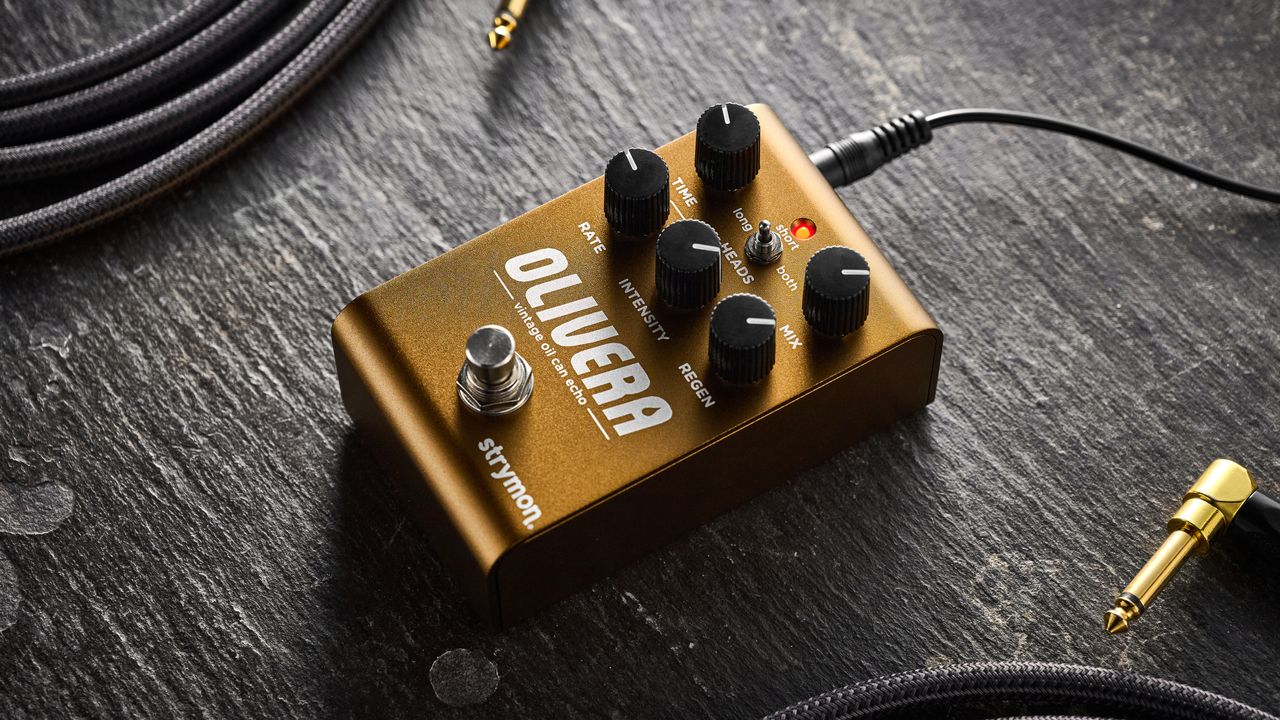
Under the hood, the Olivera is powered by an advanced ARC processor that brings 300 presets to the table and, of course, there's full MIDI control, too. Much like the EC-1, released earlier this year, you'll find five knobs on the front, including Time and Mix, as well as Rate and Intensity for modulation. The Regen knob lets you unleash wild oscillations when cranked, while the Mix knob helps you balance your dry signal with the echo. Plus, a handy three-way toggle lets you switch between different playback heads or blend them for some killer multi-tap effects.

To top it off, the pedal boasts top-mounted jacks for easy pedalboard integration and features a low-noise Class A JFET preamp. As expected, it powers up with a standard 9V DC supply and supports both true and buffered bypass.

Specs

(Image credit: Strymon)
  • Price: $259/£259/€309
  • Type: Delay
  • Controls: Time, Mix, Rate, Intensity, Regen, Tape Heads: Long, Short, Both
  • Features: Selectable tape heads, tap tempo, stereo operation, and expression pedal capability. High-impedance, ultra-low noise discrete Class A JFET stereo input and MIDI control.
  • Connectivity: Input, Output, Expression, 9V Power
  • Bypass: Switchable true or buffered
  • Power: 9V, 250mA
  • Dimensions (cm): 11.7 x 6.9 x 6.4
  • Weight (kg): 0.28
  • Contact: Strymon

Build quality

(Image credit: Future)

Build quality rating: ★★★★

At this point, the name Strymon carries with it a certain expectation in terms of quality, and I’m happy to report that the new Olivera more than lives up to that reputation. This little stomp sticks to the winning formula established by the likes of the EC-1, UltraViolet, Cloudburst and Brig, opting for a more compact, straightforward design compared to Strymon’s bulkier double- and triple-pedal offerings.

The design is a fairly simple affair, but one that reads as sleek and minimalist, rather than dull or boring. I like the understated, unfussy gold finish, and the controls look as though they’ve been plucked from the retro amps of yesteryear.

Now, it’s a given that the footswitch feels smooth underfoot, and while it comes preset to true bypass by default, it can be switched over to buffered if that works better for your rig.

The Olivera can be used in mono or stereo, giving you flexibility that’ll work with a number of setups. At the top of the unit, just above the inputs and outputs, you’ll find a handy switch that lets you toggle between mono, standard mono in/out, mono-to-stereo (where a mono input transforms into glorious stereo), and stereo mode, which is designed for a stereo input, outputting in true stereo. Just keep in mind, this is all supplied via a single output socket. So, if you’re going for that stereo magic, you’ll need a TRS adapter or Y-cable.

Usability

(Image credit: Future)

Usability rating: ★★★★

With just a handful of controls, you’d be correct in the assumption that this is an easy pedal to use. In fact, dialing this pedal is a breeze.

First up, we have the Time dial, which adjusts the delay time. For this oil can delay, you’re changing the rotation speed of the virtual can. Of course, this goes hand-in-hand with the play heads. Right in the center of the pedal, there’s a three-way toggle that lets you choose between three modes, which bracket the delay time ranges.

Switch to Long mode to mimic the furthest play head and stretch that delay time to anywhere from 155ms to 620ms. If you want something snappier, flip it to Short mode for the closer head and a shorter delay, this time only 72ms to 290ms. Now, if you’re in the mood to mix it up, select Both and unleash a wild multi-tap echo pattern that is infectiously fun to mess with.

With just a handful of controls, you’d be correct in the assumption that this is an easy pedal to use

Next up are the Rate and Intensity controls, which are your ticket to that delightful modulation, or warble, you hear on the repeats of vintage delays. As with regular delay pedals, Rate controls the speed of the modulation and intensity governs how deeply the pitch variation fluctuates.

Lastly, we have Regeneration. Often dubbed “reverb” on the original units this pedal is based on, this dial controls how much echo gets fed-back into the can for reprocessing. Crank it up, and you’re in for a space-age shimmer that will sit beautifully in the background of your licks.

If you hold the footswitch while adjusting the Regeneration knob, you can tweak the tone of your repeats. I found this perfectly handy when trying to balance the tone with my already pretty bright-sounding amp.

When I reviewed the Strymon EC-1 earlier this year, I noted how easy it was to use, and I feel exactly the same with the Olivera. Sure, there is some hidden functionality and secondary features, but at the end of the day, this pedal can be as straightforward or as intricate as you want it to be while remaining very usable throughout.

Sounds

(Image credit: Future)

Sounds rating: ★★★★½

To really put this pedal to the test, I wanted to pair it with appropriate gear for such a retro-themed stomp, so I hooked the new Gretsch Synchromatic Falcon to my Fender combo - a ‘68 Twin Reverb reissue, to see what kind of noise I could make.

There’s a dark and almost lo-fi quality to the repeats of this pedal

There’s a dark and almost lo-fi quality to the repeats of this pedal. Strymon says that the oil can design creates an “uneven cadence to the echoes,” and you can really feel it push and pull when you play. It’s actually pretty inspiring, and it most definitely made me approach the parts I was playing differently.

Using the Short play head and with the time set pretty quickly, it’s easy to dial in a brilliant and characterful slapback. As someone who played in a '50s-era covers band, it’s a sound I know all too well – but I’m not sure I’ve played one as characterful as this. The repeats happily sit in the background and let your lead parts shine, all while giving my tone buckets of vintage charm.

Switching to the longer play head and now, you’re into more traditional delay times – but we’re not talking contemporary long delay times. These are still relatively short. So if you want massively long delays, then this is most certainly not the pedal for you.

Cranking up the two modulation controls, and things start to mutate and get a little sea-sick if you’re not careful. Keep the Intensity and Rate low, though, and you are rewarded with just the right amount of movement on the repeats.

Playing with the Regen is where things get really interesting. With the dial set relatively high, you can start to create atmospheric beds under your playing. Of course, it follows the same uneven nature as the main repeats, but it still manages to feel organic and very musical. I could almost see myself using this pedal as an instrument in its own right.

If I were to have one complaint, it would be the relatively short delay times. Yes, I know that was a limitation of the original units, but having the option to tap into more drawn-out echoes would make this pedal a little more versatile.

Verdict

(Image credit: Future)

This pedal manages to be equal parts unique, fun, and inspiring

Guitarists are certainly not short of delay options, but if you want something a little off the beaten track, then the new Strymon Olivera could very well be the pedal for you. This pedal manages to be equal parts unique, fun, and inspiring – and better yet, it’s so simple to dial in that you can get a usable sound in seconds.

Okay, if you need modern, long delay times, or you need something that delivers crystal clear repeats, then you’ll definitely not like the Olivera, but if heaps of retro charm and a sound that truly stands on its own are what you’re after, then you’ve just found your new delay pedal.

Guitar World verdict: If you find yourself bored with run-of-the-mill delay pedals, the Strymon Olivera may very well be the pedal for you. In true Strymon fashion, the pedal is expertly put together, intuitive to use, and sounds fantastic. Be warned, though, this pedal has relatively short delay times, so those seeking longer echoes will want to look elsewhere.

Ratings scorecard

Test

Results

Score

Build quality

As expected from Strymon, this pedal is very well put together with a robust design.

★★★★★

Usability

Easy to dial in but there's no tap tempo option.

★★★★½

Sounds

Personally, I think this pedal sounds fantastic, but the uneven repeats aren't for everyone.

★★★★½

Overall

A unique and easy to dial in delay pedal that's not concerned with following the norm.

★★★★½

Also try

Hands-on videos

Strymon

Andertons

Chord of Orion

Sign up to read this article
Read news from 100’s of titles, curated specifically for you.
Already a member? Sign in here
Related Stories
Top stories on inkl right now
One subscription that gives you access to news from hundreds of sites
Already a member? Sign in here
Our Picks
Fourteen days free
Download the app
One app. One membership.
100+ trusted global sources.