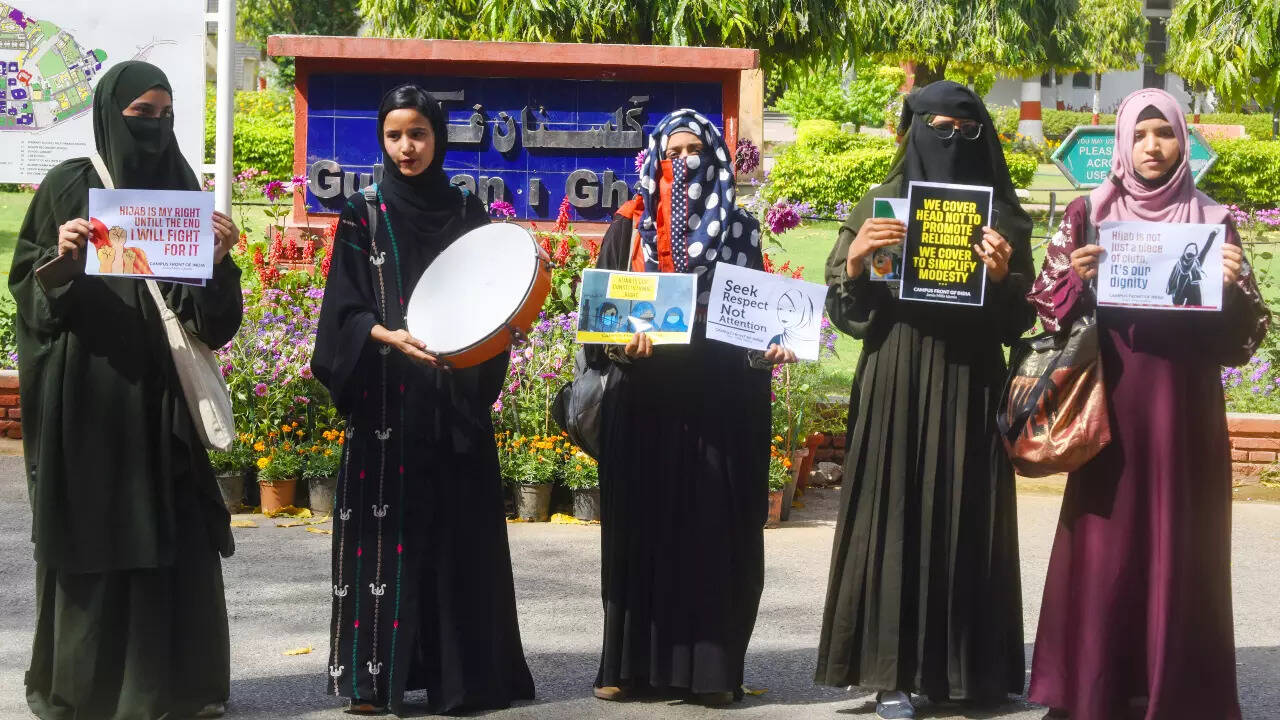
NEW DELHI: Aishat Shifa, the first person to challenge hijab ban in government educational institutions in Karnataka, on Wednesday asked the Supreme Court how a secular administration, allowing others to wear ‘bindi’, ‘kada’, ‘cross’ or ‘janeu’, could restrict Muslim students’ fundamental right to make a choice to wear hijab in addition to prescribed uniforms.
Shifa’s counsel Devadatt Kamat cited judgments from constitutional courts of the US, Canada and South Africa as well as the right to privacy judgment by the SC to buttress his argument that Muslim women students, in accordance to their religious beliefs and practices, have a right to freedom of expression that included the basic right of choosing a dress.
A bench of Justices Hemant Gupta and Sudhanshu Dhulia asked Kamat not to take his arguments to illogical levels. Referring to Kamat’s ‘cross’, ‘rudraksh’ and ‘janeu’ argument, it said, “These are not worn over the uniform. These remain concealed. No one is going to ask a student to take off the uniform to inspect what religious symbols she/he is wearing.”
“Nobody is denying Muslim students their right to wear hijab to any place, except to educational institutions, which have a prescribed set of uniforms. The question for adjudication before us is whether additional headscarves should be permitted over and above the uniform,” the bench said.
Kamat agreed and said India practices positive secularism and the Constitution, under Article 25, allows its citizens to practise, profess and propagate their religion and practices as long as they do not violate public order, health, morality and others’ fundamental rights. “Wearing hijab by Muslim students does not violate any of the above grounds specified in Article 25 of the Constitution and hence the ban was unconstitutional,” he said and requested the court to refer the petitions to a five-judge bench as they raised an important constitutional question.
The senior advocate said the SC had interpreted that right to education was a fundamental right and part of right to life, which led to the insertion of the RTE as Article 21A in the Constitution in 2002. “If a student wears a hijab, should the state be accommodative of the (student’s) religious sentiments and right to choice or be exclusionary to bar entry to educational institutions to violate Article 21A?” he asked.
Responding to Kamat’s vehement arguments on the right to dress as part of the right to freedom of expression and the right to dignity, the bench asked, “Does right to dress mean not to wear a dress?” Kamat said, no one is undressing in educational institutions. The bench changed track and said, “The question in this petition is whether additional dressing by means of hijab is to be permitted in the educational institutions.” The arguments will continue on Thursday.
In her petition filed through Javedur Rehman, Shifa has said the hijab ban militates against her fundamental rights guaranteeing choice of dress, voluntary adherence to religious faith and customs and the right to privacy.
Branding the BJP government in Karnataka as “majoritarian” and accusing it of trampling on the fundamental rights of Muslim girls to wear hijab, she has requested the SC “to restore the fundamental rights which the HC has failed to protect against a majoritarian government that is trampling on them with impunity for its own vested political considerations”.