
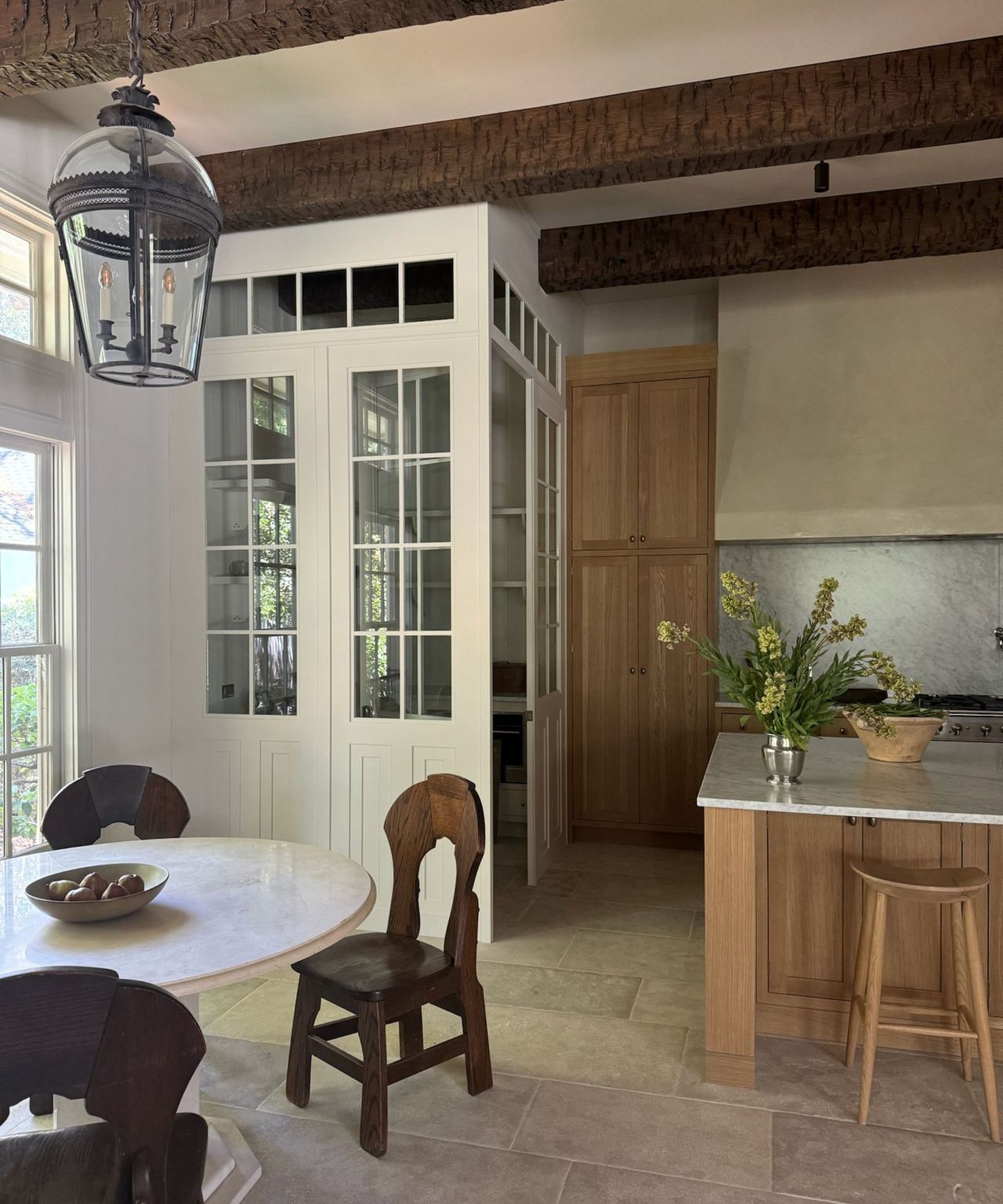
Every spring, I find myself returning to the same idea: flowers should feel like an extension of a home, not simply decoration placed inside of it.
At Molly Kidd Studio, florals are part of what I think of as a home’s framework philosophy – the layers that quietly shape the atmosphere of a room alongside lighting, textiles, scent, and collected objects.

The best arrangements are never overly styled. They feel natural to the space and to the core, as though they could not exist anywhere else.
Lately, I’ve been especially drawn to a moodier, more restrained approach to decorating with flowers for spring. Less pastel perfection, more texture and atmosphere.
I want arrangements to feel gathered during a walk through an old garden or clipped from a branch just beginning to bloom outside an open kitchen window. There’s something far more luxurious to me about a few sculptural stems placed thoughtfully than an overflowing bouquet trying too hard to announce the season.
I think this is why I’m so inspired by the quiet elegance of European interiors. In many of the homes I return to for inspiration – old Paris apartments, English country houses, Belgian interiors layered with linen and patina – flowers are treated with incredible restraint.
A single architectural branch in an oversized vessel. A loose collection of hellebores on a desk table. Wild asymmetry with a mix of tightly rounded arrangements. The flowers feel like part of the room itself.
This spring, I keep gravitating toward florals with a deeper, more grounded palette. To me, flowers say so much about the personality of a home. I often think that if a house had a signature bloom, it would reveal everything about the way it wants to be lived in.
Chocolate cosmos, with their velvety petals and almost cocoa-like scent, bring richness and softness without feeling overly romantic. Cosmos feel artistic and eclectic, slightly undone in the most beautiful way.
Smoky mauve tulips have a shadowy beauty I love paired against aged wood and stone. A tulip belongs to the quietly traditional interior – timeless, understated, tailored.
Fritillaria, with their delicate drooping heads and subtle movement, feel wonderfully intellectual and slightly untamed.
Quince and dogwood branches have become one of my favorite things to style because they create shape so effortlessly – dramatic, sculptural lines that instantly change the energy of a room. Dogwood belongs in romantic cottage interiors layered with books, gathered fabrics, and antique woods.
Peonies, despite their romantic reputation, can feel surprisingly modern in minimalist European spaces where their fullness softens cleaner architectural lines.
Roses will always remind me of Southern grandeur – gracious homes filled with heirlooms, candlelight, and entertaining.
Iris, perhaps my favorite of all, feels deeply old-world and intellectual, the kind of flower I imagine resting beside stacks of art books in a dim library.
Even the vessels matter just as much as the flowers themselves. I’m always reaching for tobacco-colored pottery, worn terracotta, smoked or Murano glass, rather than bright ceramics.
I want the arrangement to feel earthy and layered, almost as though it has always lived there. Mossy greens, trailing vines, and irregular branches create a softness that feels collected rather than arranged.
I’ve also become increasingly interested in treating florals as temporary architecture within a home. Single-stem arrangements, especially, have such incredible power. It creates movement and silhouette without visual noise. I think there’s something incredibly confident about restraint – allowing negative space to exist and letting one beautiful thing speak for itself.
And perhaps the most overlooked layer of floral design is fragrance.
I’ve noticed more and more that scent is what people remember long after they leave a home. Tomato leaf, especially, seems to have quietly taken over the design world lately, and I completely understand why. It smells green, earthy, nostalgic – like gardens warming in the afternoon sun.
Fresh lilac branches in an entryway, geranium leaves in a kitchen, jasmine drifting through an open window – these details change the emotional experience of a room entirely.
Fragrance affects memory, mood, hospitality, and even our perception of luxury. A home that smells alive feels infinitely more inviting than one that simply looks beautiful. I think people are craving that sensory depth again – spaces that feel layered and lived in rather than perfectly styled for a photograph.
What I love most about early spring flower arranging is its impermanence. Historically, arrangements were often incredibly simple: clipped branches from the garden, a few blooms gathered from outdoors, flowers placed casually into whatever vessel was nearby.
There was beauty in that looseness. In the fleetingness of it.
That philosophy continues to shape the way I approach florals today. I never want arrangements to feel overly perfected or disconnected from the home around them. I want them to soften architecture, create a mood, and bring life into a room in a way that feels effortless.
Interior designer Molly Kidd is one of Homes & Gardens' Editors-At-Large for By Design, sharing her thoughts on decor. See the rest of her articles here.
Love beautiful design ideas, expert advice, and inspiring decor trends? Sign up for our newsletter and get the latest features delivered straight to your inbox.