Get all your news in one place.
100's of premium titles.
One app.
Start reading
Guitar World
Guitar World
Entertainment
Andrew Daly

“I’d been using Marshall for so long that I’d never listened to anything else. I never gave anything else ashot”: Slash on what made him finally change up his sound – and why we’re living through a renaissance for blues guitar

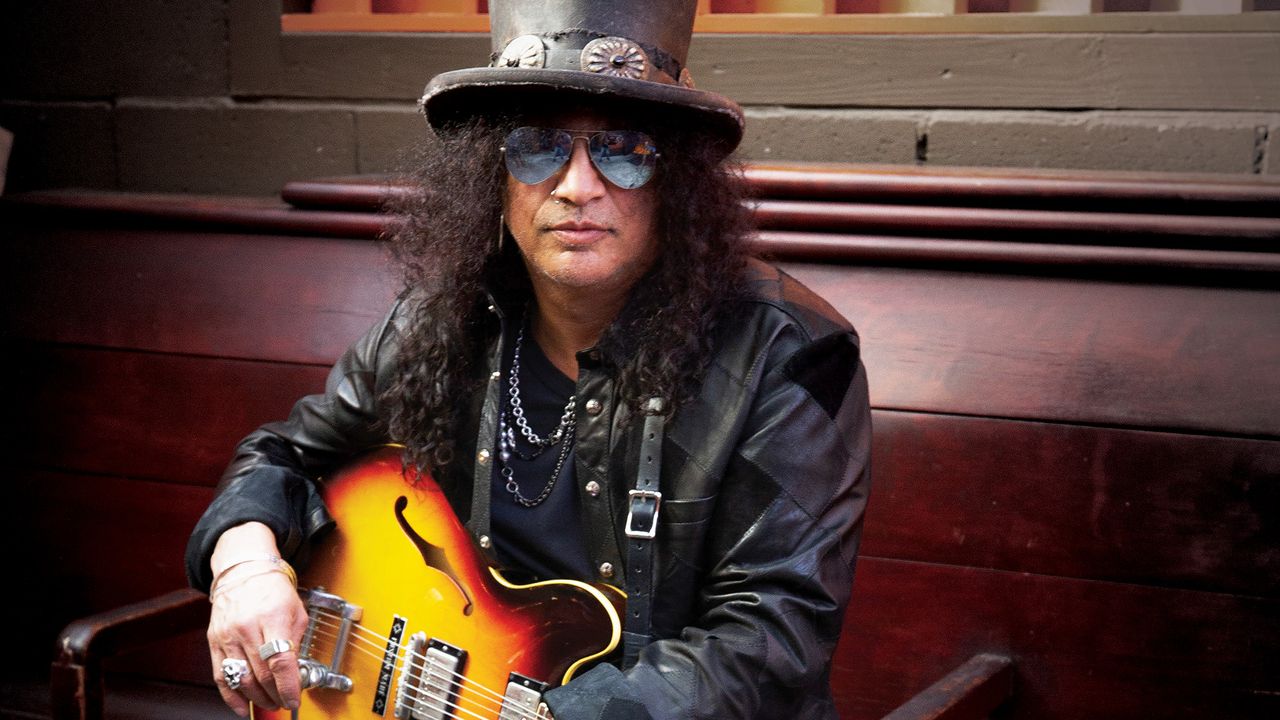
Slash poses with a Gibson ES-335.

Back in the ’90s, just after leaving Guns N’ Roses, when he was slinging his Les Paul solo, Slash hit local LA bars and clubs playing blues standards. The project was called the Blues Ball and, according to the musician, it wasn’t remotely serious.

“It was basically just a drunken excuse to go out and jam,” Slash tells Guitarist. But nearly 30 years later, his love for blues – and the gear that inspires it – has turned serious. The result was 2024’s Orgy Of The Damned, a blues cover album featuring a who’s who of all-stars – and plenty of vintage guitars and amplifiers, among them Magnatone combos that have replaced his beloved Marshall stacks.
“[The Magnatone] just sounds so much fuller in the low-end, and cleaner,” he says. “When you do a chord, you hear all the notes. It’s been a huge shift for me.”

Slash toured behind Orgy Of The Damned, resulting in a live album, Live At The S.E.R.P.E.N.T. Festival, which captured the blues-laden magic he had been conjuring with a collection of blues standards and rock staples.

The core band line-up comprised Teddy ‘Zig Zag’ Andreadis (keyboards, harmonica), Tash Neal (rhythm guitar), Johnny Griparic (bass) and Michael Jerome (drums). And with the festival’s name bearing an acronym for Solidarity, Engagement, Restore, Peace, Equality N’ Tolerance, the event also supported various charities.

This endeavour is clearly more serious for Slash than his ’90s bar days, of course – but he is still focused on fun. “I’m not trying to be a ‘blues guy’,” he says. “A lot of rock guys do that, where they’re rock players and then suddenly they discover they’re blues guys [laughs]. I’m just doing an interpretation of stuff that really had a massive impact and influence on me when I first picked up the instrument.”

(Image credit: earMUSIC)

Blues has always been integral to your playing, but your live album, Live At The S.E.R.P.E.N.T. Festival, is a different level.

You hit the nail on the head. When I started playing guitar, there were a lot of blues-oriented rock ’n’ roll guys from the ’60s and early ’70s who were my first influences. But I got turned on to B.B. King right around that time by my grandmother, who was sick and tired of hearing me listen to all these blues guys [laughs].

She goes, ‘No, this is the real deal,’ so she really opened that door – the correlation between guys like Eric Clapton and where they got it all from. So it’s always been a major root of my playing.

And then, with different things going on in the ’80s, I incorporated my influence into playing with different kinds of musicians. When Guns N’ Roses came together, that was really an amalgamation of a lot of different styles that made that band. But, for me, the core of it is all the blues stuff.

Do you see playing the blues as very different from playing heavy rock?

I just approach the blues the way I approach rock ’n’ roll: I play for feel. And I’m not what you call a huge blues purist or any of that kind of thing; I just do what I do. But it’s a lot of fun and a great release for me. Back in the ’90s, we put together this band called The Blues Ball, which was a glorified cover band.

We played around LA and then it turned into sort of a bar-circuit touring band. I was out of Guns N’ Roses when I did this, and I was in between solo projects, so this was a great sort of fun filler for me.

Fast-forward a bunch of years, I’m back in Guns N’ Roses and we had a break between legs. I thought, ‘You know, I’d really like to go and record some of those songs with those guys.’ So I called them up and we put together a bunch of those songs that we used to play, plus a couple of other ones, and made Orgy Of The Damned.

(Image credit: earMUSIC)

While recording the recent live album, and on your blues tour in general, you used a lot of gear that we don’t see with Guns N’ Roses. Does the blues bring that out in you?

Definitely. While making Orgy Of The Damned, I used a Magnatone combo that I just happened to have, which actually opened a whole door for me. And I switched amp companies [from Marshall] because of that M-80 combo that I had lying around. Then I broke out a lot of vintage guitars for this because I had an idea in mind of the kind of sounds I wanted.

I picked up [a Gibson ES-335] maybe a year prior from Norm’s [Norman’s Rare Guitars] in the San Fernando Valley. So I pulled that out and I had a Strat, a Tele and a couple of old Les Pauls. I had an Explorer, a Firebird… That’s what I used to record the record.

To do the tour, I didn’t take all of those vintage guitars out, but [used] facsimiles – Custom Shop reissues of said guitars. But I did have a 335 from there, which was really probably the go-to guitar for the whole tour and the live record, along with a couple of Firebirds.

(Image credit: earMUSIC)

The Firebirds, with the P-90s, or whatever you call those – the mini-humbuckers, which are kind of like single coils – are great. And I only used two Les Pauls on the tour, a Standard and a ’59 reissue. The Explorer that I had on tour was a ’58 replica, which was an amazing-sounding guitar. I recorded Born Under A Bad Sign with that and took it on tour.

Oh, and I had a Travis Bean for slide, and a Jackson pedal steel that I used for [It Takes A Lot To Laugh, It Takes A] Train To Cry. That covered it. That stuff, with the Magnatone M-80 2x12 combos, was the sound.

Considering you’d used Marshall amps for so long, what caught your ear with the Magnatone?

It was a big deal for me. When we went in to do the record and started pre-production, I started jamming these arrangements and I just didn’t want to use my normal Marshall sound. I had a couple of Fender Twins, a couple of Fender Deluxes, a Vox half-stack, and a vintage Vox combo. I did have my old 50-watt Marshall with me – and I had that M-80 Magnatone.

What happened was, I went, ‘Okay, we’re going to do this song…’ and I imagined in my mind, ‘Let’s try this amp and this guitar.’ I went through different amps and when I got to the Magnatone, which had been given to me but I’d never used before, I ended up using it for every song.

And now, you’re using it live for your blues tunes, and with Guns N’ Roses.

I’d been using Marshall for so long that I’d never listened to anything else. I never gave anything else a shot because it didn’t have the Marshall mid-punch, this or that

It was a big revelation because it gave me the sort of power that I wanted, but it gave me a kind of clarity. I think I was starting to get tired – as much as I hate to say it – of the very predictable Marshall sound, which I’m sort of known for… but it was starting to wear on me.

I’d been using Marshall for so long that I’d never listened to anything else. I never gave anything else a shot because it didn’t have the Marshall mid-punch, this or that. But something about the Magnatone really worked and so I recorded with it, and when we did the tour, I just took those out and it really worked.

Unbeknownst to anyone else, I actually replaced my Marshalls on the next Guns N’ Roses tour with the Magnatones and that became my thing. I got together with Magnatone a little later and we designed the 100-watt [SL-100] model, which is what I’m using now.

You’ve noted being known for a specific tone, but you’re on stage paying homage to the likes of Peter Green, Albert King and other heavy hitters, while also being a notable player yourself. That’s a delicate balance to strike.

Right! Well, this is a renaissance period for blues guitar. There are so many really amazing purist blues guitarists, like, very well studied, very educated, great musicians going out there and doing a lot of blues stuff. I think we’re in a period for the blues now, more so than it has been in the last 20 years. As far as I’m concerned, that’s a renaissance.

But anyway, I just do what it is that I do. I don’t try to take it too seriously. That’s one of the reasons why some borderline corny covers have been done so many times in this performance. The whole thing is about the huge stepping stones for what I do, and I wanted to cover them. I just try to keep the melodies intact and honour the original compositions.

We took those and then just did our own thing and really didn’t think about anything else. The guys in my band, this is what they do for a living. They play with Walter Trout, so they’re those guys – blues guys. I get to do what I do on top of that, so it’s fun.

Listening to the live record, it’s clear that you had a blast on tour. Is there more blues in your future?

Right now, I’m juggling being on the road with Guns N’ Roses and doing some recording. I’ve got a new record with the Conspirators that’s already done, coming out at the top of 2027, and then, somewhere, I’m going to try to figure out where I can do another blues record.

There are some really cool tracks that I would like to go after with that, so I’m trying to figure out a window to do that. We need to take this to Europe because there’s a big demand.

Sign up to read this article
Read news from 100's of titles, curated specifically for you.
Already a member? Sign in here
Related Stories
Top stories on inkl right now
One subscription that gives you access to news from hundreds of sites
Already a member? Sign in here
Our Picks
Fourteen days free
Download the app
One app. One membership.
100+ trusted global sources.