The Briefing:
- ICE counts 2,506 signed 287(g) agreements across 39 states and two territories as of September 14 — split among three enforcement models, with the most invasive one now the largest.
- Texas law forces every sheriff who runs a jail to apply by December 1 or risk a lawsuit from the state attorney general; Florida's 67 sheriffs already signed on.
- New York's statewide ban just faced its first real test: the state sued the one holdout county days after the compliance deadline passed, while a separate federal challenge from Washington failed to stop the law.
- Maryland didn't stop at banning the agreements — a follow-up law closed the informal workaround sheriffs said they'd use instead, and both local sheriffs and the Justice Department are now suing over it.
- The most-cited statistics linking the program to reduced crime reporting among Latinos are more than a decade old; newer research shows a subtler version of the same pattern.
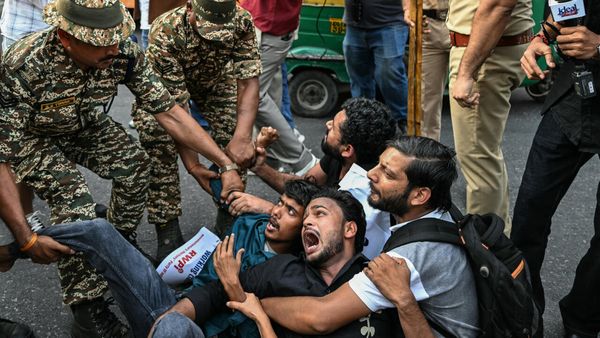
As of September 14, U.S. Immigration and Customs Enforcement counts 2,506 signed agreements with police departments and sheriff's offices in 39 states and two territories — a tally the agency updates almost weekly and keeps climbing. For a Latino family with members of different immigration statuses, that number isn't an abstraction. It can decide whether calling 911 after a burglary or a domestic incident feels safe, or whether staying quiet feels safer.
How Big the Program Has Actually Gotten
Break down ICE's own count and three models emerge: 1,773 Task Force agreements — the version that lets deputized officers question people about immigration status during ordinary patrol work, not just inside a jail — plus 553 Warrant Service Officer deals and 180 Jail Enforcement agreements. An estimated 77 million residents, close to a third of the U.S. population, currently reside somewhere a local agency has signed on, according to the ACLU's February 2026 analysis, "Deputized for Disaster." That report also flags a Homeland Security disclosure from a year earlier: by September 2025, roughly 10,000 officers had either finished or begun certification for that same street-patrol model, a push that ran alongside a broader loosening of baseline training standards across the department.
The pace of growth is real, even if one widely repeated number is starting to show its age. A February 2026 brief from the advocacy group FWD.us put participation growth at more than 900% since the start of the second Trump administration, with upward of 760 agencies newly signed onto the Task Force model. That figure is now seven months old — ICE's own tally has kept climbing since, meaning the true year-over-year growth by September is almost certainly steeper than the number still circulating in headlines.
Texas Sets a Deadline, Florida Already Crossed It
Nowhere is the pressure more direct than the South. Under Senate Bill 8, in effect since January, every Texas sheriff who runs a county jail must formally request a 287(g) agreement by December 1 or face a lawsuit from the state attorney general — and must keep reapplying annually if a request goes unanswered. Florida got there first: all 67 of the state's sheriffs have a signed agreement, a milestone the Florida Sheriffs Association first announced in February 2025 and one that still stood as the only full-state participation in the country heading into 2026.
New York's Ban Meets Its First Holdout
The opposite pattern is playing out in New York, where the Local Cops, Local Crimes Act bars these agreements statewide and gave agencies until August 25 to unwind any they had. Before the law, only one county, Rensselaer, had an active agreement, and 53 counties had never signed one at all, according to Spectrum News. Fifteen sheriffs sued to overturn the ban as it took effect, and Washington filed its own federal challenge to the law in June — a request a federal judge denied on August 3, letting the deadline stand. When Rensselaer's sheriff kept the agreement running past that deadline anyway, New York's attorney general sued the county directly — the first case brought under the state's newly created Office of Immigrant Trust. "Trust directly impacts public safety," Albany's police chief, Brendan Cox, said as the law took hold.
Maryland Shuts the Door Sheriffs Said They'd Use Instead
Maryland tells a similar story with an added twist. When Gov. Wes Moore signed a statewide 287(g) ban in February, eight of the nine participating counties dropped their agreements immediately; Frederick County's sheriff, Charles Jenkins, whose 18-year-old program was the longest-running of its kind in the country, said he'd simply keep working with ICE informally instead. "We can continue to work with ICE without necessarily being in the program," he told Fox News at the time. Lawmakers apparently took the warning seriously: months later they passed the Community Trust Act, barring local police from holding someone for ICE without a judicial warrant unless that person has a felony conviction or is a registered sex offender — closing off the exact kind of informal coordination Jenkins had described. Seventeen Maryland sheriffs sued in federal court to block the law in May, and in July the Justice Department filed its own suit against Maryland, one of 21 states it has now sued over similar local restrictions, New York included.
What the Research Shows — and How Old Some of It Is
The case that this reshapes public safety, not just immigration enforcement, rests partly on incidents from well over a decade ago. Justice Department investigations found in 2011 that Arizona's Maricopa County Sheriff's Office ran patrols pulling over Latino motorists at nearly nine times the rate of everyone else, and in 2012 that North Carolina's Alamance County Sheriff's Office stopped Latino drivers at similarly skewed rates, according to the American Immigration Council — both agencies operating under active 287(g) agreements at the time. A 2022 Arizona Law Review study by Texas A&M law professor Huyen Pham and economist Pham Hoang Van dug into 18 million-plus traffic-stop records logged by state troopers in North Carolina and South Carolina over a sixteen-year span ending in 2016, and turned up a spillover effect: troopers with no 287(g) deal of their own still pulled over Hispanic drivers at higher rates, effectively routing them toward jails where signatory agencies could hold them for immigration screening.
The most commonly cited trust statistics, though, are older still. A 2021 letter from Rep. Ritchie Torres urging Congress to defund the program cited figures showing 44% of Latinos hesitant to report crimes and 70% of undocumented immigrants avoiding police contact altogether — numbers that trace back to a survey of roughly 2,000 Latinos conducted in late 2012. A more recent 2026 policy paper points to a subtler, current-day version of the same problem: national crime-victimization data shows barely a third of all victimizations ever reach police at all, and that share drops further in neighborhoods with large immigrant populations. On the enforcement side, an ACLU report from April 2022 tied roughly two out of every three of the 142 agencies then enrolled to a documented record of biased policing or other civil-rights complaints — a snapshot of a program a fraction the size of today's, which has not seen an independent review at anything close to its current 2,506-agreement scale. Washtenaw County, Michigan, Sheriff Alyshia Dyer opted out of signing on when she took office last year; she has since argued that how Washington runs the program is straining cooperation between agencies and undermining the officers doing the actual work, according to Stateline. FWD.us policy vice president Felicity Rose was blunter still about the program's new funding model, calling it, in her words, "a confluence of two bad ideas that should be left in the past."
None of these fights are settled. Texas sheriffs still have until December 1 to comply or answer to the attorney general in court; New York's and Maryland's legal battles are just getting underway; and FOIA requests from immigrant-rights groups seeking ICE's own training materials remain unanswered. Whatever comes next will keep redrawing where — and whether — millions of Latino families feel safe picking up the phone to call the police.