
Get all your news in one place.
100's of premium titles.
One app.
Start reading
The Conversation
The Conversation
Doug Cowen, Professor of Physics and Professor of Astronomy and Astrophysics, Penn State

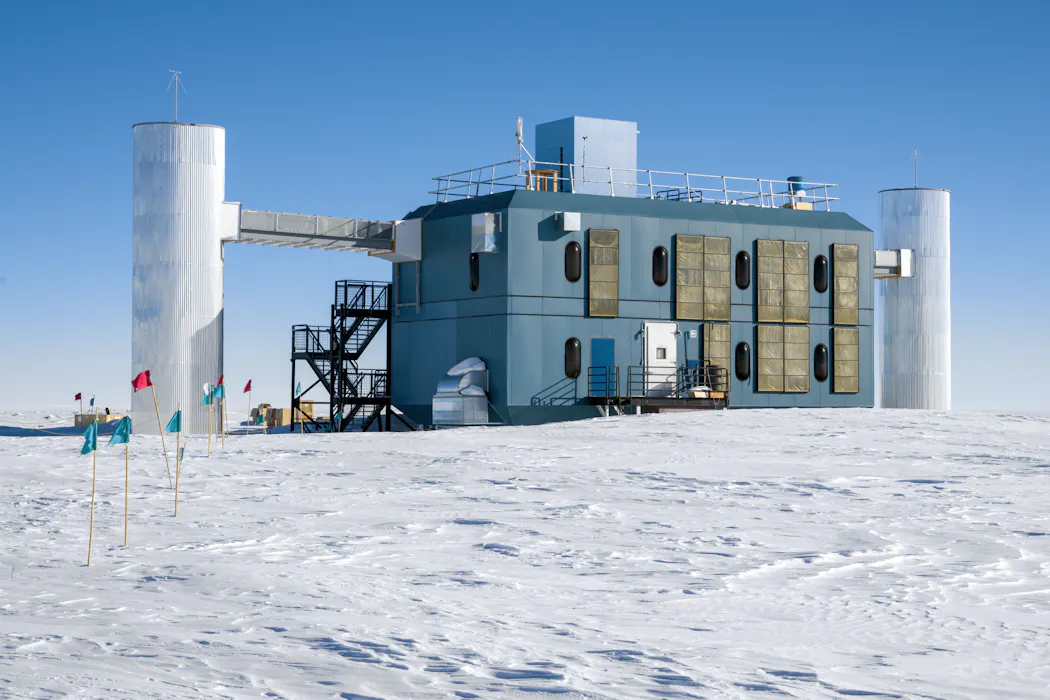
IceCube is built on decades of research into tiny ‘ghost particles’ – but it was the first to find neutrinos coming from deep space

The IceCube Neutrino Observatory sits on tons of clear ice at the South Pole, allowing scientists to detect neutrino interactions. Cmichel67/Wikimedia Commons, CC BY-SA

All visible matter in the universe – stars, planets, you, me – is made up of some combination of 12 fundamental particles. The lightest and most abundant of these are neutrinos. They are also the least visible. With every tick of the clock, more than 100 billion of these “little neutral ones” stealthily zip through you, with energies so low that they leave no trace of their passage.
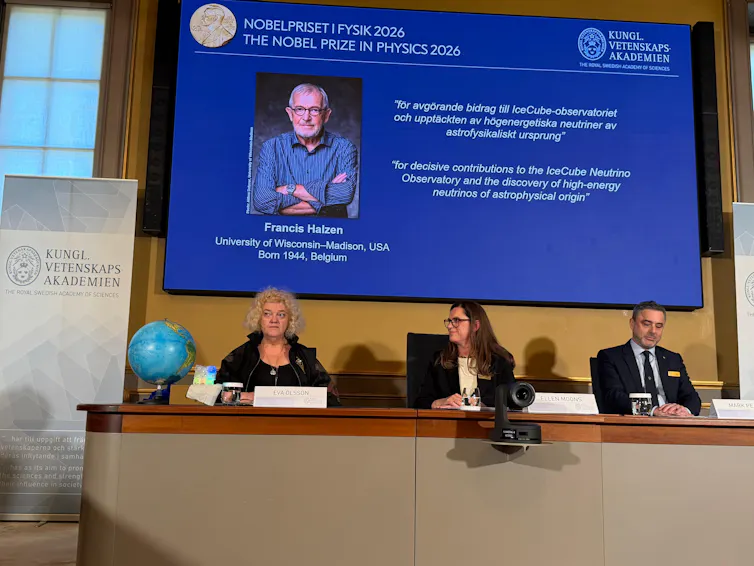

A panel of three people sitting at a table, with a screen behind them showing a photo of Francis Halzen and a description of his research.
Belgian physicist Francis Halzen received the 2026 Nobel Prize in physics from the Royal Swedish Academy of Sciences in Stockholm on Oct. 6, 2026. Atila Altuntas/Anadolu via Getty Images
Sign up to read this article
Read news from 100's of titles, curated specifically for you.
Already a member? Sign in here
Related Stories
Top stories on inkl right now
One subscription that gives you access to news from hundreds of sites
Already a member? Sign in here
Our Picks
Fourteen days free
Download the app
One app. One membership.
100+ trusted global sources.






