
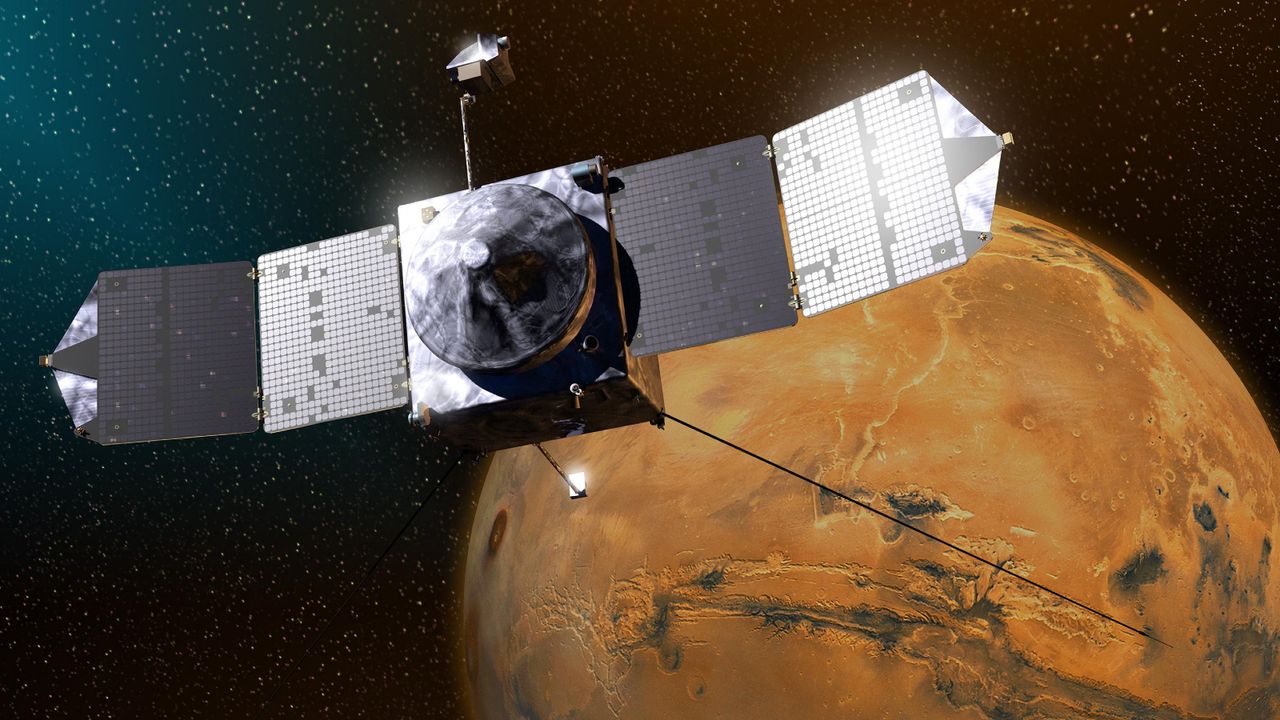
A phenomenon that was thought to be impossible on Mars is squeezing the Red Planet's atmosphere like toothpaste from a tube, a new study finds. The surprising discovery, uncovered by a NASA spacecraft during a powerful solar storm, could change how we think of dangerous space weather throughout the solar system, researchers say.
The unlikely phenomenon, dubbed the Zwan-Wolf effect, was first discovered on Earth in 1976 and occurs when "charged particles are squeezed like toothpaste coming out of a tube along magnetic structures called flux tubes," NASA representatives wrote in a statement. These flux tubes are located within Earth's magnetosphere, the invisible field that is generated by the movements of our planet's molten metal core and shields us from radiation.