
I've always been on the quest for glossy, glass skin. While I put off signing up for the Hackney Half Marathon every year, I will endure needles and vials of salmon sperm to achieve a tight forehead that screams health, and signals that I never forgo my daily supplements. But alas, I don't live a virtuous life, and as such, have never cracked the code, despite how carefully I've tended to my moisture barrier.
Last year, I discovered that I was doing my skin a disservice by using too many products, so I stripped it back and instead spent my paychecks on regenerative treatments like exosome therapy and polynucleotide facials. They worked a treat, but significantly dented my bank balance, meaning I had to think of ways to bring the clinic home. Then a eureka moment arrived—I was scrolling TikTok and spotted a tech bro-type working in front of an LED light panel. Perhaps I could gamify my skincare by stimulating collagen and elastin, all while I typed away during my nine-to-five?

A few weeks later, the Currentbody Skin LED Light Therapy Panel landed on my doorstep. At £899.99, it's pricey, but I figured that its benefits could mitigate the need for multiple in-clinic treatments, which, in theory, would save money in the long run. Plus, I really love multitasking.

Why I chose the Currentbody Skin LED Light Therapy Panel
I've long been a fan of Currentbody's LED face masks, so opting for their panel was a safe bet. The panel is soft and flexible and was designed for targeted anti-ageing, skin clearing and body recovery using four clinically proven wavelengths: blue (415nm), red (633nm), near-infrared (830nm) and deep near-infrared (1072nm).
These pre-programmed modes make it easy to tailor the treatments to your concerns—shorter 'Low Modes' (10 minutes) for direct skin contact and longer 'High Modes' (20 minutes) with increased power output, which can be used slightly further away from your skin, at 15 cm. The blue mode targets blemish-causing bacteria, oil reduction, and helps prevent future breakouts, while the red and infrared light boost collagen and elastin for anti-ageing, supporting recovery and overall wellness.
You can use it in a number of ways: flat, on a stand, or secured with straps to treat areas such as the face, chest, back, legs or hands. It's advised to use the panel 3-5 times weekly.
How I used a LED Light Therapy panel
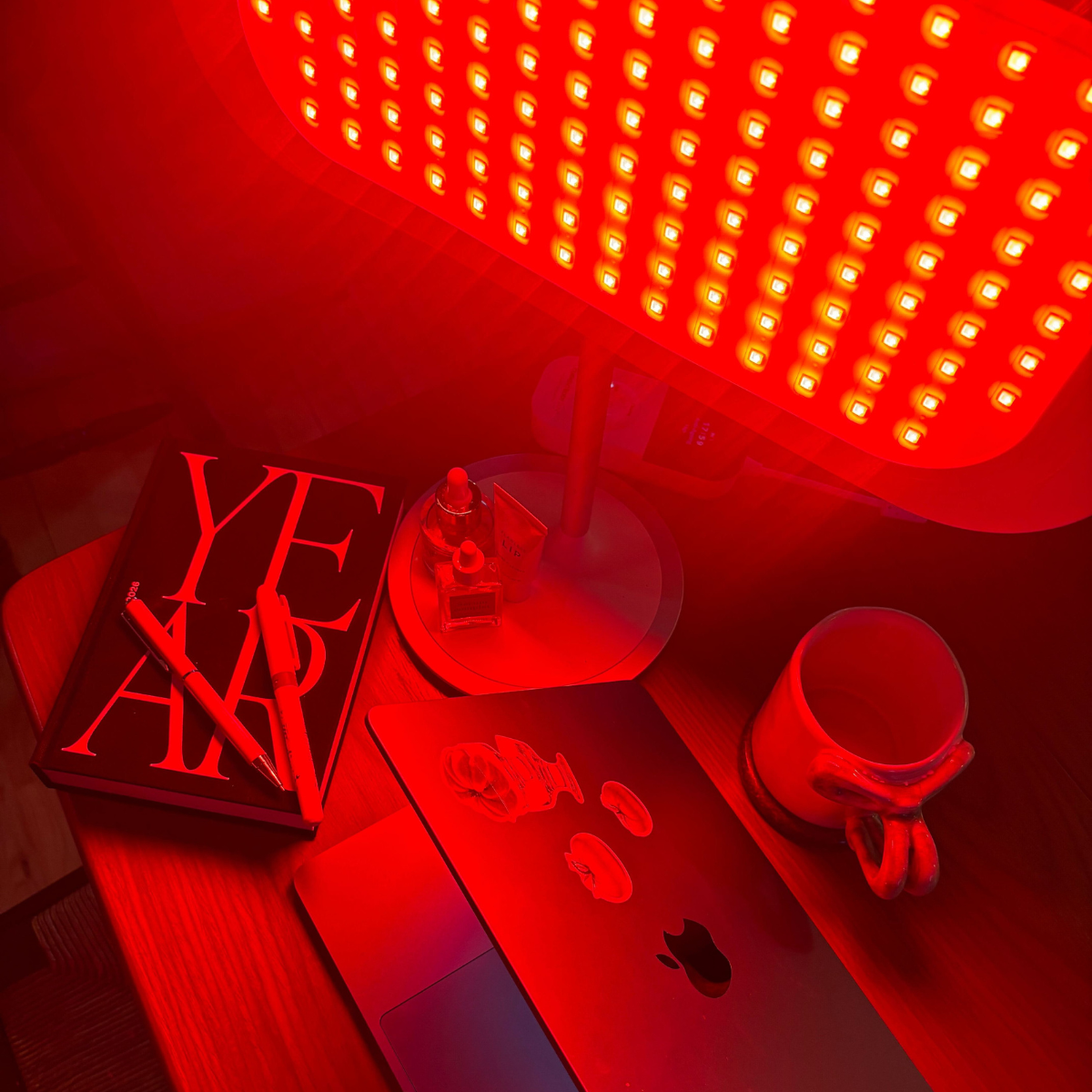
Re-jigging my desk to make space for the panel was a process of trial and error. Because I didn't want to physically strap it to me, as my main concern was my face, I had to ensure that the panel wasn't too far away—it should be approximately 15cm, or just under six inches, from the skin you want to treat. I eventually found that having it directly in front of me and to the side of my laptop worked best. Although this means that I need to alternate its position every day to ensure that both sides of my face are getting equal amounts of light.
At first, it was distracting; the high mode is bright. But after a few days of using it consistently, it became second nature to turn on the panel in the morning. Just remember to use it after you've cleaned your face, and before applying your sunscreen, as this often blocks red and near-infrared light. TLDR: It was a faff before I figured out what exactly worked for me.
What's the difference between a LED mask and a LED light panel?
The goal is the same, but masks can only be used on the face, while panels offer a larger coverage area, so they can be used on the body to treat conditions like eczema, psoriasis, and rosacea.
A beauty editor's verdict
I've now been using the LED Light Therapy Panel for two months, five times a week, during my working day, and I've noticed really positive improvements in my skin, with little to no effort. I usually do 20 minutes on the 'Clearing High Mode' followed by 20 minutes on the 'Anti-Ageing High Mode', so it is completely hands-free.

I've noticed all the same benefits that I did from using an LED face mask, but it's really the minimal effort I was after; apart from charging, I don't need to lift a finger other than turning the panel on. I've had far fewer breakouts, less congestion, and my skin generally looks brighter and clearer. Is it necessary? Definitely not, but if you have the disposable income, are time-poor and struggle to be consistent with devices, then popping an LED light panel next to your laptop means you will actually use it.
If you still want the benefits of LED light on your face, and are happy to use a mask daily, then definitely opt for that instead—they are considerably cheaper, and do the same thing. This is the lazy girl's option, but that's why it works so well for me.