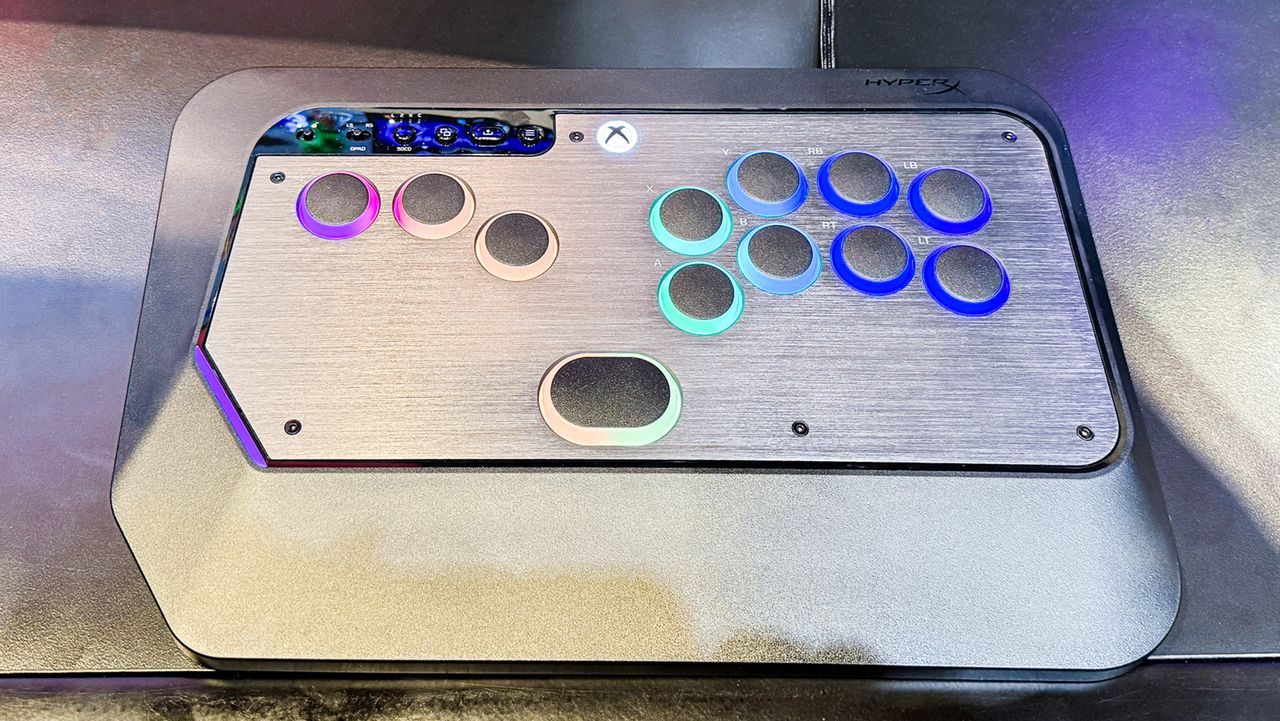
The HyperX Clutch Tachi could be the next major leverless fighting game controller. It’s the first “Hit Box” controller to feature TMR sensors, which are even more accurate and sensitive than Hall Effect switches. The Xbox-licensed controller also has an ergonomic design that should let you play for extended training sessions, and it’s highly customizable, too.
I’m a huge fan of fighting games, so I was instantly drawn to the Clutch Tachi when I saw it at an HP CES event. Though I’m not as adept at using these controllers as I am with the best fight sticks, I appreciate the peripherals for the precision they deliver. And of all the leverless controllers I’ve tested, the Clutch Tachi stands out due to its low profile and ease of use. I can see the FGC (fighting game community) falling in love with this controller.

Here are my initial thoughts on the HyperX Clutch Tachi leverless controller.
Design

The Razer Kitsune is arguably the thinnest leverless controller from a major manufacturer. It retains that crown, as the Clutch Tachi isn’t quite as low-profile. However, HyperX's controller has a smaller footprint than Razer’s peripheral, which will make taking it to local or major tournaments easier.
The Clutch Tachi has a built-in angled wrist pad, which is something I’ve never seen on a leverless controller. Because of that, your hand is angled ergonomically, which means you’ll feel less (or no) fatigue when you’re spending hours trying to nail down combos or scenarios. This was the first thing that stood out when I placed my hands on the Clutch Tachi. It just feels good underneath your hands!
I also like the button placement, as it isn’t as cramped as other leverless controllers. There are no extra buttons beyond the ones you need (four directional and four action buttons), which is fine since leverless controllers with 12 buttons or more can be intimidating. I also like how the Up button is wider than the others to ensure your thumb never misses it.
Lastly, the foam padding and rubber feet reduce slipping when the controller is on your desk or lap. This helps prevent input errors.
Performance

I briefly played training mode in Street Fighter 6 and wasn’t disappointed by the controller’s performance. After a few seconds acclimating to the Clutch Tachi, I had no trouble pulling off Mai Shiranui’s special moves and super arts. The only point of friction was with my relative inexperience with leverless controllers, not with the Tachi itself.
TMR sensors are quickly replacing Hall Effect in controllers since the former is supposed to be more responsive and precise. I’m not a professional gamer, so I can’t immediately distinguish the responsiveness of TMR from Hall Effect. However, I will say the TMR switches in this controller feel very smooth when I press buttons.
I’ll need more time with the Clutch Tachi to gauge its performance across a slew of different fighting games. Right now, I can at least say the hype about TMR sensors seems to be justified.
Customization

The Clitch Tachi, like any great fighting game controller, is highly customizable. The clearest example is that you can remove the top plate and place your own custom artwork on it. HyperX is also encouraging you to create aftermarket mods by 3D printing button shapes.
You can use the HyperX NGENUITY software to customize the controller’s RGB lighting, change the button mapping, and even set the buttons’ actuation points. I’m looking forward to diving deep into this program to see how robust the customization options are.
Outlook
With leverless fighting game controllers now being the de facto weapon for professional players, it’s not surprising to see HyperX trying its hand in this space.
Again, I’ll need more time with the HyperX Clutch Tachi to see how I ultimately feel about it, but I can definitely see it becoming a favorite among the FGC when it’s released sometime in 2026.

Follow Tom's Guide on Google News and add us as a preferred source to get our up-to-date news, analysis, and reviews in your feeds.