
Get all your news in one place.
100's of premium titles.
One app.
Start reading
Creative Bloq
Creative Bloq
Technology
Paul Hatton

I wasn't sure the Creality Sermoon P1 Scanner would handle shiny objects –then this happened

Creality Sermoon P1 Scanner.

With the release of the Sermoon P1 Scanner, Creality is hoping to cement itself as a pro maker of the best 3D scanners, joining its already established reputation of manufacturing some of the top 3D printers on the market.

This won't be an easy task for Creality, however, with strong competition from rivals like Revopoint (the 4.5-star Revopoint Miraco Plus currently occupies the top spot in our guide) producing 3D scanners with integrated screens.

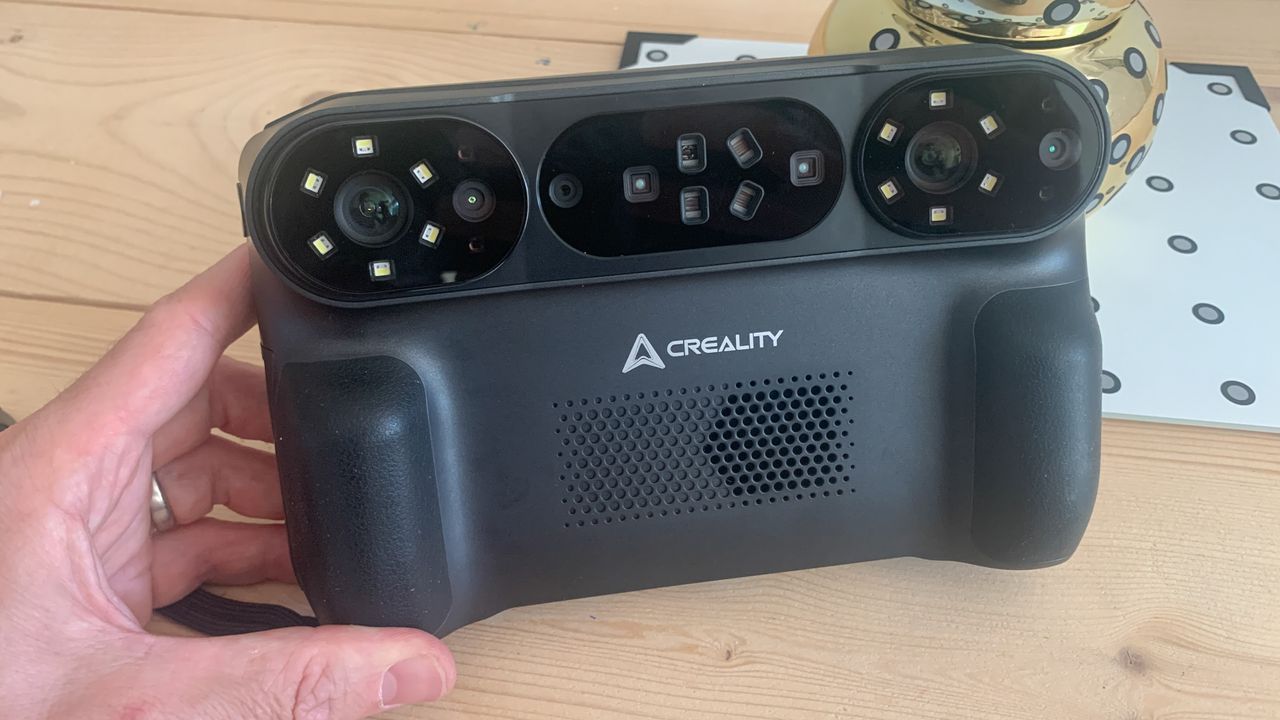
The Creality Sermoon P1 sits right in the middle of the market between basic consumer scanners and pricey industrial rigs. Its defining feature is the total standalone capability, powered by an onboard 8-core processor, a 6-inch touchscreen, and a hot-swappable battery. This means you won't need a PC to run the scanner, only for any heavy editing. But it's amazing what is possible on board the device itself.

(Image credit: Future / Paul Hatton)

The scanner runs a hybrid optical system that combines ultra-precise blue lasers with rapid Near-Infrared (NIR) light. The blue lasers provide high-accuracy, high-detail scans of small to medium objects, and the rapid NIR light captures larger surfaces and faces quickly.

I expect that the Sermoon P1 scanner will find a home in many workflows of game developers, prop designers, and digital artists, although its high price tag will more than likely put most hobbyists off, understandably.

Creality Sermoon P1 Scanner review: Key specs

Object size:

5 mm³ up to 4m³

Single capture:

Laser = 380 x 365 mm

NIR = 1450 x 1020 mm

Scanning speed:

Laser = 60 fps

NIR = 15 fps

Single-frame accuracy:

Laser = 0.02 mm

NIR = 0.075 mm

Resolution:

0.05 to 2.0 mm

Live preview

Onboard display

Dimensions:

209 x 129 x 53 mm

Weight:

830g

Compatible OS:

Windows, macOS

(Image credit: Future / Paul Hatton)

Price

• It is very expensive, but the specs justify it.

The Creality Sermoon P1 3D Scanner retails at $3,299 / £3,099, although at the time of writing it has been discounted down to £2,799 in the UK. This price point makes the scanner a premium investment when compared to other popular, all-in-one standalone alternatives like the Revopoint Miraco Plus, which generally retails for £2,110.

Both of these offer independent, PC-free processing, although the Sermoon P1 set itself apart by offering multiple blue laser lines with near-infrared (NIR) structured light. I think this gives it a substantial edge in speed and flexibility for advanced engineering tasks.

(Image credit: Future / Paul Hatton)

Unboxing

• Standalone unit that can also be connected to a PC
• Bright and clear 6-inch full HD display

The Sermoon P1 ships in a relatively small, neat carry case constructed of a slightly flexible cardboard frame, which guarantees, in most scenarios, to keep the scanner free from damage. The scanner, power unit, adaptors, backup battery, and reflective markers each have a defined cut-out space – perfect for creatives who love everything to have its place.

Design

At the rear, you'll find a large 6-inch full HD display which is nearly identical in size and resolution to the Revopoint Miraco Plus. It's bright, responsive, and large enough to perform all steps of the scanning process as well as fusion, editing, and meshing.

Keeping a hold of the scanner isn't a problem thanks to rubber grips located on the left and right-hand sides of the front and rear panels. The unit as a whole is as light as you can expect for what is packed inside, but I still found that it was too wearing on my wrists to use it for longer than around an hour at a time. Unfortunately, the kit doesn't include a tripod, although the scanner does feature the required thread.

One of my favourite features about the design of the Sermoon P1 is that it features two hot-swappable 3300 mAh batteries, which provide extended and uninterrupted operation. Having two batteries included in the main pack is a nice touch, especially when most other standalone scanners only feature one.

(Image credit: Future / Paul Hatton)

Performance

• Accurate results with all scanning technologies, but markers are required
• Easy and seamless fusing and meshing of scans

The scanner boasts a compact form factor and can be used as a standalone unit or connected either wirelessly or wired to a PC. The choice will depend on whether you're scanning in a studio location or out in the field. Each of the three work modes also features a different number of frames per second, and so the speed at which you want to move around an object might also dictate the mode.

To test the Sermoon P1, I grabbed my trusty 'difficult to scan' super-shiny gold-coloured gourd ornament with tracking markers already applied. I placed it on the supplied marker board and powered up the scanner.

Thanks to the high-performing Qualcomm 8-core 3.36 GHz CPU, Adreno 740 GPU, 256GB of ROM, and 24GB of RAM, the onboard software is fast, responsive, and incredibly straightforward to use. After creating a project, you can choose between blue laser scanning mode and NIR structured light mode.

(Image credit: Future / Paul Hatton)

I began with the blue laser mode and started the scan. The Sermoon P1 managed admirably, although it took several attempts to get a clean scan. The first couple of times the scanner became confused by the location of the tracking points and began creating a duplicated mesh in a slightly offset position. As is the case with most laser scanning projects, a little trial and error is a common occurrence, especially when objects are both shiny and curved.

With this blue light mode, I achieved 40 frames per second, which is less than the advertised 60 frames and will have contributed towards the issues I experienced. Despite this, I was eventually able to capture a clean scan. If you'd like to achieve a higher rate of frames per second, then the Wi-Fi connection offers up to 80 frames per second, while the hardwired connection jumps up to 100 frames per second.

From there I proceeded to the fusion and meshing steps. These steps were performed seamlessly and with very few hiccoughs. I particularly like the hole-filling feature, which enabled me to create mesh data along planes, tangents, and curves where the scanner had failed to collect data. It's then possible to export the mesh for further editing in a 3D package.

Being fully aware of the difficult nature of the shiny gourd object, I also set up a secondary test with a much less shiny tape measure object. I placed it on the marker board but decided not to place markers on the object itself. The Sermoon P1 was able to capture a point cloud of this object with very few problems at all.

The scanner offers 256 GB of storage, which is more than sufficient to run a number of scans before having to transfer data onto a PC. This can be carried out either using Wi-Fi 7 or using the included USB-C cable.

Overall, the Sermoon P1 is an excellent scanner that can deliver high levels of accuracy with very few problems. The standalone mode struggles to compete with the hardwired alternative of either the Sermoon P1 or other scanners such as the Revopoint MetroY Pro, but for convenience, it's very impressive indeed.

(Image credit: Future / Paul Hatton)

Who's it for?

• All types of creative professionals who need accuracy and versatility

The Sermoon P1 is a high-precision, standalone 3D scanner which will appeal to industrial professionals, engineers, and product designers who require metrology-grade accuracy without being tethered to a computer. This standalone scanner workflow also makes it ideal for on-site quality control, reverse engineering, and field research in museums or archaeological sites.

In addition, the scanner is well suited to automotive workshops and small-scale manufacturers who frequently deal with challenging surfaces. Thanks to its blue laser technology, the Sermoon P1 can seamlessly scan dark, glossy, or highly reflective metallic components without requiring messy anti-reflection sprays.

Buy it if...

  • You're a professional demanding a high level of accuracy
  • Staying tethered to a computer during scanning isn't possible
  • You're a hobbyist who just wants to have a little bit of fun

Don't buy it if...

  • Absolute accuracy is not necessary
  • You're on a tight budget
  • You are new to the world of 3D scanning
Sign up to read this article
Read news from 100's of titles, curated specifically for you.
Already a member? Sign in here
Related Stories
Top stories on inkl right now
One subscription that gives you access to news from hundreds of sites
Already a member? Sign in here
Our Picks
Fourteen days free
Download the app
One app. One membership.
100+ trusted global sources.