Every so often, a live recording of a song captures a performance of such exhilaration, feeling and spontaneity that no amount of studio virtuosity can possibly eclipse it.
A handful of such live recordings have become hit songs: Folsom Prison Blues (1968) by Johnny Cash; Crossroads by Cream (1968); Show Me The Way (1976) by Peter Frampton and I Want You To Want Me (1979) by Cheap Trick.

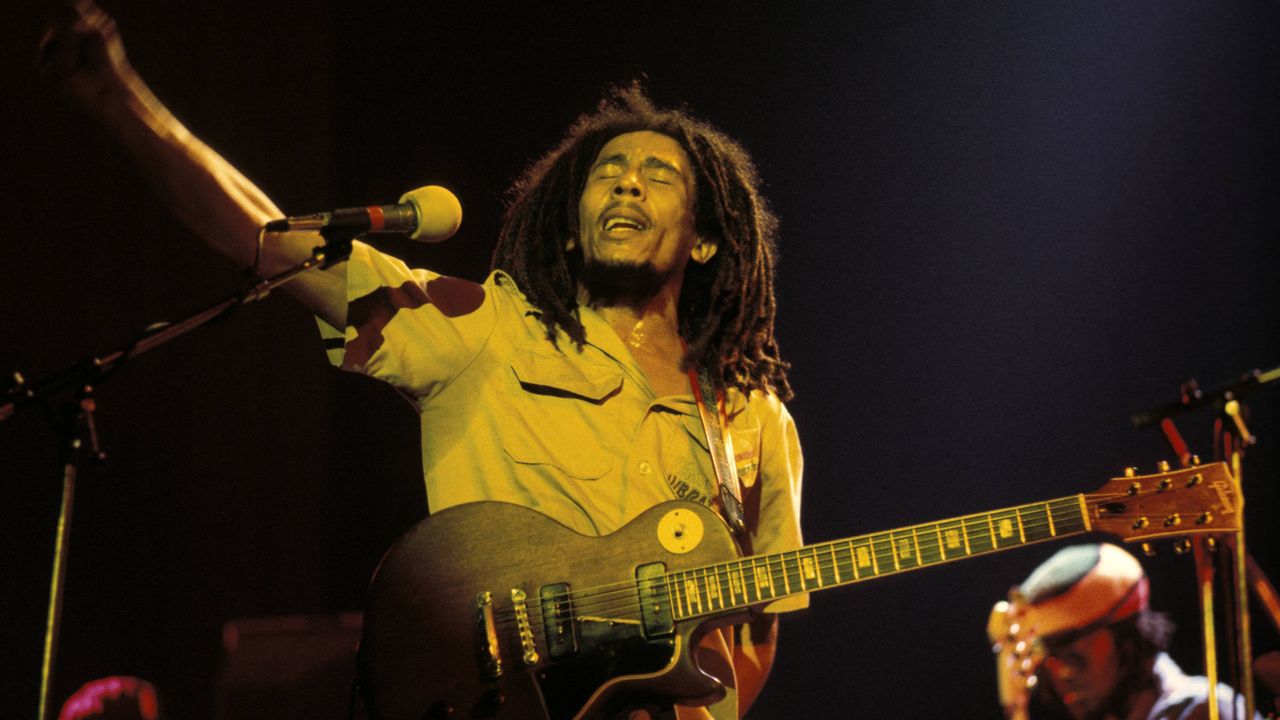
Then there is No Woman, No Cry (1975) by Bob Marley and the Wailers, captured at the Lyceum Theatre in London on 17 July 1975 and released on 29 August 1975.
The song had already been recorded one year earlier and released in October 1974 on the studio album Natty Dread. But the live version would become the best-known and best-loved, transforming Bob Marley from a charismatic figurehead of the Jamaican roots reggae scene into an international star.
Over five decades on from its release, it remains a timeless and iconic classic.
By the time No Woman, No Cry was released, Bob Marley’s reputation was already firmly established. Since forming the group Teenagers with Peter Tosh and Bunny Wailer in 1963, Marley had become one of the pioneering forces in the evolution of reggae in Jamaica, fusing elements of ska, rocksteady, mento and American R&B with a distinctive vocal and songwriting style.
Marley’s talent was more than matched by his ambition. He was driven not by personal success but by a strong desire to take reggae music global and spread his message of unity and social justice.
Rastafarianism provided the philosophical, spiritual, and lyrical backbone of reggae, transforming it from popular dance music into a global vehicle for protest, Pan-Africanism and spiritual liberation.
The ideology of Rasta would give reggae its ‘conscious’ identity by integrating tenets such as the divinity of Haile Selassie, condemnation of ‘Babylon’ (oppressive society) and core messages of unity and liberation. Artists such as Marley, Burning Spear and Peter Tosh were at the forefront, spreading the message of Rastafarianism worldwide.
By 1972, Marley was living in Ridgemount Gardens in leafy Bloomsbury, London, and that same year signed a small deal with CBS Records, embarking on a UK tour with singer Johnny Nash.
But it was an introduction to Island Records’ founder Chris Blackwell in late 1972 that really transformed Marley’s career. Island’s top reggae star Jimmy Cliff had recently left the label and Blackwell was eager to find a replacement.
Marley and Blackwell had been introduced by Brent Clarke, the road manager for Bob Marley and the Wailers. Blackwell had offered the group an advance to record an album.
Like Marley, Blackwell recognised the huge potential for reggae to cross over to a mainstream rock audience. As soon as Blackwell set eyes on Marley, he recognised that here was an artist capable of doing precisely that.
“I was dealing with rock music, which was really rebel music,” Blackwell told writer Brent Hagerman in 2005. “I felt that would really be the way to break Jamaican music. But you needed someone who could be that image. When Bob walked in, he really was that image.”
Marley and the Wailers returned to Jamaica to begin recording at Harry J Studio in Kingston. The resulting album was the critically acclaimed album Catch A Fire (1973).
But it was the follow-up album Burnin’ which was their major breakthrough and the first international release. It was a critical and commercial success, thanks largely to two tracks that featured on the record – Get Up, Stand Up and I Shot The Sheriff, the latter famously covered by Eric Clapton.
Natty Dread was the seventh album and featured the studio version of No Woman, No Cry, recorded at Harry J Studio in Kingston, Jamaica and Island Studios in London.
No Woman, No Cry was written in 1974 and is credited to songwriter Vincent Ford, a close friend of Marley’s who ran a soup kitchen in the Trenchtown district of Kingston.
Some believe that Marley wrote the music and set Ford’s words to that music, giving his friend the sole songwriting credit as an act of philanthropy. Whatever the truth, the royalties received by Ford for the song ensured that his charitable works in Trenchtown would continue.
No Woman, No Cry is a deeply spiritual and warm-hearted song that offers solace and hope, set against the poverty of the public housing projects – “the government yard in Trenchtown”.
The song is a message of comfort, strength and resilience to women who have endured hard times and struggles amid the poverty of Trenchtown, and a reassurance that hardships will pass.
By the time they recorded the original studio version of No Woman, No Cry in 1974, the original Wailers had disbanded and been replaced by a whole new line-up. The new band consisted of brothers Carlton and Aston ‘Family Man’ Barrett on drums and bass respectively, Al Anderson on lead guitar, Bernard ‘Touter’ Harvey on piano and organ, Jean Roussel on Hammond organ, keyboards and arrangement, and Lee Jaffe on harmonica. On backing vocals were the I-Threes, consisting of Judy Mowatt, Marcia Griffiths and Marley’s wife, Rita.
Natty Dread is a majestic album, arguably Marley’s finest. Each song finds the new line-up of the Wailers locked into a solid groove and there is striking lyrical and musical potency throughout.
The studio version of No Woman, No Cry was built on a drum machine pattern, rather than live drums. The studio arrangement is sparse and experimental, and radically different from the live version that would follow a year later.
Firstly, the studio version is much faster than the live version, with a lighter, upbeat feel and echoes of ska and rocksteady. Marley’s voice sounds higher-pitched and less resonant but it’s a soulful, heartfelt vocal take. When he sings the first line of the first verse, the band settles into an infectious, compelling groove. The mix feels taut and constrained but the gospel-tinged Hammond organ, squelchy clavinet stabs and high-in-the-mix percussion add real dynamism and warmth.
One year later, the Natty Dread tour rolled into the UK and Marley and the band played two sold-out nights at the Lyceum Theatre in London on 17 and 18 July 1975.
By then, No Woman, No Cry had developed into a wholly different composition – much slower and looser, with a deep, loping groove.
Also at this stage Tyrone Downe was on keyboards and Alvin ‘Seeco’ Patterson was on percussion.
Both Lyceum concerts were recorded by Island Records’ employee Danny Holloway, using The Rolling Stones Mobile Studio, but most of the tracks used on the Live! album, including No Woman, No Cry, were taken from the concert on 17 July.
Anticipation was high before the UK leg of the tour, and after a month touring across the US, Bob Marley and the Wailers were a formidable outfit.
“I wasn't prepared for what I saw that night,” recalled Sounds photographer Kate Simon in an interview with Classic Rock in 2004. “It was like seeing someone who was as good-looking as Steve McQueen, playing with a group that was peerless – as tight as anything you'd ever heard.
“And not only did you hear this magnificent voice, but the message was one of faith, truth and doing the right thing… To see someone who sang about principles, and did it in such a way that made even me dance, that was quite something.”
Chris Blackwell told the engineers to mix the live performance recordings with “more audience”. It was an inspired decision.
From the very first bars of No Woman, No Cry, the listener is immersed in the evocative live ambience. At times, the audience’s singing threatens to drown out the amplified band, but this heightens the emotive power of the song.
As Lindsay Planer put it in a review in AllMusic: “Passionate and symbiotic energies constantly cycle between the band and audience, the net result of which is one of the most memorable concert recordings of the pop music era.”
From the first few bars of the opening, ascending Hammond organ riff, there’s a joyous warmth and excitement to the 1975 live version of No Woman, No Cry. Touring had enabled the Wailers to really grow into the song, organically honing a slower, loping groove and imbuing it with real emotional heft and resonance.
It’s a beautifully melodic song and everything about this performance – from Marley’s rich, plaintive vocals to the haunting organ refrains – is seeped in pathos.
“Good friends we have, oh, good friends we've lost/Along the way, yeah/In this great future, you can't forget your past/So dry your tears, I say, yeah.”
The voices of the audience permeate the song and the brief squall of vocal feedback at 1:47 only enhances the atmosphere. The rich harmonies of the I-Threes really bolster Marley’s vocal refrains.
At 3:19 the band glides into the infectious groove of the “Everything’s going to be alright” section, with the sibling rhythm section Aston and Carlton Barrett showcasing why they were the peerless backbone for Marley’s music.
The track was enhanced by the percussion of Alvin ‘Seeco’ Patterson and guitarist Al Anderson. Anderson’s lead guitar break graced the outro of No Woman, No Cry on the studio version, but on this 1975 live version, Anderson’s lithe and beautifully melodic solo, beginning at 4:08, is a core high point of the song.
The live version of No Woman, No Cry was released as a single on 29 August 1975 to promote the Live! album and it climbed to No 22 in the UK charts.
For Island label founder Chris Blackwell, this was a moment when his vision for a lusher, fuller rock-reggae sound for the mainstream market really came to fruition.
Over two decades later, the song was covered by US hip-hop band Fugees, with the line “in a government yard in Trenchtown” changed to “in a government yard in Brooklyn”.
An official remix of the track featured Bob’s son, Stephen Marley.
Then, in 2022, Nigerian artist Tems covered the song for the Marvel Studios film Black Panther: Wakanda Forever.
No Woman, No Cry and the Live! album from which it came captured Bob Marley and the Wailers at the peak of their powers. Over five decades on from its release, it is a song that has transcended its origins to become a universal anthem of resilience and hope.