Get all your news in one place.
100's of premium titles.
One app.
Start reading
Tom’s Guide
Tom’s Guide
Technology
Amanda Caswell

'I was a fool': Elon Musk calls OpenAI's mission a ‘safety risk’— but courtroom gaffe proves he’s out of the loop

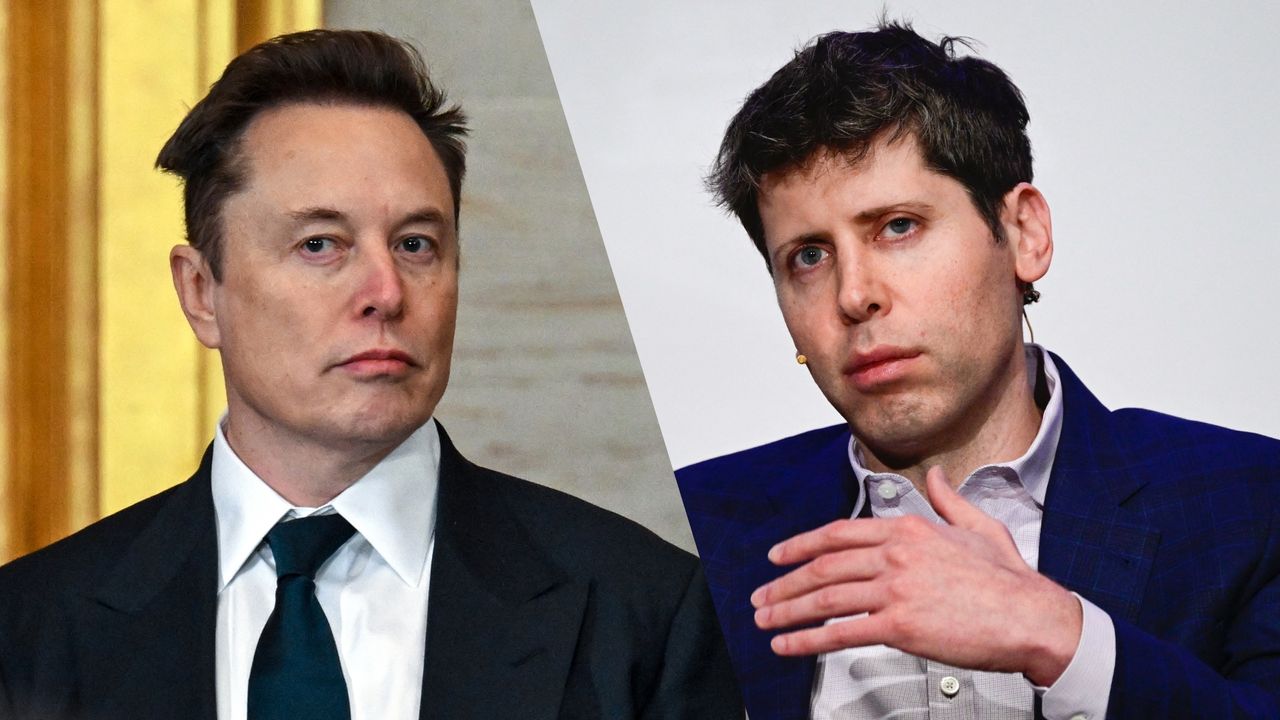
Elon Musk (left) and Sam Altman (right).

Testifying in a federal courthouse in Oakland, California on April 29, 2026, Elon Musk didn’t hold back.

Taking the stand in his high-stakes lawsuit against OpenAI and CEO Sam Altma, Musk cast himself as a founder who helped launch one of the world’s most powerful AI companies, only to watch it transform into something he no longer recognizes. According to reports, Musk told the jury:
“I gave them $38 million of essentially free funding which they then used to create an $852 billion for-profit company. I literally was a fool.”

The fight over OpenAI’s original mission

(Image credit: VCG / Contributor / Getty Images)

At the heart of the case, known as Elon Musk v. OpenAI, is a fundamental question: can a company founded as a nonprofit dedicated to benefiting humanity pivot into a commercial AI powerhouse without breaking its original promise?

Musk argues the answer is no. He claims OpenAI’s deep partnership with Microsoft and its shift to a “capped-profit” model represent a betrayal of its founding mission and, more critically, a growing safety risk as AI systems become more powerful and less transparent.

OpenAI strongly disagrees. The company says no binding agreement required it to remain a traditional nonprofit, and that its current structure is necessary to fund the enormous cost of building and safely deploying advanced AI.

According to a post on OpenAI's site, the company revealed a series of 2018 emails where Musk himself urged OpenAI to "attach to Tesla as its cash cow" and admitted that billions of dollars were needed immediately to stand any chance of competing with Google.

The company also published a 2016 email exchange where Musk appeared to agree with OpenAI co-founder Ilya Sutskever that as the company got closer to building AI, it would make sense to be "less open," seemingly contradicting Musk's current legal claims that the company was always meant to be open-source.

The 'safety risk' of going pro

(Image credit: Getty Images)

Musk’s core argument seems to be less about money and more about the "soul" of AI. He testified that OpenAI’s shift from a non-profit to a for-profit powerhouse backed by Microsoft (a move he calls "looting the charity") has created an existential safety risk.

According to Musk, when a company prioritizes profit and IPO valuations over human safety, it creates a "race to the bottom" where safeguards are ignored to beat competitors like Google. He warned the court that allowing a single corporation to control "digital superintelligence" is a recipe for disaster.

Musk's courtroom gaffe

(Image credit: BRENDAN SMIALOWSKI / Getty)

Despite his warnings about the "Terminator" end-of-days, the trial took an awkward during cross-examination. OpenAI’s lead counsel, William Savitt, pressed Musk on his actual knowledge of the safety protocols currently used in the industry.

When asked if he was familiar with "safety cards," Musk was forced to admit he was "not sure" what they were, according to a report from The Washington Post.

For a man claiming to be the world's leading voice on AI safety, missing this detail was a major blow. In the AI world, a Safety Card (or Model Card) is the industry standard, essentially the "nutrition label" for AI that discloses information such as how the model was trained or even what biases it might have. A safety card also includes the results of "red-teaming" (stress tests to see if the AI will do something dangerous).

The gaffe allowed OpenAI’s lawyers to suggest that Musk’s concerns are less about technical safety and more about "sour grapes" because he is no longer in control.

Why this Musk vs OpenAI trial matters

(Image credit: Tom's Guide/Shutterstock)

From the outside, this trial looks like a fight between billionaires, but the outcome of Musk v. OpenAI will matter to things like:

  • The price of ChatGPT: Musk is asking the court to force OpenAI back to its non-profit roots. If he wins, the current $20/month ChatGPT Plus subscription model could be dismantled in favor of public-access AI.
  • Microsoft’s grip on Windows: Microsoft has billions invested in OpenAI. Musk is seeking to "unwind" this partnership, which could fundamentally change how Copilot works in your Windows laptop or Word documents.
  • Open source vs. secrets: Musk wants OpenAI’s latest models like GPT-5.5 to be open-sourced. This would mean a flood of powerful, free AI tools for everyone, but it could also lead to the very "safety risks" Musk mentioned in the courtroom.

The takeaway

As of Thursday, April 30, the trial is nearing the end of its first week and is still only about 25% complete. Elon Musk is expected to wrap up his testimony today, with proceedings set to continue for another three weeks. Sam Altman and Satya Nadella are both expected to take the stand in the coming days.

Musk is seeking $134 billion in damages, funds he says would be returned to OpenAI’s nonprofit arm, and is also calling for Altman’s immediate removal from the company.

More from Tom’s Guide

Sign up to read this article
Read news from 100's of titles, curated specifically for you.
Already a member? Sign in here
Related Stories
Top stories on inkl right now
One subscription that gives you access to news from hundreds of sites
Already a member? Sign in here
Our Picks
Fourteen days free
Download the app
One app. One membership.
100+ trusted global sources.