
Get all your news in one place.
100's of premium titles.
One app.
Start reading
Tom’s Guide
Tom’s Guide
Technology
Jane McGuire

I walked 11,000 steps with the Apple Watch 11 and Garmin Forerunner 170 — and the results surprised me

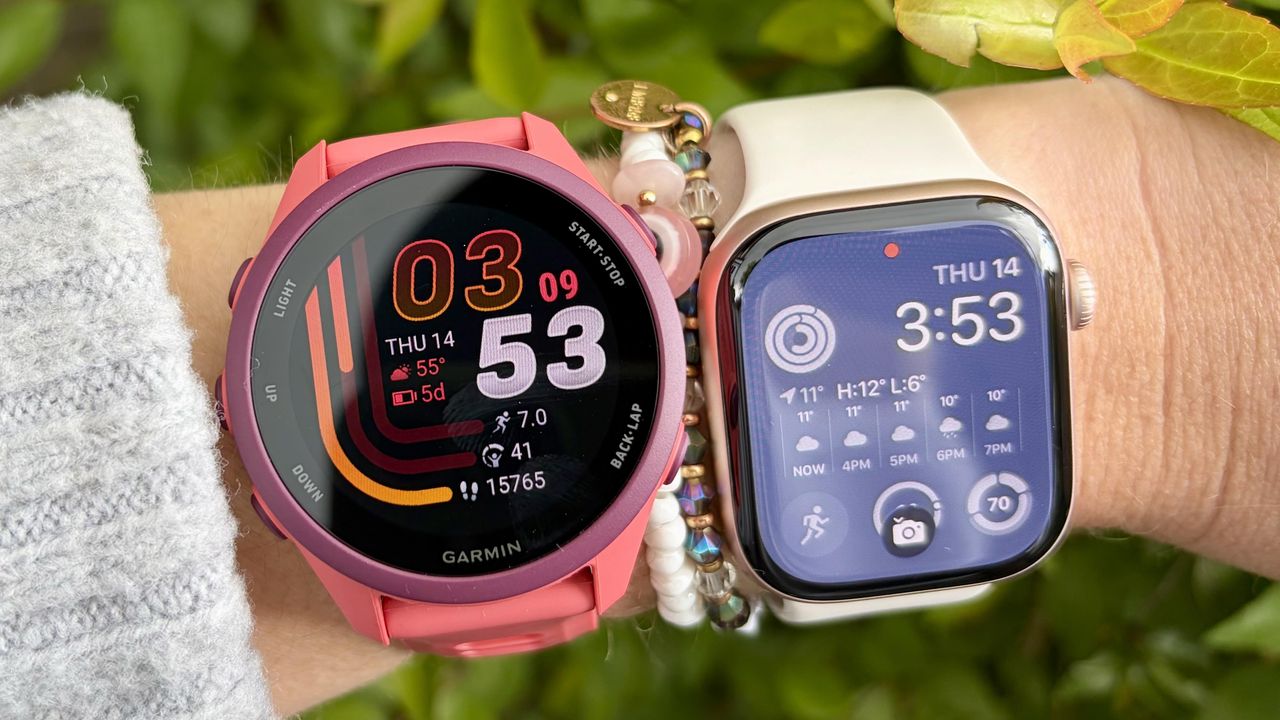
Garmin Forerunner 170 and Apple Watch 11 on the wrist.

If you see me walking down the street, and I start to cry, it’s probably because I’ve lost count of how many steps I’ve taken for another one of these Tom’s Guide walking challenges. Here at the fitness desk, we love nothing more than testing the newest tech on the market, but one simple way we gauge a new smartwatch's accuracy is to see how well it counts steps.

Of course, both the Apple Watch Series 11 and the new Garmin Forerunner 170, released on May 15, do an awful lot more than just count steps. However, the watches' step-counting abilities often indicate how accurately they calculate cadence.

The Apple Watch 11 is one of the best smartwatches on the market, and is an extension of your iPhone on your wrist. I’ve had the Series 11 on my wrist since it was released last September. The newest iteration of Apple’s most popular smartwatch has hypertension alerts and a sleep score to help you gain a deeper understanding of your overall health.

The Garmin Forerunner 170, on the other hand, has only been on my wrist for four days. It’s Garmin’s new entry-level running watch, and it’s packed with a lot of the features that have, until now, been reserved for the more expensive models.

But which was more accurate when it came to my 11,000-step count test? Read on to find out more.

I walked 11,000 steps with the Apple Watch 11 and Garmin Forerunner 170 — here’s which came out on top

If you’ve read one of these articles from the Tom’s Guide fitness desk, you’ll know that manually counting 11,000 steps is out of my remit, so I rely on a trusty $5 clicker tool from Amazon.

I manually click every time I take a step. For this test, I wore the Apple Watch 11 on my left wrist and the Garmin Forerunner 170 on my right. Both watches count your steps using an internal accelerometer, which measures the swing of your arm.

Each swing counts for two steps, and it doesn’t matter whether you wear your watch on your dominant or non-dominant hand. It doesn’t matter if you walk with your hands in your pockets or holding a cup of coffee; the accelerometer should still measure your body’s movement. It does, however, make a difference if you’re pushing a stroller — no, Apple, I promise I haven’t done a 45-minute elliptical workout while trying to get my toddler to sleep.

As with all of the best Apple Watches, the Apple Watch 11 doesn’t tell you the number of steps you’ve taken during a specific workout; instead, you see an overall number of steps throughout the day. Probably because steps aren’t actually that useful a metric, but annoying for me when writing these articles. For this comparison, I downloaded a third-party Pedometer+ app onto my Apple Watch 11.

I split this test into two walks, and when I got home, I downloaded all the data and compared the results:

Walk one

Manual recording:

6,689 steps

Apple Watch 11:

6,769 steps

Garmin Forerunner 170:

6,674 steps

Walk two

Manual recording:

4,424 steps

Apple Watch 11:

4,419 steps

Garmin Forerunner 170:

4,498 steps

Total

Manual recording:

11,113 steps

Apple Watch 11:

11,118 steps

Garmin Forerunner 170:

11,172 steps

I’ve done this test multiple times, most recently with the Apple Watch 11 and Garmin Forerunner 570, and I don’t think Apple has ever come out on top. Of course, this isn’t to say there is anything wrong with the Garmin Forerunner 170 — perhaps it was an unfair test to wear such a new watch that probably hadn’t quite figured out my stride yet, but for Apple to only be five steps out is astounding.

(Image credit: Future)

It’s also worth noting that for Garmin to overcount by 59 steps is practically nothing. The average person takes 2,000 steps in a mile, so missing 59 of them in the grand scheme of things won’t really make a difference.

To really compare these two watches, you’d have to do a lot more testing and look at more than just steps. Both watches recorded pretty much the same distance on both walks, as well as a similar average heart rate.

(Image credit: Future)

There are also a few key differences between the two watches, and I’d argue they are intended for different purposes. The Apple Watch 11 excels as a smartwatch — there are endless apps to download, and you can easily reply to messages and make phone calls from your wrist.

The Garmin Forerunner 170, on the other hand, is more limited from a smartwatch perspective, but has a huge number of excellent features, including Garmin Coach, Body Battery, Training Readiness, morning and evening reports and suggested workouts. Even with the new sleep score, Apple’s device doesn’t have as many tools to help you monitor how well your body is actually coping with training.

From a price point of view, the Apple Watch 11 costs $399/£369, whereas the Garmin Forerunner 170 comes in two varieties: one with onboard storage for music, priced at $349/£299, and one without, at $299/£259.

I’ll continue testing both watches, but if you’re thinking of buying either, you can rest assured that they do the basics exceptionally well.

More from Tom's Guide

Sign up to read this article
Read news from 100's of titles, curated specifically for you.
Already a member? Sign in here
Related Stories
Top stories on inkl right now
One subscription that gives you access to news from hundreds of sites
Already a member? Sign in here
Our Picks
Fourteen days free
Download the app
One app. One membership.
100+ trusted global sources.







