
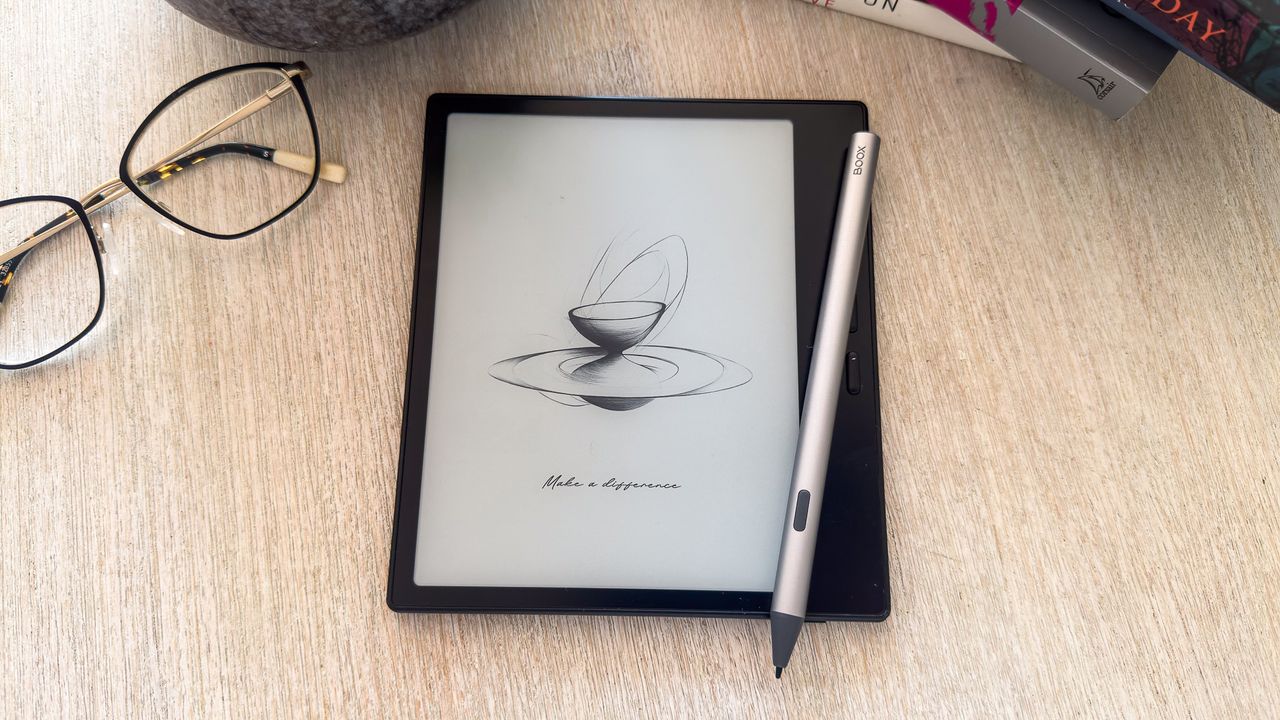
Onyx Boox Go 7: Two-minute review
I received the Boox Go 7 months ago for review, along with the Boox Go Color 7 (Gen II), and I’m glad I delayed my testing. A few firmware updates since I tested its color sibling have improved overall performance and I now have the new stylus for it.

That’s right: the Go 7 is more than just a basic ereader, offering stylus support and a native Notes app that’s full featured. You’ll need to purchase the stylus separately, though, but that’s not unprecedented – you’ll need to do the same for the Kobo Libra Colour as well, for example. While the new InkSense Plus is an improvement over the older Boox InkSense pen previously sold, writing on the Go 7 isn’t as nice as I’ve experienced on other ereaders – there’s just not enough friction.
That said, the 7-inch E Ink Carta 1300 display here is the standout feature and there’s nothing more important for an ereader than its screen. Right from the start, it made the Go 7 the better device compared to its sibling – something I said in my Boox Go Color 7 (Gen II) review and I still stand by that statement – putting it on par with the likes of the current-gen Amazon Kindle Paperwhite (2024). Text is sharp and crisp, while the overall reading experience is enhanced by very snappy performance. Page turns are quick, whether you want to tap to turn or use the buttons.
Speaking of which, access to the Google Play Store gives you a lot more flexibility on how you want to use the ereader – the native apps are great, but if you have personal preferences for specific reading or productivity app, they’re easy to install, with fast load times and smooth third-party functionality.
Another reason I love a Boox device is the impressive file and font support. You can sideload a wide variety of files and fonts, and you don’t even need a wired connection for that – Google Drive and Dropbox support help with cloud transfer that’s quick and easy. Transferring directly from a USB-C external hard drive or portable SSD is also remarkably simple and very fast and, in all honesty, I don’t see the need to tether this device to a PC at all for file transfer.
The Boox interface has also improved but, as I’ve said before in many of my previous reviews, there’s still too much going on and some setting options are still hidden within the native app and accessed from different submenus. Better streamlining is definitely called for, which would be a huge help to first-time Boox users.
Another reason I’m docking marks from the Go 7 is its lack of waterproofing. Given its price tag and that all its main competitors have IPX8 certification, it’s a huge oversight. If you’re careful with it while traveling or reading by the pool, in the bath or near the kitchen sink, this is arguably the best Boox device I’ve tried in a long time.

Onyx Boox Go 7 review: price & availability
- Released in April 2025 in most major markets
- List price: $295.99 / €249.99 / AU$419
- Available to buy directly from the Boox Shop and select retailers
It seems very strange to me that if you’re in the US and you shop directly from the online Boox Shop, the Go 7 costs more than the Go Color 7 (Gen II) – the latter is listed at $279.99, while the former is $295.99 at full price at the time of writing.
On the other hand, the pricing for Europe and Australia makes more sense: €249.99 and AU$419 respectively for the Go 7 compared to €279.99 and AU$459 for the color variant.
No matter where you live, the monochrome Go 7 is a relatively expensive ereader, although it can be argued that its price is justified by the open operating system and 64GB of onboard storage that’s expandable via a microSD card.
Moreover, its features include writing (although the InkSense Plus stylus will need to be purchased separately for $45.99 / €45.99 / AU$69) and built-in stereo speakers (sound isn’t great though). That said, not everyone will need the freedom that the Android operating system provides and the likes of the Kobo Libra Colour is cheaper at $229.99 / £209.99 / AU$379.95.
• Value score: 4 / 5

Onyx Boox Go 7 review: Specs
Display type: |
E Ink Carta 1300 |
Screen size: |
7 inches |
Resolution: |
300ppi (1680 x 1264) |
CPU: |
Qualcomm Snapdragon 690 |
Frontlight: |
Warm and cold |
Storage: |
64GB (expandable) |
Battery: |
2,300mAh |
Speaker: |
Stereo/dual |
Water protection: |
None |
Software: |
Android 13 |
Connectivity: |
Wi-Fi (2.4GHz + 5GHz); Bluetooth 5.1 |
File support: |
20 document; 4 image; 2 audio |
Dimensions: |
156 x 137 x 6.4 mm (6.1 x 5.4 x 0.25 inches) |
Weight: |
195g (6.9oz) |
Onyx Boox Go 7 review: design & display
- Crisp and clear 7-inch E Ink Carta 1300 display
- Slim, lightweight and compact body with page-turn buttons
- Features speakers and microSD card tray
The Go Color 7 II and the Go 7 are siblings, meaning they’re identical physically – the only difference being the screen technology they use. In fact, the design has been inherited from the original Go Color 7 and that’s not a bad thing at all.

The Go 7 is slim, lightweight and compact enough to take with you anywhere. And the page-turn buttons are well placed to be just where your thumb would sit when holding the tablet in one hand. Personally, though, I would still prefer the old Kindle Oasis asymmetry (still used in the Kobo Libra Colour) that had a little extra thickness along the larger bezel to make it more ergonomic. The thinness of the Go 7 can make the fingers hurt if you're someone who reads for long hours. Having a case to add some overall thickness helps with this little issue.
I love how the page-turn buttons feel and work – there’s a nice little feedback that makes them satisfying to use. They become volume-adjustment buttons if you’re using an app that doesn’t need scrolling or page turning, which is nice since you can listen to audio files here.

As with the color variants (Gen I and II), the rear is textured, and there’s a small power button on the bottom right corner of the tablet. One slim edge is just thick enough to house a USB-C port for charging, as well as a microSD card tray and speaker grilles. A tiny mic is on the opposite edge.
Boox continues to steer clear of waterproofing for its ereaders, sadly, with the Go 7 also missing out. In my opinion, it’s an unforgivable oversight given its price tag.

The star of the show, however, is the Go 7’s display. As its name suggests, it’s a 7-inch screen using E Ink’s Carta 1300 technology. This display has proved itself time and time again on other ereaders and does so again here where it’s been optimized well.
Text and images are displayed marvelously well and the anti-glare coating on top ensures bright overhead lights don’t distract when you’re reading. The LEDs for the screen are fantastic, far better than the screen light on the Go Color 7 II. The light is brighter and not nearly as yellow as on the color version of this ereader. In fact, I’m amazed at how different the two screens are – the Go 7 is practically perfect while the Go 7 II is fuzzy and too warm.
• Design & display score: 4.5 / 5
Onyx Boox Go 7 review: software & apps
- Runs a slim version of Android 13 with excellent native apps
- Full access to the Google Play Store offers a lot of freedom
- Clean user interface, but some settings are hidden in submenus
An ereader running Android is an excellent choice for anyone who doesn’t want to get locked into either the Kindle or Kobo ecosystems. The freedom to use third-party apps or source content from any platform, can make a huge difference to the user experience.
That said, the native apps have plenty to offer and the average user may not even need to download anything else from the Play Store. The library app called NeoReader, for example, offers plenty of customization options that you don’t need to use MoonReader or KoReader… unless that’s really what you prefer. The same goes for the native Notes application too. There’s also a browser and music player, among other things.
Some of the third-party apps I’ve used on this Boox device are Kindle, Kobo and Evernote, but I’ve used Libby on a different Boox ereader.


The Boox interface has evolved into a much cleaner version of the convoluted UI from years past, but there’s still room for improvement. For example, it’s not at all obvious that there’s some library settings in NeoReader hidden on the top menu bar under More – it’s very easily missed unless you have the patience to explore every single menu option on the device.
The Notes app is also not available on the home screen navigation by default; you need to head into the device’s System Settings to find it and apply it to be visible if you plan to use it often. For me, given the Boox Go 7 has stylus support, the expectation is that the Notes app would be available by default on the home screen.

I saw a major change in how the ebook styling menu in the library app was set up in 2025 and that’s been carried over, which is a good thing. However, the complications still exist: tap in the middle of the screen when an ebook is open to bring up the menu, choose Style and the setup is much cleaner than before, but you need to tap on More Settings to adjust fonts, spacing and margins. These are much easier to access on a Kindle or Kobo.
Long story short: I can see the Boox UI is improving, but there’s really just too much going on still and the average user doesn’t need so many customization options. I don’t think even a power user like me needs so many options on an ereader. Less is more, Boox.
• Software & apps score: 3.5 / 5

Onyx Boox Go 7 review: user experience
- Arguably one of the best reading experiences on an electronic device
- Full featured, but takes some learning to get it set up for individual needs
- Not a great writing experience
Most of us read text-heavy books, so opting for a monochrome ereader makes economical sense as there’s really no point in opting for a color screen if you aren’t going to be viewing anything more than a book cover in color. But the Go 7 makes a much stronger case of being the better ereader compared to the Go Color 7 (Gen II) by offering a much nicer reading experience.
As I’ve already alluded to in this review, the screen on the Go 7 is a standout. Text is sharp and there’s good contrast too, making it one of the best Boox ereader I’ve used. This is further enhanced by the fact that page turns are quick, whether via a tap on the screen or the buttons. That said, individual books take a little longer than the Amazon Kindle Paperwhite (2024) to open, but all other library functionality is snappy. Boox really has done an excellent job of optimizing the E Ink Carta 1300 display for this device.


Text selection for highlighting or annotating is also quick, and it’s very precise if you use the InkSense Plus stylus. However, the Boox Go 7 doesn’t support global handwriting, which means you won’t be able to annotate or markup books using NeoReader – and that's despite a feature called FreeMark (which allows you to write on the screen when any app is open but not annotate). The native Calendar (for memos) and Notes apps are the only places where there's default stylus support.
This might seem restrictive, and for a power user like me, that definitely is, but the average user looking for a capable ereader won’t necessarily need all the bells and whistles of a more advanced epaper tablet like the Boox Note Air series.


If you did want to use the Notes app, though, be warned – the writing experience isn’t great. The InkSense Plus glides over the screen with barely any friction and it can be a little disconcerting at first, but you do get used to it. That said, there’s absolutely no lag and stylus input is instantaneous. I’ve used it to write and draw crude designs on the Notes app and didn’t mind it, but I would much prefer to use the Boox Go 7 as an ereader rather than a note-taker.
• User experience score: 4 / 5
Onyx Boox Go 7 review: performance
- Fast and snappy performance
- Occasional ghosting only when reading image-heavy books
- Battery drain is higher compared to the competition
The Go 7 uses a Qualcomm Snapdragon 690 chipset paired with 4GB of RAM – the same combo powering the color variant – and performance is generally very good for an E Ink device.
While the NeoReader app isn't the fastest book loader, that's not a fault of the device but he application. However, using third-party apps is smooth, with quick loads and all other functionality within them working well. Where I’ve previously encountered third-party app crashes on older Boox tablets, I had no such issues here.
As with the Go Color 7 II, I found wired file transfer via OTG to be remarkably quick and, for the first time while testing a Boox tablet, I didn’t even bother using Google Drive or BooxDrop to access my ebooks. I only signed into my Google account to access the Play Store.
Thanks to the Carta 1300 screen, the Go 7 doesn’t suffer as much from ghosting as the color version. In fact, I had no ghosting while reading text-only books, but there was the occasional overlay when reading graphic novels, which is common when reading image-heavy titles on epaper displays.

Battery life, however, is disappointing. The expectation from an ereader boasting a 2,300mAh capacity pack would last a few weeks, but in real-world use Android devices like the Go 7 don’t offer as much use on a single charge like a Kindle or Kobo.
If you have Wi-Fi switched on at all times, you’ll get about a week of use when reading about two hours a day and the screen brightness set at medium levels. You’ll eke out more with Wi-Fi (and Bluetooth) turned off and the light dim.
Start doing more than just read and you will see the battery drain even faster. The browser and music player are power hungry, and the more you jot notes, the quicker the Go 7 will run out of juice. Battery drain even in sleep mode is quite significant – something I’ve seen in nearly every Boox I’ve tested to date.
While there’s no quick charging here, you don’t need to wait too long for the battery to top up. On average, the Go 7 took about two hours to go from 9% or 10% to full over the several months I used it when plugged into a USB-C port of a 65W wall charger. It will be slower if you use a dock connected to your PC or a USB-A to C cable, but this is quite standard for most ereaders.
• Performance score: 4 / 5
Should I buy the Onyx Boox Go 7?
Attribute |
Notes |
Score |
|---|---|---|
Value |
It's a relatively expensive device, but its open Android ecosystem could justify its price for many users. |
4 / 5 |
Design & display |
Lightweight and compact, this is a fantastic spiritual successor to Amazon's Kindle Oasis, with an equally fabulous screen to read on. |
4.5 / 5 |
Software & apps |
While Android offers a lot of flexibility on a device like this, Boox's interface requires a steep learning curve to master. |
3.5 / 5 |
User experience |
If you're use it solely for reading and the occasional productivity feature, it's fantastic. There are, however, restrictions on where stylus use is supported. |
4 / 5 |
Performance |
There's barely anything to complain about when it comes to performance, although keep an eye on the battery drain. |
4 / 5 |
Overall |
Boox makes good ereaders, but the Go 7 is arguably my favorite. |
4 / 5 |
Buy it if...
Don't buy it if...
Onyx Boox Go 7 review: Alternatives
If you're not sure whether the Boox Go 7 is worth picking up, I've listed a few alternatives below, with the Kobo Libra Colour, despite its color screen, being its closest rival from a design perspective. There are other standard ereaders as well and I've listed their specs in the table below to help you compare them all.
Onyx Boox Go 7 |
Kobo Libra Colour |
Kobo Clara BW |
Amazon Kindle Paperwhite (2024) |
|
|---|---|---|---|---|
Price |
$295.99 / €249.99 (about £217) / AU$419 |
$229.99 / £209.99 / AU$379.95 |
$139.99 / £129.99 / AU$249.95 |
from $159.99 / £134.99 / AU$299 |
Screen |
7-inch E Ink Carta 1300 |
7-inch E Ink Kaleido 3 |
6-inch E Ink Carta 1300 |
7-inch E Ink Carta 1300 |
Resolution |
300ppi in B&W |
300ppi in B&W; 150ppi in color |
300ppi in B&W |
300ppi in B&W |
Operating system |
Android 13 |
Linux-based |
Linux-based |
Linux-based |
Storage |
64GB (expandable) |
32GB |
16GB |
16GB |
CPU |
Qualcomm Snapdragon 690 |
Undisclosed 2GHz dual-core chipset |
Undisclosed 1GHz dual-core chipset |
Battery |
2,300mAh |
2,050mAh |
1,500mAh |
Undisclosed |
Connectivity |
Wi-Fi, Bluetooth, USB-C |
Wi-Fi, Bluetooth (in select regions), USB-C |
Waterproofing |
None |
IPX8 |
IPX8 |
IPX8 |
File support (including images and audio) |
25 |
16 |
16 |
17 |
Speakers |
Yes |
No |
No |
No |
Dimensions |
156 x 137 x 6.4 mm |
161 x 144.6 x 8.3 mm |
112 x 160 x 9.2 mm |
176.7 x 127.6 x 7.8 mm |
Weight |
195g |
199.5g |
174g |
211g |
How I tested the Onyx Boox Go 7

I might have had the Boox Go 7 for months, but I've used it on and off for maybe just two of those before writing this review. That's because I got distracted by other Boox devices...
I digress, though. For this review, I tried various ways to upload files, including signing into Google Drive. I moved one font folder over, but used the OTG support to import the ebooks I wanted on the device for my testing. I used the same method to transfer a couple of music files to test the built-in speaker as well.
I was sent the new InkSense Plus stylus towards the end of December and I was pleasantly surprised to see that setup was remarkably simple as long as the pen was charged.
From the Play Store, I downloaded the Kindle and Kobo apps to access my existing libraries and to test how third-party apps function. I also used Evernote and Libby on this device, plus downloaded CPU X to confirm what hardware was powering this device.
I used the stylus to both write and draw, but spent most of my testing hours reading. I did use the browser briefly.
I've been testing ereaders for nearly a decade now for TechRadar and built up a strong knowledge base to help me able to objectively compare different models from different brands – and the Go 7 definitely stands out.
Read more about how we test
[First published January 2026]