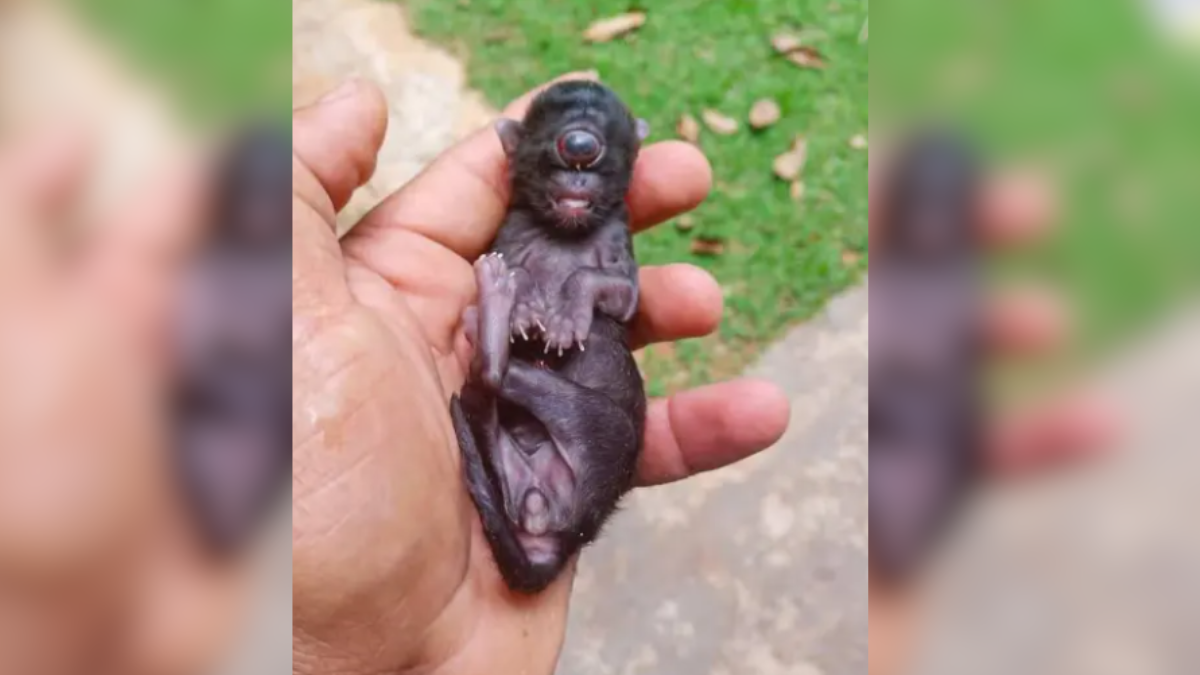
One of the most powerful things about life is that you can experience something once thought impossible. A farmer in Brazil recently did just that when his cat delivered a one-eyed black kitten.
The kitten — now dubbed “the cyclops cat” — has taken over local conversations in Brazil and beyond. The video of the feline, with one large eye in the center of its head, has gone viral across the globe. Usually, when a cat goes viral online, it’s for something expected — like tripping its owner and nearly causing chaos, or showing off surprising emotional intelligence. But this time, the conversation has shifted to the very essence of what a cat can look like.

According to the New York Post, Gilberto Almeida, a 32-year-old farmer, owns the cat that gave birth to the kitten. Having worked on his farm his entire adult life, Almeida thought he’d seen it all. He told local media that this particular cat had delivered many litters before — but nothing could have prepared him for this.
At first, many people online assumed the video was just another AI-generated image. These days, there are few things AI can’t fabricate. Every time you log into social media, there’s a chance you’ll stumble on an elaborate AI-generated animal video, showing creatures doing impossible things with humans. So, it’s understandable that some users dismissed the “cyclops cat” as another example of artificial intelligence at work. Yet, once it was confirmed to be real, some people admitted they felt oddly relieved — a rare moment of reality cutting through the digital fog.
The congenital disorder, known medically as cyclopia, is named after the one-eyed monster from Greek mythology — the same creature expected to appear in full glory in Christopher Nolan’s upcoming film starring Zendaya, Odyssey. Veterinary doctor Janete Silva explained how the condition develops: “When the embryo is forming, instead of the brain structure dividing into two parts, a single mass forms. Because the eyes follow this division, the result is a single eye positioned in the center.”
While even rarer in humans, cyclopia can occur among us too — roughly one in every 100,000 births is affected. The condition is often linked to exposure to certain medications during pregnancy or chromosomal abnormalities that can’t be prevented using known medicine and technology.
Sadly, the cyclops cat died shortly after birth. Animals born with the condition typically struggle to breathe once separated from their mothers and often pass away soon after. In some cases, they are even stillborn. This, however, was not the first known case of a cyclops cat. In 2006, NBC reported a similar story about a white kitten born in New York with the same condition — though that one didn’t have a nose at all. It survived for only a single day, but its owners were so captivated by the rare creature that they chose to have it embalmed at a local funeral home.
Though the cyclops cat’s time on Earth was brief, its story remains a reminder of how extraordinary and unpredictable life can be.