I started out in film and I have a big collection of analog negatives and transparencies, particularly 35mm black-and-white negatives. There are still some good shots in there but digitizing them to a decent quality has proved time-consuming and expensive.
I’ve tried flatbed scanners with transparency adaptors, but A4 scanners aren’t able to resolve the extremely fine detail in 35mm originals – even scanners designed specifically for photographers.
So what about film scanners, which are designed specifically for 35mm negatives? These are expensive and getting harder to find. Nikon no longer makes CoolScan film scanners, my Minolta DiMage Scan Elite 5400 II bit the dust long ago, and both were slow to use. Even the best film scanners can be hard work.
That’s the technical approach. But my new approach owes more to the kitchen table than the physics lab.
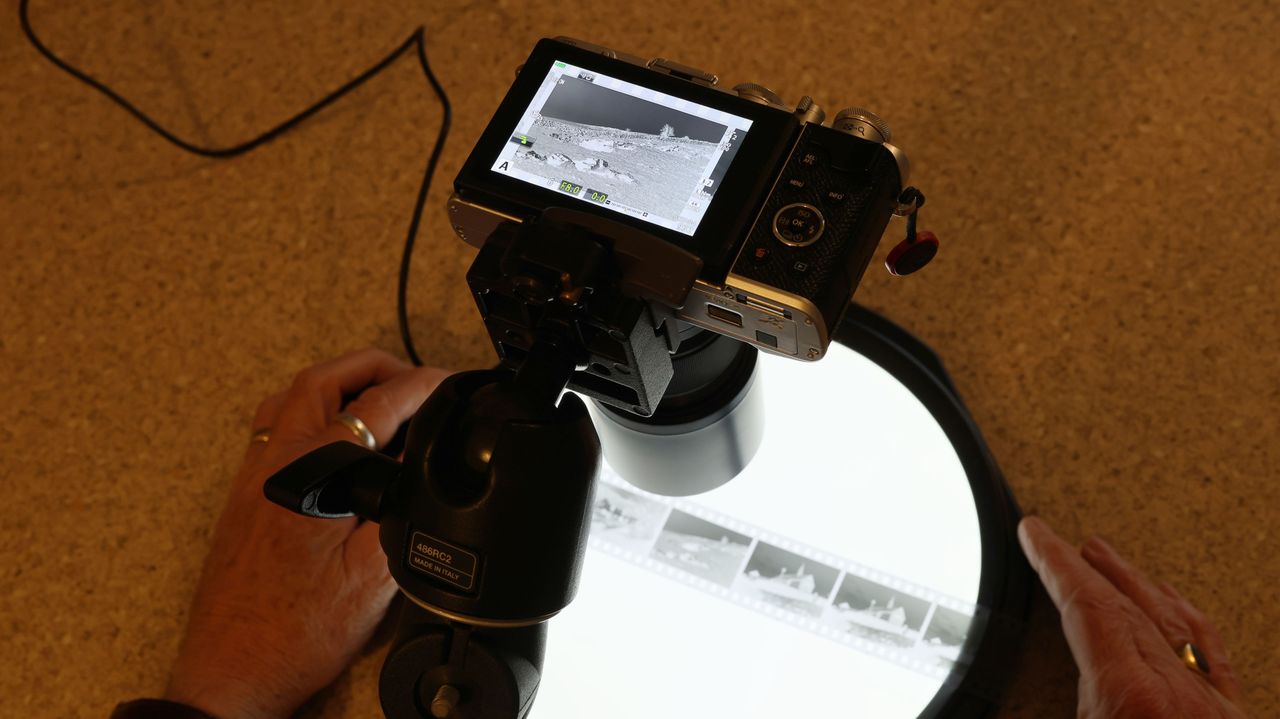
A photographer friend convinced me to try it out. He uses a copy stand, a lightbox and a camera with a macro lens. I don’t have a lightbox, so I use a Joby light with a diffuse front panel as a lightbox on my kitchen table, a tripod, my Olympus PEN E-P7 and an Olympus M.Zuiko 60mm Macro lens with a hood to keep any flare from the lamp to a minimum.
Honestly, the whole thing has proved so quick and simple that it's made me start looking again at the best film cameras, since I do think analog film has a special character that is very difficult to match with a digital camera.
The trick is to position the camera very carefully so that it’s exactly perpendicular to the film, and then to move the film and not the camera as you go from one negative to the next.
So does the 20MP Micro Four Thirds sensor of my E-P7 have the resolution and dynamic range to do justice to my 35mm negatives? Easily! Here’s why.


First, analog film does not have the resolution of digital sensors. The E-P7’s sensor can easily resolve even the finest grain in my negatives.
Second, analog negatives do not have the kind of extreme tonal range you might imagine. Film can capture an extremely wide brightness range, but it compresses it into a narrower range in the negs. As a result, my E-P7 can easily accommodate the tonal range of my negs, and I typically have to ‘expand’ it editing to restore full black-and-white values.
With this setup I can ‘scan’ a whole 36-exposure film in around 10-15 minutes, extract every ounce of image quality from my negatives and I don’t even get the dust issues that used to plague my film scans.
So, this is the weirdest thing – it’s taken a modern mirrorless camera to bring back my old analog negatives into my digital workflow. I’ve even bought film for the first time in 20 years!
You might also like…
Interested in analog photography? Take a look at the best film cameras and the best film for 35mm cameras.