
Get all your news in one place.
100’s of premium titles.
One app.
Start reading
TechRadar
TechRadar
Dan Mold

I’ve been happily using the Canon EOS R5 for four years – here’s why I’m skipping the Mark II

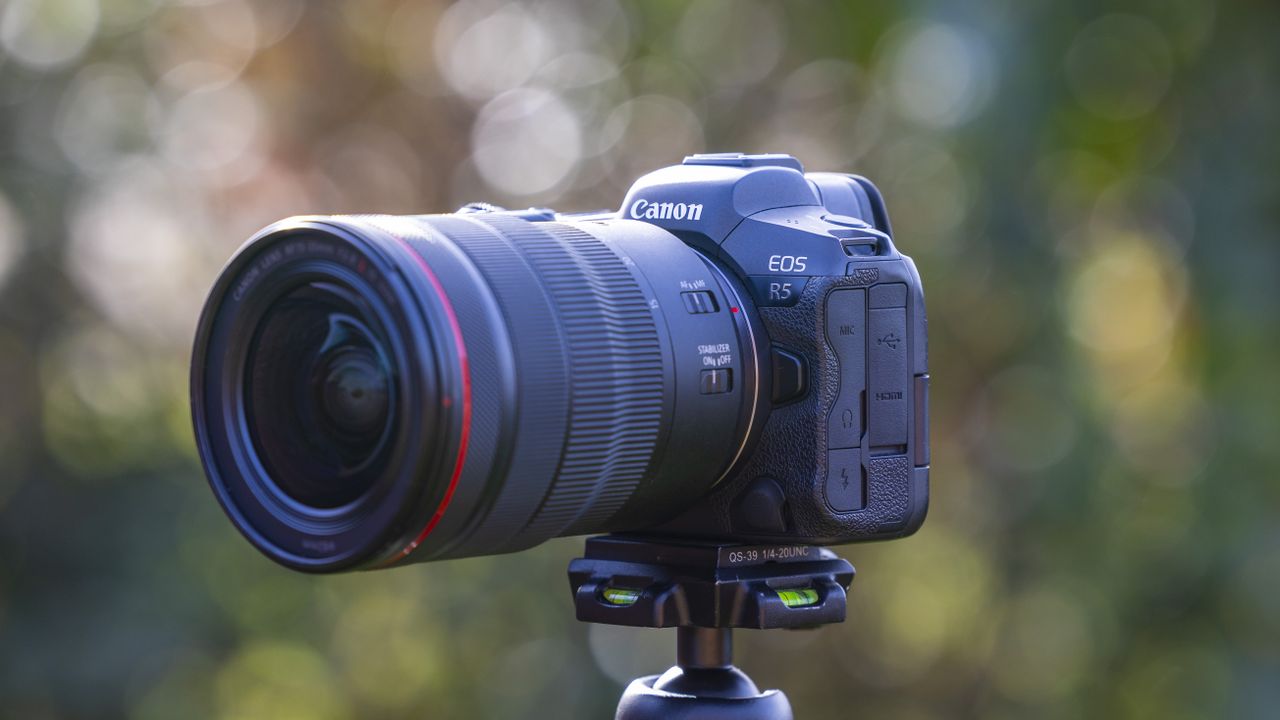
Canon EOS R5.

The Canon EOS R5 was so future proof when it launched all the way back in July 2020, that even now it's considered one of the best full-frame mirrorless cameras money can buy. And it remains my workhorse body when I need professional results whether I’m shooting weddings, commercial property or product photography.

My only change during my ownership of the EOS R5 has been to add a battery grip to make it better to hold when shooting in portrait mode. I’ve also added a Canon EOS R6 Mark II to my kit bag, too — it has a lower resolution 24.2MP sensor which compliments the hi-res 45MP EOS R5 rather nicely, and is the better option when I’m shooting in low light.

I was lucky enough to attend the launch event of the Canon EOS R5 Mark II as well as the Canon EOS R1 in 2024, and I was blown away by some of the tech shown off. Truth is, however, when the excitement of playing with a brand-new shiny toy wore off, I found few compelling reasons to upgrade.

Putting the cost of forking out for a new camera to one side, I've compiled my reasons for sticking with the perfectly good original EOS R5. Do you agree, or do you prefer the latest and greatest features? Have a read, and let me know what you love about Canon’s EOS R5 and EOS R5 Mark II in the comments, and what you’d like to see from Canon for the EOS R5 Mark III.

(Image credit: Canon)

Bigger isn't always better

To house all of the new tech found in the new EOS R5 Mark II, Canon had to make the body larger, seen in the additional space behind the LCD screen which houses the air vents for better passive cooling.

There’s also a larger viewfinder which features a sensor for eye tracking AF so you can move the AF point with your eyeball – very cool technology, but I’ve found its results to be quite hit and miss and tended to opt for other autofocus methods.

Bigger isn’t always better - I much prefer the smaller EOS R5 body to attract a little less attention when shooting street photography, and as a travel photographer every bit of space saved in my kit bag is a win.

I appreciate that the size probably isn’t going to go down when a successor to the EOS R5 Mark II does eventually come out – most likely around the 2028 Summer Olympics in LA – but that’s a bullet I reckon I'll have to bite when the time comes. I’ll continue to enjoy using the slightly smaller EOS R5 body until then.

The EOS R5 Mark II is the bigger brother of the original EOS R5 – literally! It sports cooling fans behind its LCD screen and a larger EVF to house the eye tracking AF sensors making it a little taller and deeper than its predecessor. As a travel photographer – every bit of space saved in my kit bag counts. (Image credit: Canon)

The OG is sporty enough for me!

The EOS R5 Mark II was launched in tandem with the EOS R1 ahead of the 2024 Olympics, and while some of its more athletic features will be a hit with pro sports photographers, I’d bet that most of us regular folk don’t need a camera quite as kitted out as this one.

One area where the Canon EOS R5 Mark II does see a big leap forward is for autofocus when shooting sports such as soccer, basketball and volleyball. It has an Action Priority mode powered by its secondary processor called a Digic Accelerator. This is also the same powerful mode found in the $6,799 / £6,999 Canon EOS R1 flagship. The R5 Mark II also has register face priority, allowing you tell the camera which star players on the field to prioritise when acquiring focus.

Now don’t get me wrong, these are impressive features. But as I don’t personally shoot a lot of sporting events regularly, it’s not reason of its own to merit an upgrade.

I do however shoot a lot of weddings, which is an area where the register face priority function could be very handy for registering the bride, groom and key family members to prioritize them. However, it’s not a deal-breaker for me at the moment – plus the EOS R6 Mark III has this feature so I may still benefit from it when I eventually upgrade my EOS R6 Mark II.

Resolution king

I will admit the one area that I can see the EOS R5 Mark II being particularly desirable for stills photos is its new sensor. While they both have a healthy 45MP resolution – the Mark II’s stacked sensor is new, and works with a second processor called the Digic Accelerator to boost readout speeds to reduce rolling shutter defects. It’s also backlit, placing the wiring behind the sensor, which gives it a boost for low light performance.

Even still, Canon’s EOS R5 is a formidable high resolution beast when it comes to stills. Its 45MP resolution serves pretty much all of my needs when supplying my clients with high quality images. The mechanical shutter of the EOS R5 is also rated to half a million shots, so mine has plenty of life left in it yet!

When it comes to video the EOS R5 can shoot up to 8K/30p or 4K/120p, and although it’s limited to a 30 minute record time and doesn’t have the better cooling design of the Mark II, it’s still overkill for what I need from a video camera. If you need the 8K/60p, 10-bit recording, 4:2:2, longer recording times, active cooling and Canon Log 2, the R5 Mark II will be a fantastic improvement.

Canon's original EOS R5 can shoot 4K video at buttery smooth 120fps and RAW still images at up to 45MP so I never feel like I need more resolution, though I will concede that accessing the video modes is easier on the Mark II which has a dedicated Video/Still switch on the top plate. (Image credit: Dan Mold)

Sign up to read this article
Read news from 100’s of titles, curated specifically for you.
Already a member? Sign in here
Related Stories
Top stories on inkl right now
One subscription that gives you access to news from hundreds of sites
Already a member? Sign in here
Our Picks
Fourteen days free
Download the app
One app. One membership.
100+ trusted global sources.