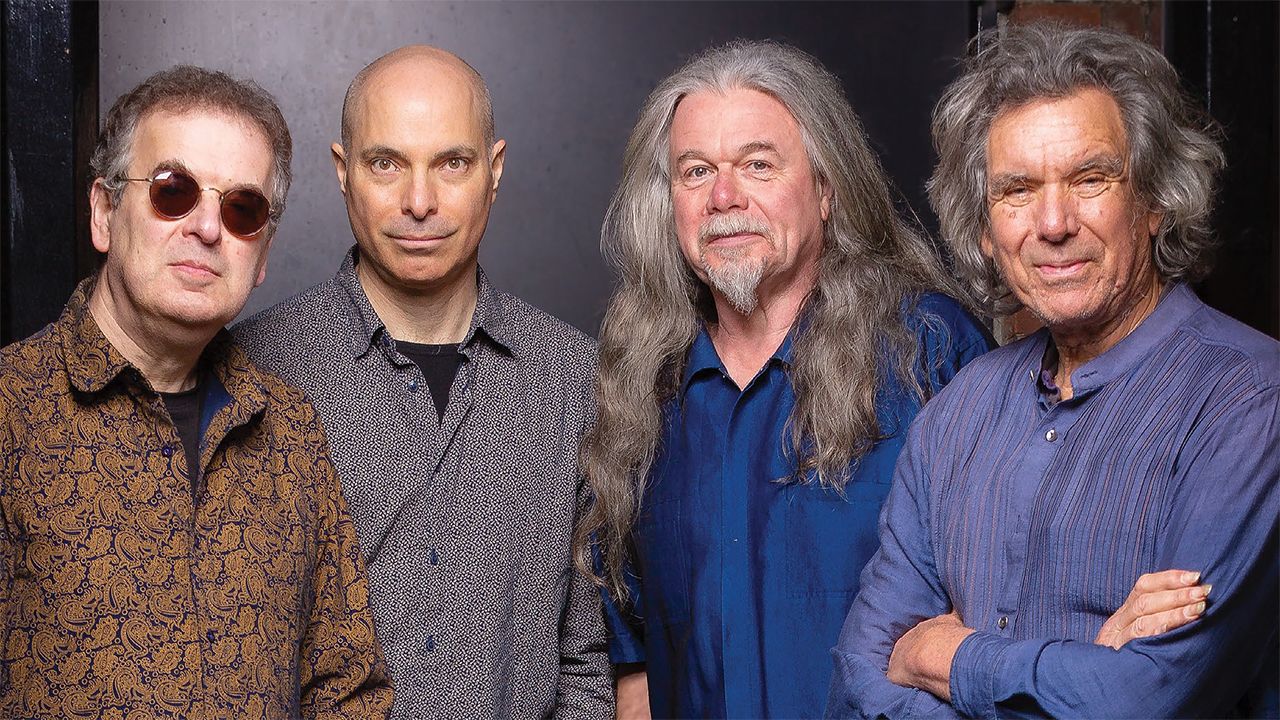
Soft Machine’s 13th album is packed with impressive songwriting and even a few firsts, it’s arguably one of the ever-evolving collective’s luckiest releases. Woodwind and keys player Theo Travis tells Prog about its creation and the posthumous appearance from one of the band’s co-founders.
What is it that burrows deep within the British psyche to male it near impossible for a person – especially a musician – to accept a compliment? Evidence of this characteristic is on display when Prog catches up with Soft Machine’s Theo Travis to talk about the making of the band’s latest release, Thirteen.

When it’s put to him that the new album is their best since he began his tenure with 2007’s Steam, the pause is eventually broken by a reticent sigh as Travis haltingly admits, “I… agree!”
With the dam of British inhibition now split open in what amounts to a confessional flood, he continues, “I would boldly say this is the best Soft Machine album in a long time. I would say you could hold it up to some of the great earlier ones, like Fifth, Six and Seven.”
This unfailingly polite and modest player – whose credits include Steven Wilson, David Sylvian, David Gilmour, Robert Fripp, Bill Nelson and others – is not given to bouts of egotism. But Thirteen, the first release with the new configuration of veteran Soft Machine guitarist John Etheridge, bassist Fred T Baker, and Asaf Sirkis (who took up the sticks following the passing of drummer John Marshall in 2023) is a rejuvenated force.
In addition to being a world-class drummer, Sirkis is an experienced and nuanced composer bringing three pieces to the record, including the ascendant opener Lemon Poem Song and the doleful Waltz For Robert. Baker’s formidable compositional debut Turmoil brilliantly scales twisting, dramatic heights, probing the unsettling sonorities encountered in vintage pieces such as Facelift, and featuring a corkscrewing solo from Etheridge, who brings two exquisite pieces to the record.
However, it’s Travis who is responsible for the bulk of the compositions, including Open Road, which clears the way with thunderous drums, bulldozing fuzz bass, and foreboding Mellotron underpinning a soaring sax and guitar theme.
“I listen to a lot of rock music,” Travis says. “I was experimenting on the piano and came up with the long chord sequence with the arpeggios; that’s the rock thing coming through.”
The Mellotron is a first on a Soft Machine album. “Well, I love it,” says Travis, almost apologetically. “I’ve got the same Mellotron app on my iPad that King Crimson used in concert – but I was keen not to use any digital simulations and instead we had real instruments running through the album.
“Real organic sounds: real organ, real Fender Rhodes, real piano. I was able to use Steven Wilson’s Mellotron in exchange for me guesting at his 2025 London Palladium show!”

He continues: “I think we touched base with a lot of the classic Soft Machine sounds, but in a contemporary way. We brought back the very textural elements including free improvisation, a lot of melody and a lot of structure – much like the long compositions on Third.”
Given Travis’s prolific writing for the album and his sole credit as producer for the album, does he see himself as stepping into the role of head Machinist in much the same way as Karl Jenkins did? “Oh, not at all! John definitely leads the band. He loves playing live, whereas I think I love making records more than John does.
“I just got enthusiastic – rather than waiting for everyone to do a bit, I was motivated to do more. I spent months doing the demos for Open Road and The Longest Night, maybe a year-plus listening, re-evaluating and rewriting.
“It’s not because I see myself as the leader; it’s because I really wanted to make this album something special. It’s still very much a democracy; everyone has to approve of the material and everyone has to like where things are going.
That Thirteen ends with Daevid’s Special Cuppa is no accident. Built around a previously unused sample of the late Daevid Allen’s distinctive glissando guitar, it offers a poignant conclusion while honouring the artist without whom Soft Machine may never have existed.
“Daevid was a very playful man who always had a mischievous twinkle in his eye,” Travis recalls, having worked with the Australian musician in various stints as a member of Gong between 1999 and 2010. “I love the sound of glissando and I wanted to do something with it, so the track was built from that up. I had this connection with Daevid – bringing him into a Soft Machine album in 2025 feels like coming full circle.”
As for calling the album Thirteen, Travis isn’t bothered by associations with bad luck. “I did some research as to the meanings of the number 13; not only is it not unlucky in all cultures, but some actually consider it positive. It can also be a number of renewals, rebirths and growth.”
There was a feeling you had to earn the right to have a numbered title
Then there were these various coincidences that were entirely unanticipated: “There are 13 tracks, and the longest is 13 minutes. Also, Daevid was born on the 13th of the month and died on the 13th of the month. So it felt like it fitted, and we were happy with that.”
While the ‘number-as-title’ concept is clearly a conscious nod to the past, its use is also, in some ways, a statement of validation and confidence in the future. “There was a feeling you had to earn the right to have a numbered title, because of that significance in Soft Machine history,” Travis says. “It’s like you have to earn your stripes to deserve being put in that continuum.”
This incarnation of the band clearly enjoys recording and playing live together. That hasn’t always been the case. It’s a matter of recorded fact, not often publicly acknowledged, that happiness in earlier incarnations was in short supply.
Aside from resentments, petty and otherwise, there was an almost toxic diffidence preventing members from congratulating one another on their respective performances or ideas. Life in the Machine could often be a pretty miserable experience.
“Because we’ve played a lot together live and we are comfortable doing that, we have this energy together,” Travis says. “I think on Thirteen we’ve not only captured that – we’ve also caught the band’s precision and fire as well.”
Thirteen is on sale now.