
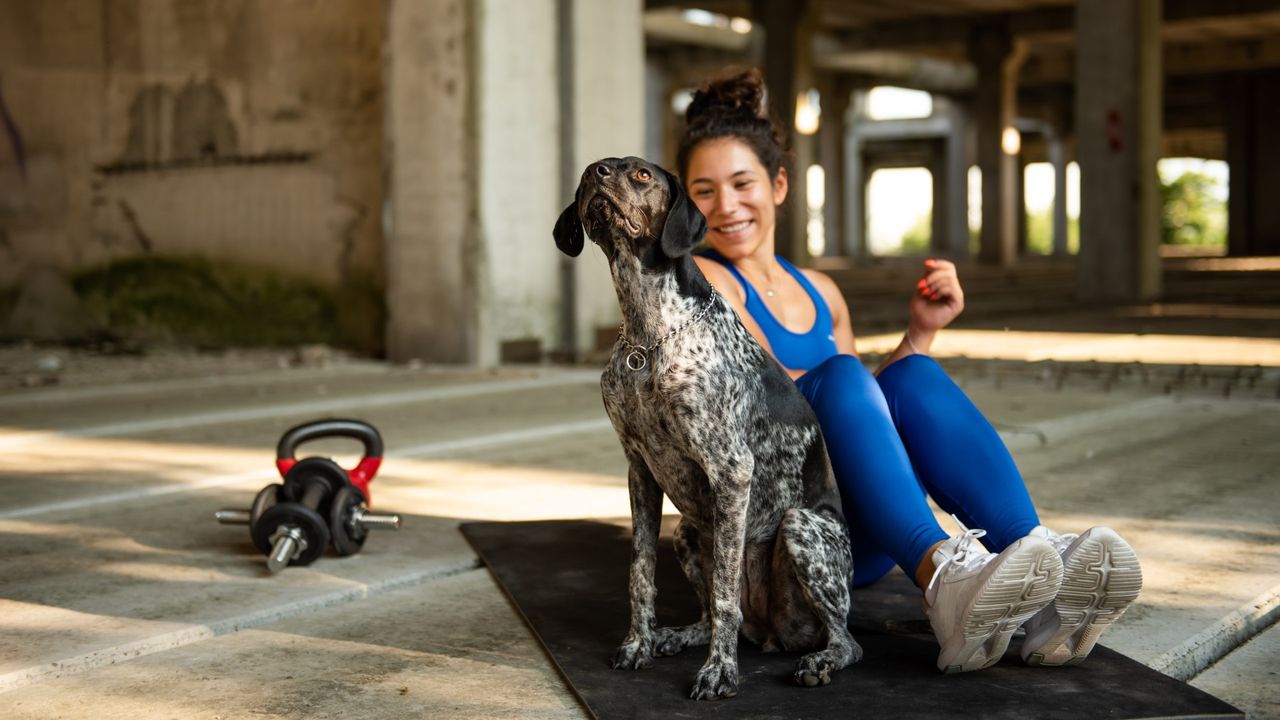
Recently, I had a random thought: what if I swapped dumbbells for my dog during workouts? So, ever curious to try new things with my training, I gave it a try.
I didn't think Mobie (that's my dog) would appreciate anything high-intensity, but a three-move mobility routine felt like a great place to start, as mobility combines strength and control (with or without load) to improve balance, stability, and range of motion in the body.

Mobie weighs 5kg (roughly 11lbs), so I knew I'd be able to perform some of the best mobility exercises I know using her safely. I like to perform mobility routines at least twice per week, as this helps me not only build but maintain results, so I repeated this several times, keeping the sets and reps consistent each time.
If you're keen to find out what happened, I documented it below and show you how to try it for yourself.
If you experience pain at any time, stop and rest. If you're working with an injury or health condition, or you're currently pregnant or postnatal, I recommend seeking advice before starting these exercises.
Watch: 3-move mobility routine
A post shared by Tom's Guide Fitness (@tomsguidefitness)
A photo posted by on
The goal with any mobility routine is to protect the body against injury and the natural decline in strength, balance, and stability that comes with aging. Call it a longevity routine, if you will.
This is also important for maintaining healthy fascia, a web of connective tissue that helps hold everything together, like your bones, muscles, and organs. Tight fascia increases friction, and mobility work helps reduce this using movement.
The routine: You'll need one of the best yoga mats and time to complete 3-4 sets and 8-10 reps.
- Wide-leg lifts: Sit upright with your legs wide apart until you feel a stretch down the inner thighs. Sit tall with your spine long and core braced, shoulders relaxed. Place something (or someone!) inside of your right foot at a challenging height setting. With control, lift your foot up and over to the other side, then back again. Complete reps on one side, then swap to the other leg.
- Cossack squats: Stand with your feet hip-width apart, core engaged, and hold a weight to your chest. Take a big step to the right side with your right leg, toes pointed forward, and bend the knee to lower into a lunge. Keep your back straight and chest lifted, lowering as far as you can. Pause, then drive up through your legs and step to standing. Repeat on the other side.
- Windshield wiper hip extensions: Sit with your legs bent at 90 degrees, similar to a 90-90 stretch position , and hold a weight to your chest. Keep your spine long and core engaged. Sweep your knees over to the opposite side, then lift your hips and butt into the air and squeeze your glutes. Pause, then carefully lower to the ground and sweep your knees in the opposite direction. Continue alternating.
What are the benefits?
Each of these exercises is beneficial for lower-body mobility, core stability and healthy hips.
Wide-leg lifts: This is an effective hip flexor strengthener, as you must lift and lower your leg with control. You don't need to place anything there to begin with, but using a dumbbell, yoga block, or similar as a target is useful to ensure you lift far enough each time and creates a challenge as you progress.
Cossack squats: These are killer for the legs, glutes, hips, core and even the upper body, as you sit your butt low while lifting your chest, balancing and stretching the inner thighs. Your entire lower body will feel this one, and not only does it increase mobility, but also strength and power in the legs, especially when loading the move.
Windshield hip extensions: Building space and strength around your hips is crucial for proper movement mechanics, and the 90-degree position of your legs does this while also activating the gluteal muscles. The added benefit is that you'll lift your hips and squeeze your glutes at the top, adding hip extension and further glute work to the movement.
Each of these exercises is beneficial for lower-body mobility, core stability and healthy hips.
Give yourself enough time to really work through and control these movements, rather than rushing.
Combined into one routine, you'll build stronger hips, groin, adductors and glutes while challenging your range of motion and ability to control strength-based movements.
Adjust the reps and sets as necessary, and play around as I did, with weights and equipment. You can stick to using your bodyweight, but if the moves feel too easy, adjust, even if that means testing a few out with your pooch.
It's important to keep your core active and spine long throughout, so try to avoid any hunching over, especially in seated positions, where posture is lost very quickly.
I had great fun getting Mobie involved in this one, and she offered the perfect amount of weight (and cuddles) to make these already challenging moves more so. Not only did I focus on controlling the exercises and moving slowly, but I also contended with keeping her safely steady at my chest, meaning I was actually really focusing on these moves.
Besides, any excuse to give my dog an extra cuddle, right?
Give these a try, and let us know how you get on in the comments.
Follow Tom's Guide fitness on Instagram for more workouts, routines, tips, and tricks.
More from Tom's Guide
- I teach people how to be more mobile: 3 low-impact back and shoulder moves that build stability and strength after 40
- Stop doing 100s of sit-ups: I'm a personal trainer, and I use 'shoot-throughs' to build strong abs and obliques instead
- I teach people over 50 to be mobile: 3 low-impact moves that build more stability than a 30-minute walk







