
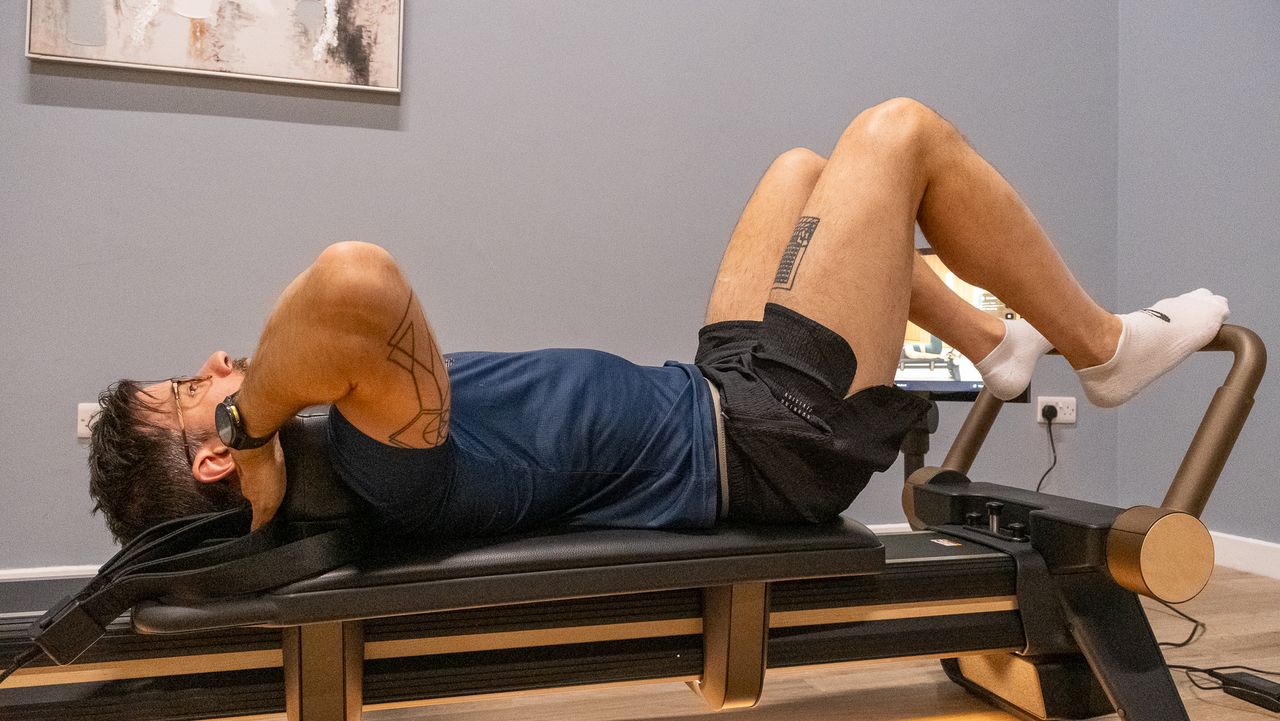
Just like everybody else, I’ve been struggling with all sorts of ailments all my life. I have mild scoliosis – an abnormal, sideways curvature of the spine – which I’ve known about for the last 25 years. Lately, I've also started feeling sciatica pain, which I’m sure is something to do with my scoliosis.
Even though I know the reason, it doesn’t change the fact that I have nerve pain that has kept me up at night over the past half a year. On one particular occasion, I woke at around 2 am to excruciating pain, which was so sharp that I couldn’t stand or sit down, so I had to hobble around my living room until the painkiller kicked in.

Long story short, having sciatica isn’t a pleasurable experience, and no matter how I tried to get rid of it, the pain hasn’t left me for months. I did dead hangs, NHS-prescribed stretches, curled myself into a fetal position, and rested my body in deep squats, but to no avail.
Applying heat helped ease the discomfort, but the pain never fully left my body, making me hobble as I walked and preventing me from sitting still for longer than half an hour. It’s not an ideal state to be in for anyone, let alone if you make a living out of testing fitness and outdoor gear.
The reprieve didn’t last
That is, until about two months ago, when the pain suddenly subsided. I’m not sure what happened; the discs just probably loosened enough to release the nerve. I was happy, as the lack of pain meant I could start exercising again properly.
I went running, started doing bodyweight workouts in the morning (my pull-up strength is getting there), and generally appreciated being able to function as a human being again.
I always tell people that fitness isn’t a burden but a gift, and this episode reminded me of that. Sadly, despite my best efforts to stay active and strengthen my back, the sciatica returned recently. You know that feeling when you have a small, niggling pain, and you kind of know what it is, but you’re trying to convince yourself it isn’t.
I was there two weeks ago. Then, the pain returned with a vengeance, and I was back to hobbling, gobbling painkillers and not feeling like my best self. This period also coincided with the launch of NordicTrack’s new premium Ultra 1 Reformer Pilates machine, and the brand very kindly offered us the opportunity to try it for two weeks.
Little did I know that by the time the machine arrived, I’d find it hard to sit straight, let alone do a workout. Nevertheless, I’m a thorough reviewer, so I decided to give it a try.
Not to mention, I was excited to try an ultra-premium fitness machine – it’s not often you get to do that. Better still, having the Ultra 1 for myself meant I could skip the class setting, which always gives me the heebie-jeebies.
A reformer built like a luxury fitness machine
The Ultra 1 is NordicTrack’s attempt to recreate the equipment and instruction of a Pilates studio at home. As its £4,499 / $4,999 / €4,999 / AU$7,999 price suggests, this isn’t a lightweight reformer designed to be folded up and hidden under the bed once you’ve finished exercising.
Its structural aluminium spine has three springs, keeping the moving parts out of sight. Resistance ranges from 22 to 99lb (10 to 45kg) and can be adjusted in 11lb (5kg) increments using buttons.
The padded carriage travels along stainless-steel tracks and operates exceptionally smoothly and quietly. You also get adjustable shoulder rests, a seven-position footbar and the usual ropes and loops for working your arms and legs.
It’s a handsome piece of equipment, with rounded edges and a minimalist finish that makes it look less clinical than the reformers you might encounter in a studio.
One thing to note is that it’s quite large, almost an immovable fitness machine. I needed help getting it out of its box, and moving it into place required a little moving trolley.
On the other hand, the machine radiates solidness, and at no point have I felt wobbly on it whilst performing my workouts. Plus, the Ultra 1 looks good enough to be left out in full view; but again, once you set it down somewhere, it’s there to stay for eternity.
iFIT takes the guesswork out of Pilates
Dominating one end of the Ultra 1 is a tilting 24-inch HD touchscreen that runs iFIT, the same connected training platform used by NordicTrack’s treadmills, exercise bikes and rowing machines.
An iFIT Pro membership unlocks more than 160 reformer workouts, covering everything from introductory classes and traditional Pilates to higher-intensity sculpting sessions.
This proved especially useful for someone like me who knows relatively little about reformer Pilates and would otherwise have had no idea where to place my limbs or how much resistance to select.
The display can be tilted towards the carriage or repositioned for exercises performed beside the machine, meaning I rarely had to crane my neck to see what was happening. That said, if you’re unfamiliar with this type of exercise, you will have to occasionally look at the display, at least at the beginning, but that’s just the name of the game, sadly.
NordicTrack’s Smart Spine system also turns the Ultra 1 into a connected fitness machine. It measures power output, stroke rate and estimated calories burned in real time, while iFIT records completed sessions and tracks progress over time.
You don’t necessarily need data to have an effective Pilates workout, but it gives the Ultra 1 a familiar hook for anyone coming from running, cycling or strength training.
An iFIT Pro subscription is required to access the complete workout library and smart tracking features. The reformer can still be used without one, but removing the guided content also removes a significant part of what sets the Ultra 1 apart from a conventional machine.
Moving in the right direction
Mounting myself on the machine – carefully – and selected an appropriate-looking lower-back workout, and got to work. The carriage was rolling smoothly under me, and, to my surprise, didn’t feel too small.
In fact, and as mentioned above, the machine itself was reassuringly solid, which is exactly what you want to feel when your body is compromised. I certainly didn’t want to feel like I could fall off accidentally, potentially rendering my whole body useless if the fall triggered the sciatica.
I could feel the nerve moving as I powered through the workout, but to my surprise, it gradually eased the pain. It was surprising because previous workouts I tried not only didn’t help but, if anything, exacerbated the pain. I expected the Pilates workout to have the same effect.
Quite the opposite happened. The more I pushed, arched, swung and moved my arms and legs, the less my nerve felt aggravated. Granted, the pain hasn’t fully subsided, but the sensation certainly eased, allowing me to move less like a pirate and more like a fully functional human being again.
I can see why the reformer Pilates workout might have made the difference. The combination of gentle exercises, the moving carriage, and the instructions provided the right mix of input to the nerves or discs to do the right thing. Plus, the Ultra 1’s commanding size and smooth performance enabled me to focus on the workout and nothing else.
Needless to say, the pain returned soon after the session, but even this brief exposure to reformer Pilates enticed me to try it more. I wish I could afford the Ultra 1, but I might have to opt for a somewhat more affordable model or attend classes, at least for the time being.
The Ultra 1 is available at NordicTrack UK, NordicTrack US, NordicTrack EU and NordicTrack AU for the recommended price of £4,499 / $4,999 / €4,999 / AU$7,999.