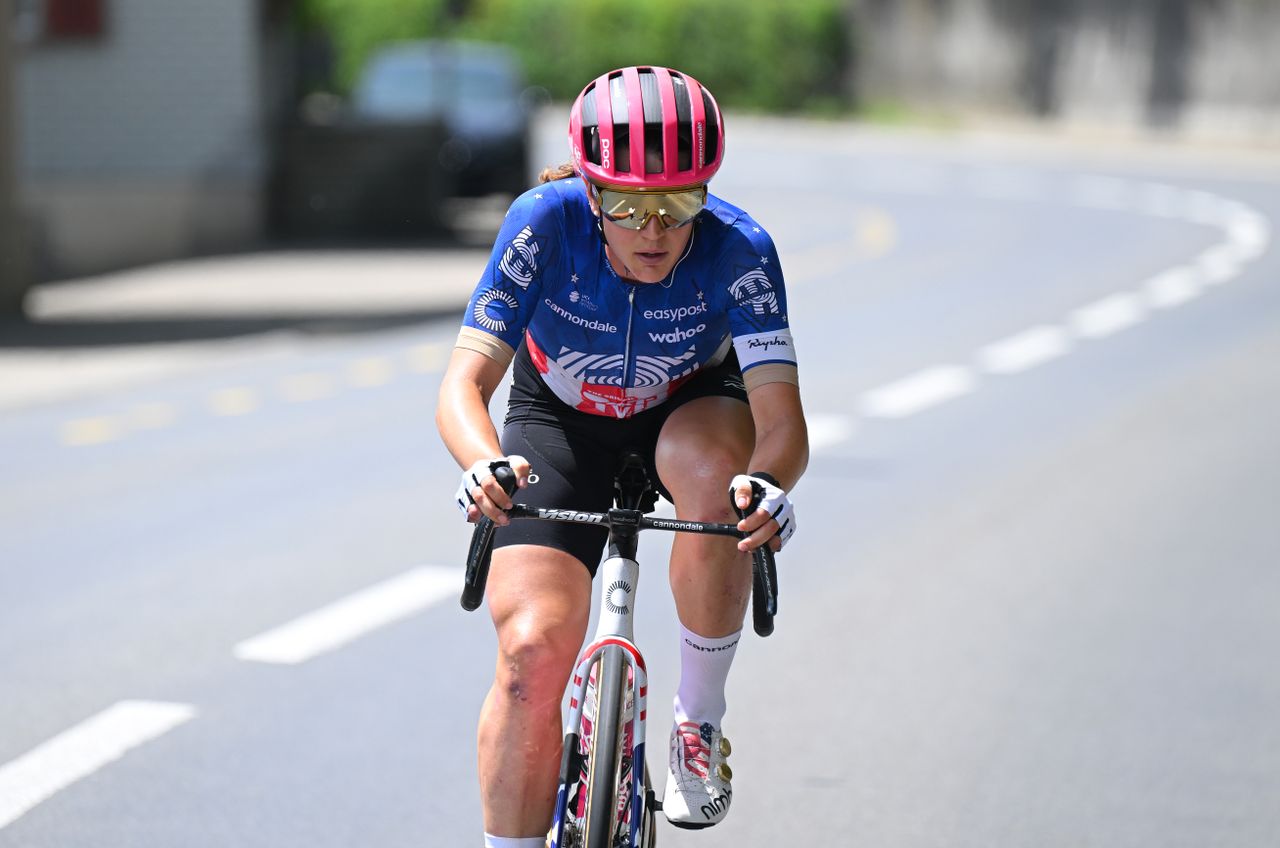
Olympic road champion Kristen Faulkner says she has hit a new 20-minute power personal best thanks to her own AI research.
The EF Education-Oatly rider wrote on LinkedIn that she has been coding with her own personal data for more than 10 hours a day over the last two months.

As a result, she has built a system that processes her information – such as heart rate, sleep, weight, power, and menstrual cycle phases – and runs it against 4,400 hours of her training history, giving her “actionable” ideas.
“The research I needed about my own body did not exist. So I built it with AI,” Faulkner wrote.
“So little performance research is done on women, particularly regarding the needs of elite female athletes. So I took matters into my own hands, and I started writing the research myself. I did not want to keep waiting for someone else to study the questions that matter to my body.
“For nine years, I collected biometric data that I struggled to synthesize. Heart rate. HRV. Sleep. Weight. Power. Temperature. Training load. Menstrual cycle phases. Bloodwork. DEXA scans.
“Every app gave me one piece of the story, but the answer was never in one app.”
The research I needed about my own body did not exist. So I built it with AI.https://t.co/fvX09qFXuZApril 22, 2026
Faulkner explained the AI models she has built for herself are “trained on my body” and “specific to my history”.
The research has been so valuable, she added, that she credits it with helping her to win three gold medals at the recent Pan American Championships: the individual pursuit and team pursuit on the track, and the time trial on the road.
“Sometimes I'd get back from my ride and jump onto my laptop in kit before putting my bike away. I'd start a coding session and let it run while I showered,” she wrote.

Faulkner became a pro cyclist for the first time in 2021, aged 28, following a career in venture capital. She holds a bachelor’s degree in computer science from Harvard University, one of the top universities in the world, and invests in AI companies.
“AI is going to change women’s performance research from the bottom up, and I want to be a part of it,” she said.
“I came into cycling late. I did not win because I had the deepest race history or the most experience. I won because I used my brain as much as I could. Before my first European race, I made flashcards of the riders, I studied every corner of every course, and I analyzed my data rigorously. I am doing the same thing now, with AI.”
The number of AI training platforms has multiplied in recent years. Already, cyclists can subscribe to a virtual coach with HumanGo, receive AI-powered plans through apps like Spoked, Vekta and Garmin Coach, and speak with an AI chatbot version of Sir Bradley Wiggins with The Coachsters.
“While AI offers valuable guidance, a balance is crucial,” David Bailey, head of sport science at NSN Cycling Team told Cycling Weekly earlier this year. “Recreational cyclists risk becoming too reliant on AI, potentially ignoring their body’s feelings.”