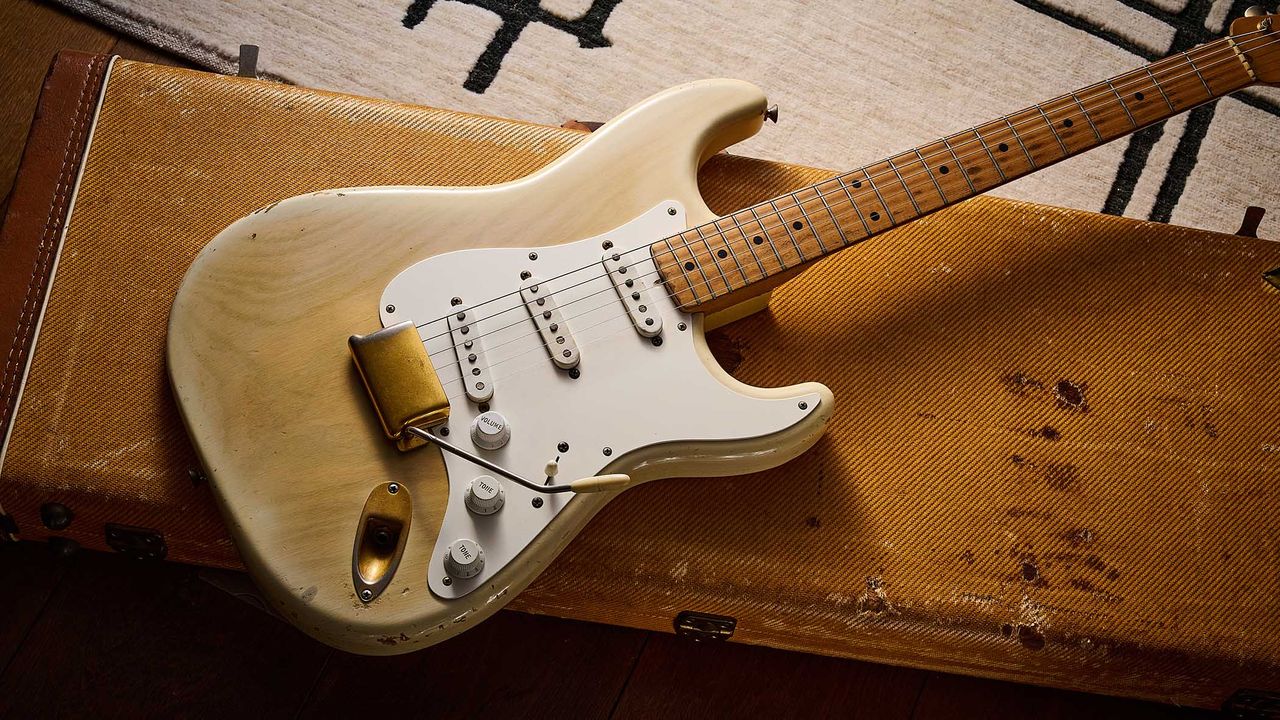
Gretsch had the Chet Atkins 6120, and Gibson offered various Les Pauls – but Fender’s most famous artist signature model was never officially anything of the sort. It’s maybe because the guitars were selling like hot cakes that Fender is better remembered for its manufacturing processes than marketing strategies.
Unlike all the other big US guitar manufacturers, Fender never bothered with artist signature models during the pre-CBS era. Even so, the Mary Kaye Stratocaster eventually acquired that status in a de facto sort of way and has become the ‘holy grail’ of vintage Fenders for many serious collectors.

There was nothing fancy about the neck profile, the pickups, or the wiring. In fact, only two features distinguished a Mary Kaye Stratocaster from any other Stratocaster that might have rolled off Fender’s production line during the mid-to-late 1950s. The most immediately recognizable was a translucent blonde finish over an ash body.
By 1955, the ‘butterscotch’ finish Fender applied to Broadcasters, Nocasters, and early Telecasters was being replaced by an off-white ‘blonde’ finish to match the newly introduced white pickguard.
Although sunburst was the standard Stratocaster finish, blonde examples have been documented from early 1955 onwards, but they came with regular chrome and nickel-plated hardware. To be a true ‘Mary Kaye’, a Strat must also have factory-fitted 14-karat gold-plated hardware.
Keys To Kayes

It is widely accepted that a Stratocaster currently owned by Phil Hylander (of Seven Decades) was the first to leave the Fender factory with a blonde finish and gold hardware, and it’s the actual guitar that was pictured in the hands of Mary Kaye. The body is dated January 1956 and it carries the serial number 09391, but the neck is a period replacement – and we’ll get into that later.
A previous owner called Iain Ashley Hersey researched the guitar’s history for a 2003 article in Vintage Guitar magazine. According to Hersey, the blonde/gold combination wasn’t officially offered to the public until 1957. In February 1957, Fender announced it in The Music Trades with a list price of $330. A sunburst Strat would have cost $274.50 that same year.

For its first six months, the guitar was kept in Don Randall’s office. During that period the guitar was photographed with Mary Kaye and her trio before an early 1956 performance at the Frontier Hotel in Las Vegas. As a publicity shot, the original backstage photo was somewhat less than ideal because the headstock was in shadow and the Fender logo was almost impossible to make out.
In other versions, the end of the fretboard and the headstock were crudely retouched and a larger than life logo was added. It was Mary’s understanding that the guitar was hers to keep, but the Fender employee who brought the guitar to the photoshoot took it back with him.
Mary was briefly reunited with the guitar when she appeared in a movie called Cha-Cha-Cha Boom! and used it while miming to three numbers. If you watch the footage you’ll see the guitar, but you won’t be able to hear it. The rhythm guitar on the tracks sounds like an archtop to us.
After the shoot, the guitar once again went back to Fender and next appeared at the Summer NAMM Show in New York. There it was demo’d by Johnny Cucci, and at the end of the show Don Randall told him: “Well, since you’ve been playing it for four days, we can’t exactly sell it as new… so we would like you to have it.”

Although primarily a jazz player, Cucci favored the Strat over his Gibson Super 400 and D’Angelico archtops. Johnny Cucci and his lap-steel-playing musical partner Jody Carver had a band, and on their 1958 recording, Hot Club Of America In Hi-Fi, you can hear the Strat being put through its paces by a very decent player.
The album cover features a wonderful photo of Cucci with the guitar, and the accomplished but profoundly odd music sounds like a heavily sedated Les Paul attempting to sightread a Sergio Leone score for a David Lynch movie with a backing band of inebriated Hawaiians. It’s a rare treat.
Soon after Cucci acquired it, however, the neck developed a twist. Having turned down Randall’s offer of a new guitar, a replacement neck was sent on the proviso that the original was returned to Fender ‘for inspection’.

This replacement neck was dated September 1956 and has remained with the guitar ever since – just as the guitar remained with John Cucci until he sold it to Guitar Trader in New Jersey in early 1982. They sold it to Jimmy Crespo, who had replaced Joe Perry in Aerosmith, and he used it to record the rhythm parts on their Rock In a Hard Place album.
The guitar continued to go back and forth between Crespo and Guitar Trader until the late 80s, when it passed through several owners and was eventually offered to John Entwistle as part of a large collection.
In return for his help in arranging the deal, Entwistle gave the Strat to guitar tech extraordinaire Alan Rogan. In the summer of 1995, Rogan traded the Strat with Lloyd Chiate of Voltage Guitars in Hollywood, who subsequently sold it to Iain Ashley Hersey.

From him, it eventually went to a collector and, so far as we can tell, the most recent sale went through Julien’s Auctions when, in early 2025, it achieved a hammer price of $224,000. Prior to the sale, the guitar was thoroughly inspected and played by Julien’s in-house appraiser Mike Adams.
“It looked like a one-piece body to me,” Mike recalls, “because I couldn’t detect any seams. I didn’t make notes about the weight, but it certainly didn’t impress me as being heavy. The neck has a very soft V profile with a nut width of 1.65 inches and a depth of 0.94 inches at the 1st fret, and by the 12th fret it only gets up to 0.98 inches. So the depth doesn’t change a whole lot, but it’s a big neck.
“The original Stackpole potentiometers date to the 36th week of 1955,” Mike continues, “and my pickup readings were 5.9k[ohms], 5.71k, and 5.74k at the neck, middle, and bridge respectively. It’s a lovely set of pickups – not too bright at the bridge and very full-sounding in the neck position. Having looked under the hood, I can say that a treble bleed network was installed and there was a blue ground wire that was non-original. It sounds fantastic and it’s just such an impressive instrument.”
Gold Standard

In its almost 70 years of existence, the guitar has seen periods of regular use and, presumably, years of relative inactivity as it languished in various collections. As a result, this first Mary Kaye Stratocaster remains in superb condition, and even the notoriously damage-prone maple fretboard shows relatively minor fingerwear.
For an up-to-the-minute report on the current market for Mary Kaye Strats we consulted Mike Long of ATB Guitars.
“They’re well up there in the hierarchy of vintage Fenders,” Mike confirms. “A really nice Broadcaster or an exceptionally rare custom color pre-CBS Strat may come close, especially maple-neck Cinnamon Red examples from the 1950s. They’re far less common, although Mary Kayes aren’t exactly common, either. I would struggle to think of any Fender that surpasses a Mary Kaye Strat in value or collector appeal.”

Since blonde was offered as a finish option, the danger for any prospective Mary Kaye owner is the possibility that gold hardware may have been added at a later date.
After much cajoling from Mary’s nephew, she was presented with a brand-new Custom Shop Strat in 2002
“That’s true,” ATB’s Mike Long agrees, “but the one part that those people attempting to create pretend Mary Kayes tend to overlook is the gold-plated truss rod adjuster. With the originals there is normally not a great deal of gold plating left, but if there are traces of gold it’s a good sign that a Strat is a genuine Mary Kaye. We also look for evidence that the hardware has been swapped over, such as imprints in the wood that don’t quite match the hardware and altered screw locations.”
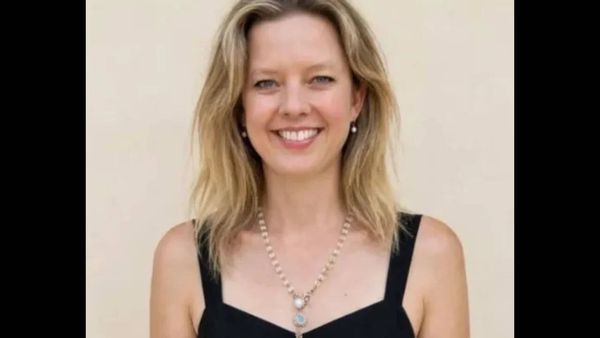
Almost half a century after Mary Kaye’s name became inextricably linked with the most desirable incarnation of the Stratocaster, Fender finally made good on its promise. After much cajoling from Mary’s nephew, she was presented with a brand-new Custom Shop Strat in 2002.
Although once devoted to her electrified D’Angelico, Mary eventually began playing a Telecaster, and in the three years leading up to Fender’s gift, she had been playing a Squier Strat. Her new guitar came with a Custom Shop certificate that read ‘Mary Kaye Stratocaster’, serial #MK001, and the neckplate was inscribed: “To Mary Kaye from your friends at Fender.”
- With thanks to Phil Hylander, Mike Adams of Julien’s Auctions, and Mike Long of ATB Guitars
- This article first appeared in Guitarist. Subscribe and save.