Get all your news in one place.
100's of premium titles.
One app.
Start reading
Tom’s Guide
Tom’s Guide
Technology
Dan Bracaglia

I ran a 5K with the Garmin Forerunner 570 vs Apple Watch Ultra 3 and although the pace data matched up perfectly across both devices, the Garmin’s exercise load metric and detailed vertical ratio analysis made it the clear winner

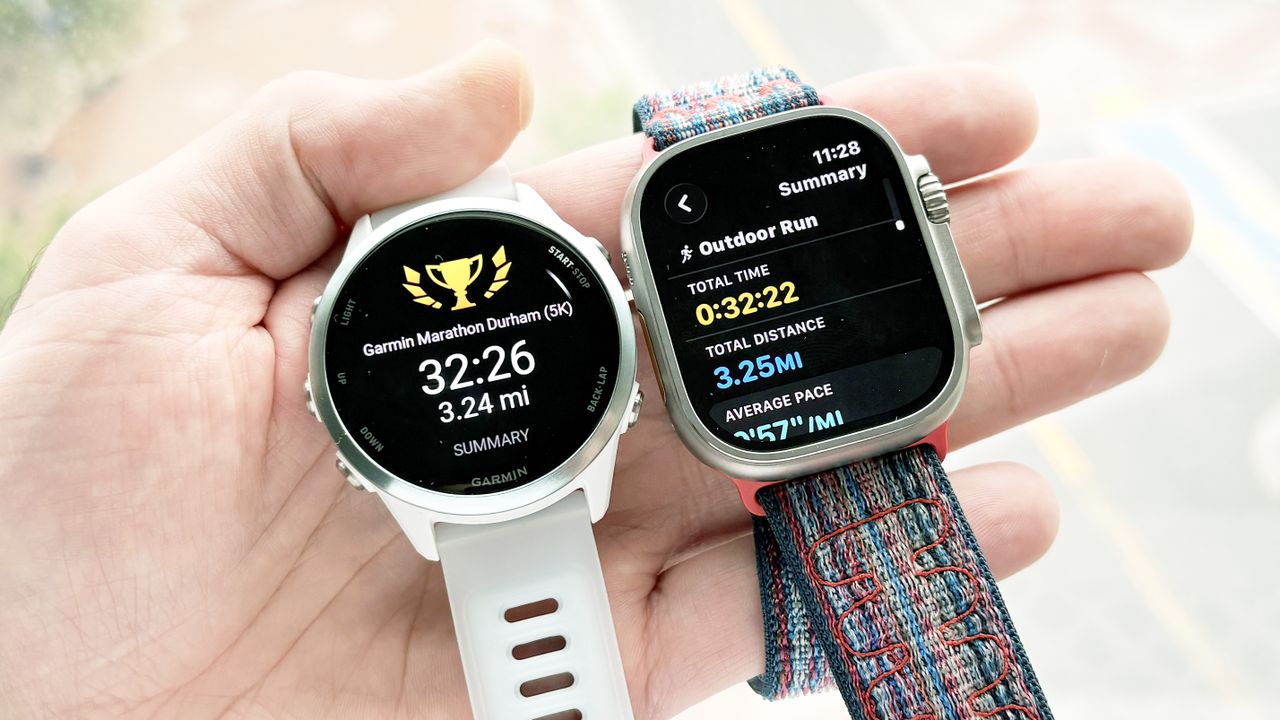
Close-up of the Garmin Forerunner 570 and Apple Watch Ultra 3 in the writer's hand showing the results of a 5K run.

I just participated in my very first official running event: a 5K in Durham, North Carolina. Despite some pre-race jitters, I managed to complete the event in 31 minutes and 11 seconds, a much faster time than I was anticipating!

While my running bib for the event tracked my progress and pace throughout the race, I also wore a Garmin Forerunner 570 on one wrist and an Apple Watch Ultra 3 on the other for additional insights into my performance.

Both watches performed well, churning out similar data across the board. However, there are some exceptions worth calling out, especially when comparing the watch stats to my official race time and pace.

1. My official finish time was faster than Apple's and Garmin’s

(Image credit: Dan Bracaglia/Tom's Guide)

The chip in a race bib begins tracking the second you cross the starting line and concludes the moment you pass the finish, for an ultra-precise time calculation, and one that ultimately proved to be quicker than what Apple or Garmin calculated.

To be fair, I began tracking on both smartwatches about 50 feet before crossing the start, and forgot to end tracking until a minute or more after the race’s completion. As a result, the Forerunner 570 noted a “moving time” of 32 minutes and 27 seconds, while the Ultra 3 said my “workout time” was 32 minutes and 22 seconds.

These finish times are still pretty close to my official finish; however, I expected the Garmin to be more in lock-step with the chip’s tally, given the fact that I’d preloaded the race and course onto my Forerunner 570 the night before.

2. Garmin’s post-run performance insights go deeper than Apple’s

(Image credit: Tom's Guide)

In addition to metrics like heart rate, average pace, elevation gain, and finish time, both the Apple Watch Ultra 3 (using Apple’s native fitness app) and Garmin Forerunner 570 provide insights into power, cadence, vertical oscillation, ground contact time, and stride length.

Only Garmin breaks down your time spent walking versus running though. In my case, I spent 91 seconds of the race walking, a takeaway I was pretty proud of. Garmin also provides a metric for vertical ratio. While vertical oscillation tells you how much vertical movement your torso makes with each step, vertical ratio clues you into just how efficient your running style is.

Calculated by dividing vertical oscillation by stride length (and multiplying by 100), the lower your vertical ratio percentage, the more efficient your running is. Mine was 9.1 cm, which is about average for my age and gender.

3. Pace data matches up nicely across the board

All three tracking methods noted a similar average pace. The bib chip noted a pace of roughly 10:02 per mile, while Garmin calculated my average pace at 10:01 per mile. Apple’s tally was a little more generous with a pace of 9:57 per mile.

4. Garmin's recovery insights are better than Apple's

(Image credit: Tom's Guide)

Apple’s native fitness tracking app still doesn’t provide recovery time recommendations post-workout, while Garmin does. For my 5K running efforts, the Forerunner 570 recommended a recovery time of a whopping 71 hours!

That seemed like a lot, at first. However, I’m now roughly three days out from the event, and still feeling a tad sore in my quads. So, perhaps 71 hours of post-race rest was right on the money.

I also appreciate Garmin's exercise load metric, which you won't find on even the best Apple Watch models (though Apple does offer a training load stat). Garmin’s exercise load calculates the physiological impact of a workout, or how strenuous it is on the body, by monitoring your post-exercise oxygen consumption and how long it takes you to return to your non-workout baseline.

A higher exercise load number, between 185 and 300, indicates a harder workout. Meanwhile, scores below 100 reflect an easy workout, while scores between 100 and 170 reflect moderate effort. In my case, Garmin calculated my exercise load for the 5K at 225, indicating a more intense amount of effort than normal.

5. Both watches showed my speed increasing with each mile

(Image credit: Dan Bracaglia/Tom's Guide)

Lastly, both the Apple Watch Ultra 3 and Garmin Forerunner 570 showed my speed increasing with each passing mile. Garmin calculated my first mile at 10:39, my second at 9:38, and my third at 9:35. Apple, meanwhile, noted a mile-one time of 10:21, a mile-two time of 9:36, and a mile-three time of 9:34.

More from Tom's Guide

Sign up to read this article
Read news from 100's of titles, curated specifically for you.
Already a member? Sign in here
Related Stories
Top stories on inkl right now
One subscription that gives you access to news from hundreds of sites
Already a member? Sign in here
Our Picks
Fourteen days free
Download the app
One app. One membership.
100+ trusted global sources.