Get all your news in one place.
100’s of premium titles.
One app.
Start reading
Louder
Louder
Entertainment
Dave Ling

"I probably should have retired years ago but I really love keeping the band alive": Ten Years After are down to one original member but there's still gas in the tank

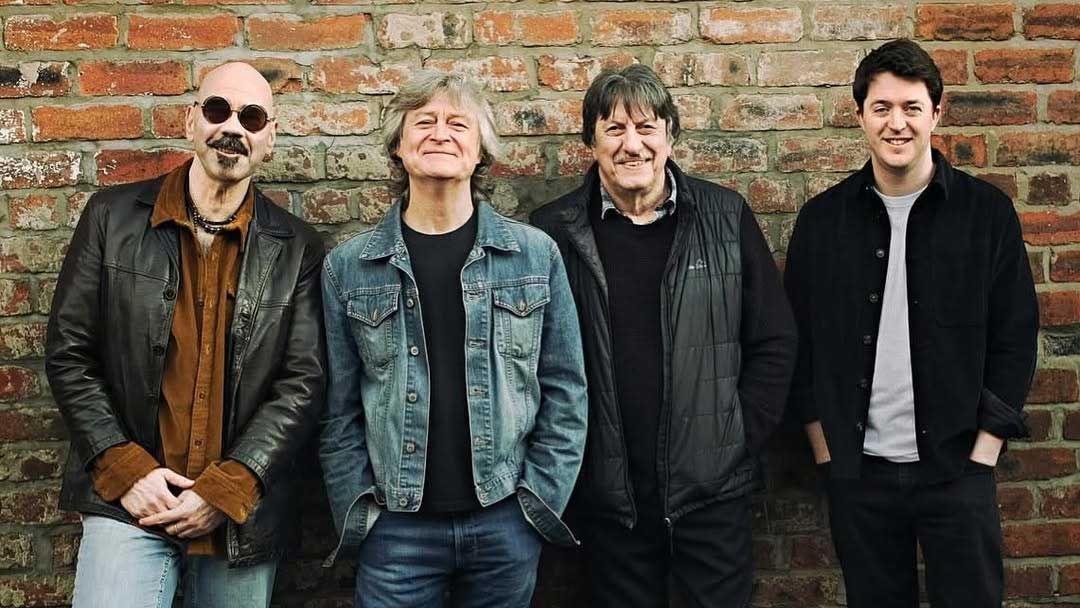
Ten Years After standing against a brick wall.

Formed in Nottingham in 1966, Ten Years After secured rock immortality three years later after their performance of I’m Going Home became a highlight of the legendary Woodstock Festival and the subsequent film of it. After breaking up in 1975, the band existed sporadically. Guitarist Alvin Lee passed away in 2013. Now, following a period of stability, drummer Ric Lee has assembled a new line-up.


There have been a lot of personnel changes during the life of TYA. First of all tell us about the new guitar player, Samuel C Lees?

Sam’s very, very good. He sings, too. Our new bass player, Craig Fletcher, was with the John Lees version of Barclay James Harvest, and he’s another singer. This is the first time the band has used harmony vocals, so that’s a bit of a new thing for us. And we’ve got Dave Burgoyne on keyboards, but he also plays violin on Portable People, TYA’s first ever single [from 1968].

Guitar players Joe Gooch and Marcus Bonfanti each had long stints in the band until fairly recently. Why did Marcus’s decade-long spell come to an end?

Well, Colin [Hodgkinson, bass] decided to retire, and Marcus had worked so well with Colin that he thought it was time to move on. He’d given us ten really good years. when I asked Chick [Churchill, keyboard player] what he was going to do, he said: “If those guys are stopping, I think I will, too.” Effectively, that meant starting again from scratch.

Did you consider calling it a day?

Oh no. I wanted to carry on. One of my favourite jazz drummers, Art Blakey, went at the age of eighty-four. I saw him at Ronnie’s Scott’s Jazz Club just before he died. So I’m targeting eighty-four to stop playing, I’ve a little way to go. [In fact, Blakey died aged 71 – Ed.] The new line-up came together much easier than I had expected. Several were recommendations. I was very positive about keeping the band going.

Like you, keyboard player Chick Churchill was an ever-present part of Ten Years After, so his departure must have hurt.

I do miss Chick, but we still communicate. Colin and Marcus, too. And the guys that came in have been so positive. They’re also much younger than me, so I have to keep on top of my game.

(Image credit: JL Visiongraphy)

There’s a new, expanded edition of TYA’s third album, 1969’s Ssssh. The deluxe three-CD Hardcover Edition is quite a package. Presumably you were involved in its compilation.

I helped with all of the others, but this one was assembled by the record company, Chrysalis. I haven’t seen or heard the new version, to be honest.

Apparently recorded on eight-track, as opposed to the then more common four-track, Ssssh was an important record for Ten Years After.

[Nodding] It was the first that we did at Morgan Studios [in London], and it has our version of [Sonny Boy Williamson’s] Good Morning Little School Girl, which on stage became a bit of a guitar and bass battle between Alvin [Lee] and Leo [Lyons]. We still play that one live. The one that we don’t do live, because Alvin never liked it, was I’d Love To Change The World [1971], our highest-charting single. Joe Gooch wanted us to add that one to the set.

A new take of I’d Love To Change The World was released recently by complete accident…

That’s right. We were informed that a version that we performed at a festival in France was taking off on Instagram – it was filmed by some younger fans and posted online, and suddenly people were talking about it. So we re-recorded it.

Joe Bonamassa is a big fan of Ten Years After.

So I believe. It’s lovely that he’s a fan of ours. I’ve seen Joe live a couple of times and he’s great. Joe is keeping the blues alive, and that’s something we’re trying to do too. We’ve already begun recording a new album.

Do you ever tire of I’m Going Home? It can’t be the most satisfying song for a drummer to perform.

Not really. I’m a timekeeper [for the guitarist]. It’s a showcase for the band, and that’s important.

That song’s most iconic version is, of course, the one the band played at Woodstock. Is there a tendency to regard Woodstock through rose-tinted spectacles?

No. We had a good time there… once we finally got the guitars in tune. It was so damp that they kept going out of tune. There were no electronic tuners in those days. It happened four times, but we had to keep going.

What was it like to look out on a sea of human faces as far as the eye can see?

Scary. It really was. You’d never be allowed to put on a show like that now. The rain cover was just two bits of tarpaulin, which is why the stage was live for two hours. We had to wait until it dried.

You turned eighty a few days ago. What keeps you so determined to keep going?

I probably should have retired years ago, but playing keeps the brain engaged and I really love keeping TYA alive.

Ten Years After appear at the London Blues Festival on January 21 and tour with Clearwater Creedence Revival in March. For dates and tickets, visit the Ten Years After website.

Sign up to read this article
Read news from 100’s of titles, curated specifically for you.
Already a member? Sign in here
Related Stories
Top stories on inkl right now
One subscription that gives you access to news from hundreds of sites
Already a member? Sign in here
Our Picks
Fourteen days free
Download the app
One app. One membership.
100+ trusted global sources.