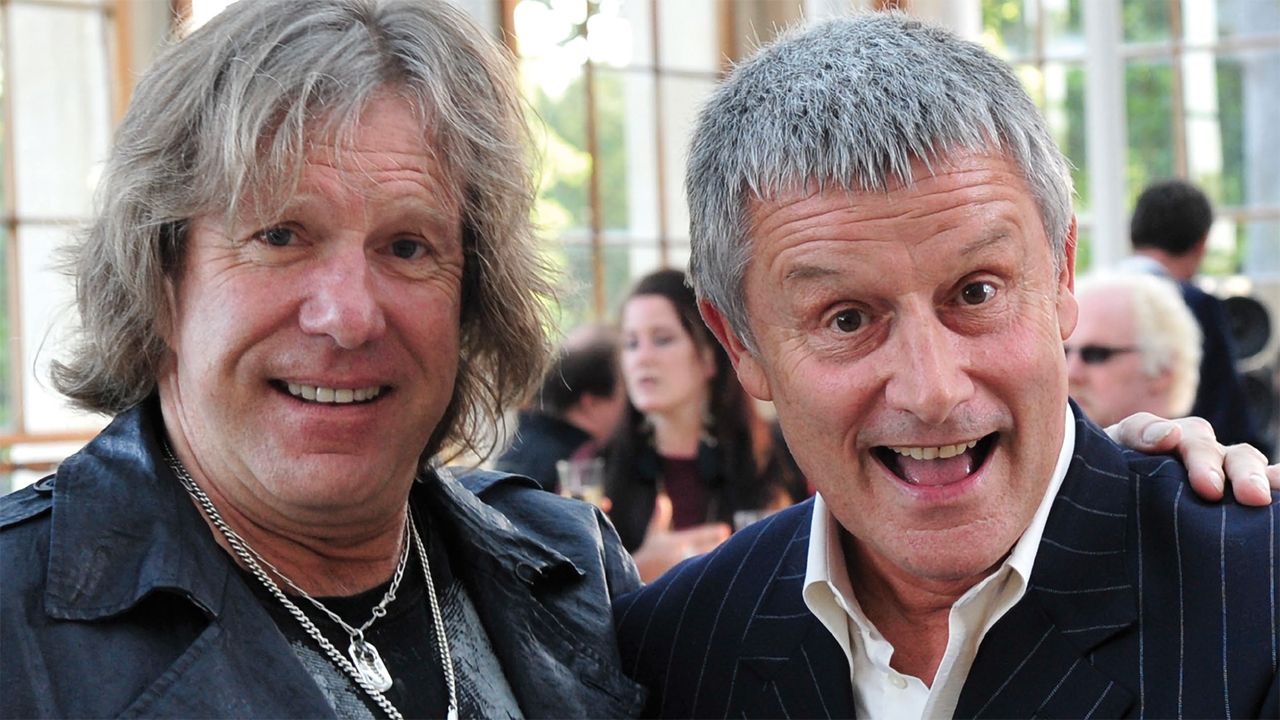
Surviving Emerson, Lake & Palmer member Carl Palmer remembers his first meeting with the supremely talented Keith Emerson, and reflects on a long and extraordinarily creative career with the man he describes as “the best rock’n’roll keyboard player.”
Carl Palmer was 17 and playing drums with Fleetwood Mac the first time he met Keith Emerson. It was late 1967 and Mac bassist John McVie had asked Palmer to sit in for a sick Mick Fleetwood at Goldsmith’s College in south London. “I said, ‘Yes! Who else is playing?’” says Palmer today. “He said, ‘The Nice.’ I said, ‘I know them. That’d be great.’”
Palmer had seen The Nice at The Marquee, where they had a Monday night residency. He was particularly impressed with their keyboard player Keith Emerson, a slight, long-haired 20-something with a showman’s streak and the ability to conjure magic from his Hammond L-100 organ.
“I grew up around a lot of classical music,” says Palmer, “and The Nice had a lot of classical adaptations. I thought that was the way to play classical music – in a contemporary sense with contemporary instruments.”
On the night of the Goldsmith’s gig, Palmer approached Emerson and introduced himself. “I told him I’d seen him at the Marquee quite a lot. He wouldn’t have known who I was.” Perhaps not, but that low-key meeting proved to be hugely auspicious, sowing the seed for a musical relationship and friendship that would last nearly 40 years, stretching from ELP’s formation in 1970 to Emerson’s death on March 11, 2016.
“Most people who play keyboards want to be known as a piano player,” says Palmer. “And, of course, Keith was a great piano player. But to me, he was the best rock’n’roll keyboard player I’ve ever heard. Forget about the daggers, riding the L-100 across the stage, laying on the floor on his back and all that. Just the actual playing, and the spirit of it – he did it to an ultimate level.”
Palmer was a member of Atomic Rooster when Emerson’s manager, Tony Stratton- Smith, asked if he wanted to audition for a new band. “When Keith and I got together and talked about the albums we had and the music we listened to, there was a lot of overlap,” says Palmer. “We both loved Stravinsky, Bartók, that kind of thing. He said, ‘I steal from everyone – I just try to play it better.’
“I said, ‘Could you play something by Errol Garner?’ And he said, ‘Of course,’ and rattled something off. He had a phenomenal memory – his catalogue of musical styles and the information he had made him what he was.”
Palmer remembers ELP rehearsing intensely five days a week. “We’d get there at 12, and Keith would always be late. “We’d stay there until seven, and Keith would often stay on. He was probably reading all these manuals on the Moog, which was like wallpaper! It was like coming home for me. It wasn’t the volume; it was the musical integrity. That was really high.”
The drummer recalls Emerson had a clear idea of what he wanted from the band. “He really bought the direction of what we should do and how we should do it,” he says. “The Nice set the blueprint, with the Hammond sound and everything. The magic of it all was that Keith’s music was really underpinned by Greg’s songs; they were two peas in a pod in that respect.
“Keith and Greg were great writers, though they always wrote separately then came together at the last minute. It was a great team to be involved with. One of the biggest things I learned from Keith – and it’s something that I apply to my band as well – is that he would always listen to everyone’s ideas.

“Tarkus is a good example. I came one day and said, ‘I’ve got this 5/8 or 10/4 pattern; I think you could write a melody on top of where the accents fall. What do you think?’ He said, ‘Play it.’ He wrote out the rhythmical notation. The next day he came back with the keyboard riff from Tarkus. He would take a small germ of inspiration, and then you’d be looking at a 17-minute piece of music.”
In many ways, there were two Keith Emersons: the man offstage, funny but not outrageous, and the showman onstage straddling his Hammond or wrestling it on the ground. “He was a reasonably shy character; introverted,” says Palmer. “But onstage he’d turn into a monster. He was doing all that stuff when I saw him with The Nice at The Marquee. He just made it bigger, bolder and brighter.
“But when people see a picture of him lying on the floor with an L-100 across his knees, what they don’t get is that those keyboards were back to front, and he’s still playing the tune. They don’t realise that what he’s doing takes a lot of work. He was a natural.”
Nighthawks was wasted in a way – if ELP had played it, it would probably have been a second Tarkus
For all his onstage presence, Emerson suffered from stage fright. “Keith was always nervous before he went on,” says Palmer. “In the 90s we played two nights at the Royal Albert Hall. We were standing backstage and Keith was as nervous as hell, like he normally is. I opened the curtains a bit and said, ‘Look out there – look at all these people who’ve paid to see us!’ I didn’t realise that was the worst thing I could have done, because it made him even more nervous. But every time, once he was out there it was fine. It all came out onstage.”
ELP were the people’s band, not least in the USA, where their huge sound sated the massive appetites of American audiences, filling the enormodomes they played throughout the 70s. It was a different matter when it came to the music press, especially back in Britain. Few bands received the opprobrium that ELP got, and Emerson took the criticism to heart more than anyone.
“He could get sensitive,” says Palmer. “I tried very hard to get him out of that. I’d say, ‘This is one guy’s opinion. All these people bought our records, all these people bought the concert tickets. We’ve just got to forget that.’ But yeah, he got disturbed.”
Emerson, Lake & Palmer went their separate ways following 1978’s ill-fated Love Beach album, after which Emerson successfully moved into soundtrack work, providing the music for Dario Argento’s 1980 horror Inferno and Sly Stallone’s 1981 cop movie, Nighthawks. “Nighthawks was a great piece of music,” says Palmer. “I think it was wasted in a way – if ELP had played it, it would probably have been a second Tarkus.”
It had got to the stage where he could play maybe half an hour and his hand would start to curl under
In 1988, Emerson and Palmer joined forces with American singer and bassist Robert Berry in the short-lived project 3, releasing the lone album To The Power Of Three. “For some reason, Keith wanted to go and play the clubs, these 1,400-seater places,” says Palmer. “The album didn’t do anything, but for Keith and I to go out and get down and dirty was just great.”
By the early 1990s, the inevitable happened and the E and L reunited with the P for a two-album second act. But Emerson was starting to have problems with his ulnar nerve – aka the funny bone – in his right arm, which affected his hand as a result. Between 1992’s comeback album Black Moon and 1994’s follow-up In The Hot Seat, he had an operation to rectify the problem.
“I said, ‘Do you think you should have a second opinion?’” recalls Palmer. “He said, ‘I’ve had second opinions here, and I really think I’ve got to do this.’ I said, ‘Well, I’ll take you to the hospital in the morning.’ I dropped him off and he was picked up that night by his keyboard tech, with his arm in a sling. We were getting ready to make a new album, and he played the whole of it with his left hand. The man was just a phenomenal musician.”

While the operation was initially successful, the problem had returned by the time ELP reunited for a third time to play the High Voltage festival in London in 2010. “It had got to the stage where he could play maybe half an hour and his hand would start to curl under,” says Palmer. “If he left it for a couple of days then he was okay for a whole set. It wasn’t easy for him, but then he’d always surprise you.
“He started conducting in LA, and he was still writing some phenomenal music. But at the end of the day, it was something that was going to catch up with him mentally. We just didn’t know how severe that was.”
Watching Keith play every day – and Greg too – was unbearable for the first three weeks
The drummer was on tour in Italy with Carl Palmer’s ELP Legacy when he received the to say that Emerson had died. “I said, ‘No, it can’t be right,’” he recalls. “I’d spoken to Keith about three weeks before that, about coming along and sitting in with my band when he gets into London. He’d said, ‘Yes.’ Normally, he’d say, ‘Ah, Carl, I’m not sure; wait until I get in and then I’ll decide.’ But this time he said yes straight away.”
Palmer was left numb by his bandmate’s death. The hardest part, he says, wasn’t actually receiving the news, or even attending the funeral. It was editing the footage of the two shows they’d played at the Albert Hall in the 1990s, which he intended to use in his ELP Legacy shows to pay tribute to both Emerson and Greg Lake, who died just 10 months after his bandmate.
“Watching Keith play every day – and Greg too – was unbearable for the first three weeks; just depressing as hell,” he says. “But I had to get it done. I realised they’d want to see themselves like this, at the top of their game and still playing with me. And now, whenever I look up at the screen, I see Emerson blasting away, and I smile.”
Ask Palmer what his favourite piece of Keith Emerson music is, and his reply isn’t Tarkus, Pirates or Fanfare For The Common Man. “Probably the one piece of music that displays him as this great keyboard player and this great arranger is Jerusalem. It was a hymn we were all connected with from being at school. By the time he got hold of it and started putting these big church organs on it, it would make you cry. That can’t be anyone other than Keith Emerson playing. It blows the doors off anything.”
Palmer is sure that if his old friend was still around, they’d be working together. “At the back end of it all I said to him, ‘If you ever want to do anything, we could put the ultimate jazz group together – it’d be great to do something a bit different.’ I’d be talking him into that.
“Keith was the greatest musician I ever played with. I’m so grateful I had the chance.”