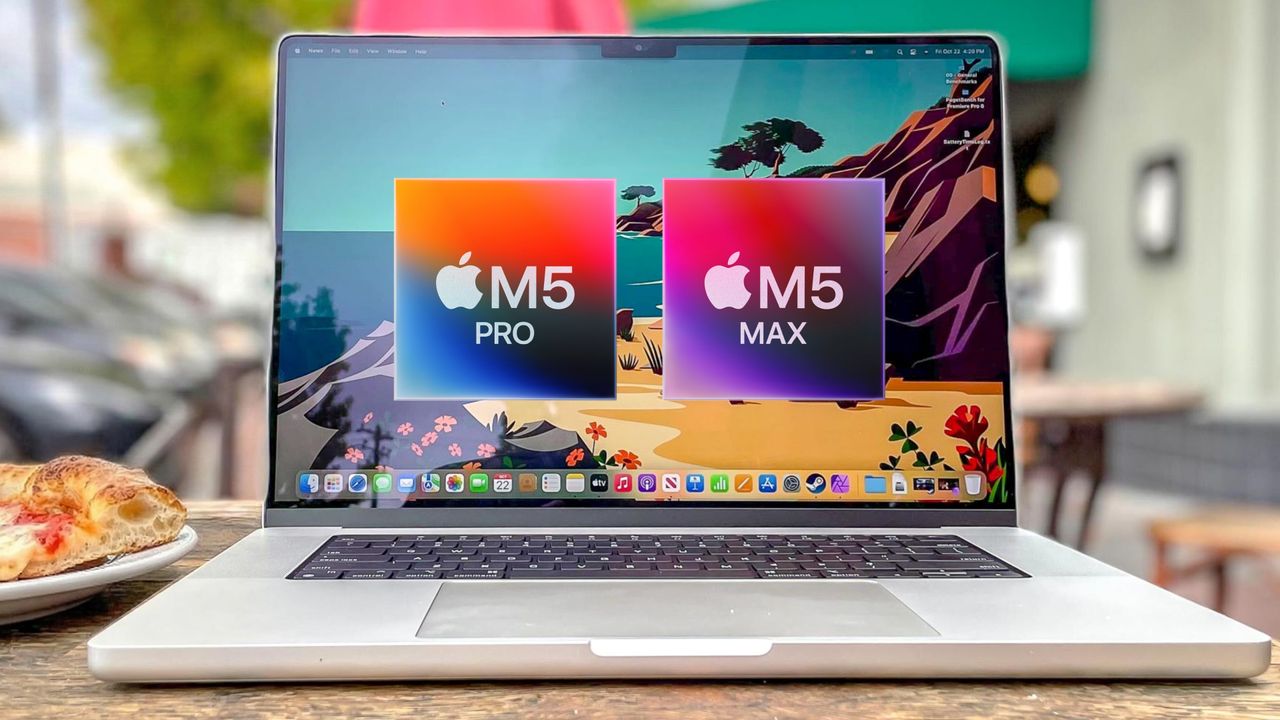
As inevitable as day turns to night, the latest Apple silicon tests get leaked on Geekbench. This time around, it’s the M5 Max that has been exposed and as you probably expected, it’s an absolute monster.
But it’s easy to just see the M5 Pro and M5 Max MacBook Pros as simply “big number goes up” — I mean that’s exactly what my mates thought when I was trying to explain the new architectural changes while sharing a pizza.

“So, what’s the big deal then?” Ben asked (with an inappropriate amount of tomato sauce around his mouth). Then, I looked at the slice I was holding, and it hit me.
Apple calls it “Fusion Architecture,” and this is a pivotal moment where the company has stopped trying to make a bigger pizza, but build a buffet instead. This isn’t just a small change, it’s a generational leap that changes the way your computer thinks from having a single brain to a hive mind that can scale as big as the buffet allows.
Sounds weird, I know. But let me explain.
Why the monolith had to die

Intel names it “chips on a system” for its Core Ultra Series 3 chips — whatever it’s named, this is the direction everyone is heading in. And in trying to explain this to my friends, I went to the one dish I’m always thinking about.
Imagine you’re making a pizza. As more and more people love the pepperoni special you make, you have to go bigger. But you can only make a tasty ‘za so big before it won’t fit in the oven, or the middle stays raw while the crust burns.

Traditionally, Apple Silicon has always been a system on a chip (SoC): everything (the CPU, GPU and RAM) on one giant pizza. Great for efficiency, but limited in being able to scale up.
Chipmakers cannot print a single chip larger than a certain size without it becoming buggy and incredibly expensive. There’s a scaling issue (roughly 858mm-squared based on maximum exposure area of the lithography machines that make chips) and a quality yield issue:
- You could keep making the dough bigger, but your pizza oven is a fixed size.
- If you have a 5-foot monster pizza and a single hair falls on it, you have to throw the entire thing away.
So instead of trying to make one impossible pizza, Apple has decided to make four perfect 12-inch pizzas and “fuse” them together on one giant serving platter.
With M5 Pro and M5 Max, the Cupertino crew has gone back to the drawing board and rewrote the rules with chips on a system (CoS). Instead of just jamming it altogether, multiple specialized chips are fused together to act as one — tightly bonded so the software thinks it’s still just one chip.
- It’s much better for efficiency — if one pizza as a hair, you only need to toss that one small piece
- You still get that size advantage — you can still feed the masses a ton of pizza
- The Fusion Architecture magic — the “platter” these pizzas sit on is so fast that the person eating it (the software) can’t even tell they’re separate pizzas

Intel’s been the first big chipmaker to jump into this with Core Ultra Series 3, and not only has it made silicon production much more efficient for them, as you can see from numbers, it’s also brought a big performance/power efficiency boost with it.
And in Apple’s case, you can see how the floor of the M5 Pro chip has been raised, the ceiling of what a MacBook Pro can do has effectively doubled, and the architecture is now future-proofed with simplicity (all they need to do for an eventual “M5 Ultra” is just fuse more blocks onto it).
M5 Max: by the numbers

So how does this fusion architecture perform? We’ve got a solid idea from this Geekbench CPU test score.
That’s a 5.3% increase in single-core and 13% jump in multi-core speeds. Through this lens, it’s a minor jump, but then you take a step back and realize it’s actually faster than the M3 Ultra — Apple’s current workstation-class beast found in the Mac Studio.
Intel Core Ultra Series 3 is similar too, where the CPU speed increases are relatively small. But it’s in the GPU where you’ll see the biggest gains. Just like you saw with Team Blue, Apple’s touting some serious performance increases — all thanks to every single one of those 40 GPU cores having a neural accelerator in them:
- A 50% graphical performance boost
- 4x faster LLM prompting (making Siri and local AI feel instant)
- 3x faster video rendering in DaVinci Resolve (as the GPU is now AI-aware)
Also, shoutout to the 20% improved memory bandwidth to make things a whole lot faster, and the claimed 2x improvement in SSD speeds to 14.5 GB/s.
The modular future

At the beginning of this year, I went to an Intel event where they broke down the architectural shift of Core Ultra Series 3 by giving everyone a Lego set to build the chip. I thought this was a little weird at first (not a problem — love Lego), but the further we get into this year, the more I think it’s the perfect analogy.
We are entering an era of silicon Lego. This whole idea of waiting for a single giant chip is over, because the future is about how well you can glue smaller chips together. For the last few generations, Apple focused on making the “pizza” denser (moving from TSMC’s 4nm process to 3nm in chipmaking).

But we’ve reached a point where the ingredients can’t be made any smaller without things getting weird at a sub-atomic level. So by moving to chips on a system, M5 Pro and Max have broken the oven wall — not limited by how big a single pizza can be, but only by how many they can stick together.
Like I’ve been saying, 2026 is a huge year of change for laptops — with the biggest change happening in the brain of each system. And now with the ceiling virtually eliminated, the sky’s the limit for how far these performance gains can go.
Now, if you excuse me, I’m feeling hungry.

Follow Tom's Guide on Google News and add us as a preferred source to get our up-to-date news, analysis, and reviews in your feeds.