Get all your news in one place.
100’s of premium titles.
One app.
Start reading
Tom’s Guide
Tom’s Guide
Technology
Peter Wolinski

I'm an ex chef — here's how I keep my knives razor sharp without a whetstone

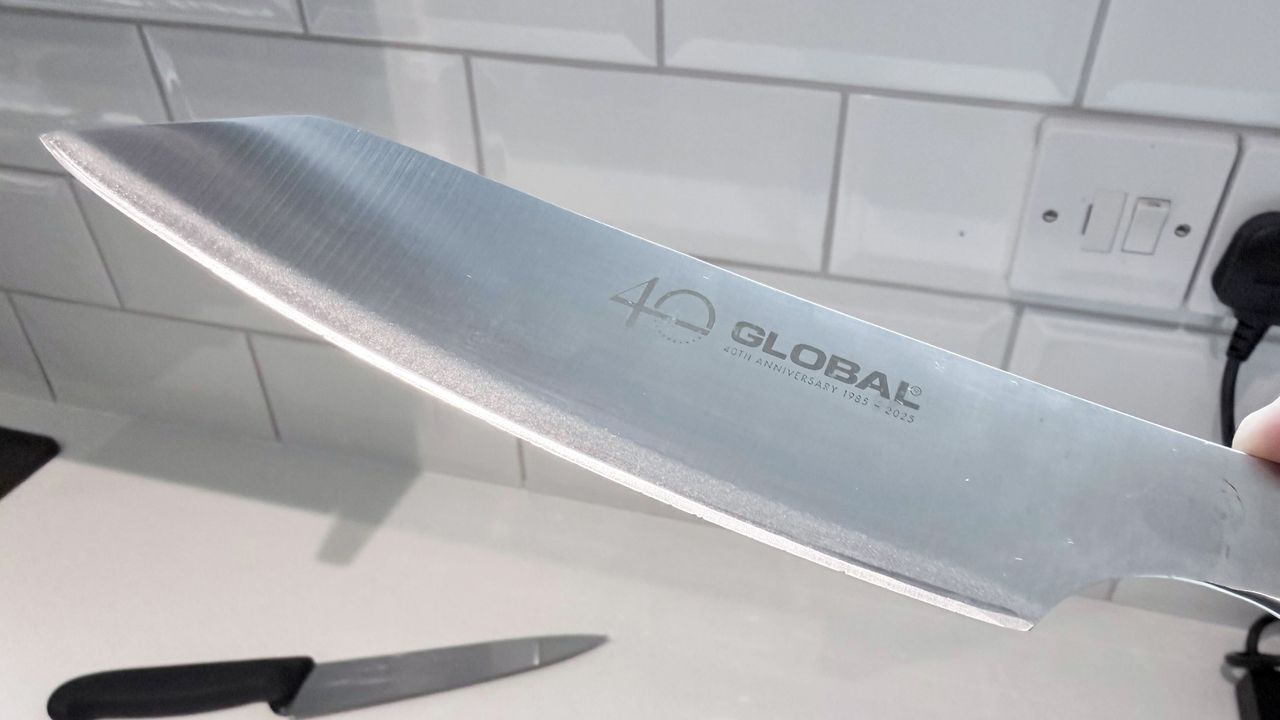
A Global knife in hand with the edge showing brilliantly in the light.

I have two sets of knives: one for me, and one for my wife and everyone else. Once upon a time, I was a classically trained chef. Through my training and professional practice, I learned the importance of keeping knives sharp.

Sharp knives are, perhaps counter-intuitively, far safer than dull ones. A dull knife is more likely to slip or bounce off whatever you’re trying to cut, hitting your hand or finger when it does. It’s also important to keep your knives sharp for longevity. Look after good knives and they’ll last you a lifetime. Avoid damaging them, hone them every use and sharpen them when required, and all you’ll ever need to do is basic maintenance to smooth out the odd nick or put back a slightly dull edge.

Anyone who owns and appreciates good knives will know all this. Unfortunately, that’s not most people. My knives are a set of meticulously maintained Wüsthof Classics that have served me excellently for over a decade, and will doubtless do at least a couple more. My communal knives, while also owned by me, are the ones that everyone else uses, and some of those are in a bit of a sorry state.

Thankfully, Tormek — a Swedish manufacturer that’s been making commercial sharpening tools since the 1970s — sent me its T-1 home knife sharpener to try and get them back into shape. And I can’t recommend it highly enough. It’s now become my default tool for keeping my knives honed on a daily basis, for periodic sharpening and for putting edges back on dull or damaged blades.

If your knives need some TLC, here’s why I think you should buy one.

No skill required

(Image credit: Future)

One of the traditional ways to sharpen kitchen knives is by using a whetstone — a slab of stone that you soak in water and then run the knife across, to grind an edge into shape.

Honing versus sharpening

Honing, often done using a steel rod, is the process of smoothing out tiny nicks, edges and ridges that form on a blade’s edge during use, pushing them back into position to straighten the edge, removing no metal. Sharpening wears away the blade's metal to remove large nicks, restoring an edge or creating a new one. You hone every time you use the blade; you sharpen when the blade is dull or damaged.

The Tormek T-1 uses a sharpening wheel with a fine 600 grit to grind away an edge like a whetstone, only much faster, as the wheel surface is made from diamond rather than stone and is fully electrified. Accuracy is ensured by a locking angle guide that can be adjusted between 10 and 20 degrees, helping you achieve the same grind angle every single time. This removes the risk of messing up your angle on a whetstone and applying an uneven edge, which is very easy to do — you can use whetstone guides to help with this, but the Tormek still comes out on top here and proves much easier.

Simply put the knife in the guide, pull it backwards, et voilá. This removes the skill, yes, but I’m not some storied Japanese artisan — I don’t care about the process or tradition of whetstone-ing, I just want sharp knives as reliably and quickly as possible.

Another common type of tool are pull-through metal and ceramic sharpeners. These work well and are very reliable — I even use Wüsthof’s pull-through for my Wüsthof knives. However, these aren’t a catch-all solution. They’re a harsh way to sharpen as they work by shaving or planing away strips of metal.

(Image credit: Future)

Put the wrong steel through them — steel that’s brittle for instance — and you can completely ruin a knife edge in just one or two pulls (the fate that had befallen my Victorinox chef’s knife). Once again, with its angle guide and more subtle diamond grinding wheel, the T-1 offers the ease-of-use of pull-through sharpeners without the same risk of damage.

Far from foolproof

While the Tormek T-1 is much, much easier to use than, well, any other sharpening method I’ve ever tried, it ain’t exactly foolproof. How do I know? Because I’m a fool, of course.

The first time I used the T-1, I didn’t realise the knife went inside the guide, so I ran it outside. This still works, but is much likelier to result in misalignment, and as such I scuffed up a knife pretty bad.

(Image credit: Future)

You can also wiggle knives inside the angle guide. Not by much, but enough to slightly change the angle and result in different edge profiles along the blade.

There’s also serious risk involved if you point your knife the wrong way when using either the diamond sharpening wheel or the composite honing wheel. This can result, at the very least, in your knife digging in and damaging either wheel. At worst, it can result in your knife firing back at you.

Naturally, common sense must prevail, which is advice that applies generally to handling knives anyway.

Professional results in minutes

(Image credit: Future)

So, is it worth it? Good lord, yes. Once you’ve got the hang of the (very small) amount of pressure required when pulling knives through, it’s so easy to put edges back on knives.

Knife #1 — Wüsthof paring knife

I started on a slightly dull Wüsthof paring knife, which just needed its 18-degree edge sharpening. A few minutes was enough to put back a beautifully sharp edge and bevel.

(Image credit: Future)

After four passes on one side, I could feel the blade burr on the other side, telling me that side was done and it was time to swap. After sharpening, I took the blade to the honing wheel, which also features a polishing agent, resulting in a brilliantly shiny and smoothed out bevel and edge.

The T-1's composite honing wheel. (Image credit: Future)

I then moved onto two problem cases. The T-1 isn't designed to be used for repairing damaged blades regularly, but it can be used to do so... with some patience.

Knife #2 — Global Kiritsuke

First up, a moderate problem: my Global 40th Anniversary Kiritsuke, which has somehow unfortunately become one of the general knives in my house — and suffered for it.

In fairness, Global steel is pretty brittle and the edge angles are very thin, so this chef’s knife would've taken a beating just by existing anyway, even though it gets honed regularly (by me, at least).

(Image credit: Future)

As you can see above, its edge was covered in sizeable nicks and needed metal grinding away with a new edge and bevel applied. It was in a pretty sorry state. (This is why I choose to use Wüsthof knives, as their steel and edge angles stand up much better to wear and tear.)

I set the Tormek T-1 to 10-degrees and ground the knife back to life. This took me around 15 minutes of grinding and honing.

(Image credit: Future)

As you can see from the third gallery photo above, there are a few minor nicks still visible, so it needs a few more passes next weekend. But the new edge still looks fantastic, especially after polishing on the honing wheel. I used the renewed knife for the first time a few hours later on some veg prep for a risotto — it was ferociously sharp, chopping through two punnets of mushrooms like they were nothing.

I even ran it along the top of my index finger and it shaved off all the tiny hairs! Talk about razor sharp.

Knife #3 — Victorinox chef's knife

Next up was the biggest problem case: my battered Victorinox chef’s knife, given to me on my first day of culinary school. Worth much less than my other knives (at least in financial terms) this poor little chef’s knife was already in a shabby state through general use and a lack of honing by others — mostly dull, with numerous nicks.

(Image credit: Future)

Then it had been subjected to my Wüsthof pull-through sharpener, which the steel and bevel angle were not designed for. The edge and bevel were absolutely destroyed in the process. The image above doesn't really do justice to the state it was in — it was totally jagged and sorry-looking.

(Image credit: Future)

Restoring this knife took about 30 minutes and probably 40-or-so passes on each side, after which it was back in respectable shape. It isn’t perfect, and I still have work to do removing a few more deep nicks and getting the very base of the blade to match the rest. But hey, it’s way more usable now, and again savagely sharp.

A long-term investment

At $420 / £355, the Tormek T-1 is pricey, there’s no getting around it. But this tool is a long-term investment. Tormek tells me the T-1’s grinding disk is designed to last for 1,000 normal sharpenings (after which you can buy replacement wheels). Obviously, that doesn’t include the heavier repair work I’ve done, but if you use the T-1 regularly for honing and sharpening, the idea is that those instances will be rare one off occurrences.

$420 may seem like a lot now, but spread that cost over 10, 15, even 20 years, and the economics make a lot more sense. People like me buy expensive knives knowing they’ll last decades, and the same logic applies to the T-1. If you want the best for your knives, with as little fuss and variability as possible, I can’t recommend the Tormek T-1 highly enough.

Affordable alternatives

As I mentioned above, I think the T-1 is a solid long-term investment. It should last you many years without even needing to replace the grind wheel. Let's say you keep it for 10 years — that's $42 a year to keep your knives in perfect condition.

However, I am well aware that it's still a lot of money to spend. If you can sacrifice some of the Tormek's ease-of-use and versatility, here are some alternatives for keeping those knives razor sharp.

Follow Tom's Guide on Google News and add us as a preferred source to get our up-to-date news, analysis, and reviews in your feeds.

More from Tom's Guide

Sign up to read this article
Read news from 100’s of titles, curated specifically for you.
Already a member? Sign in here
Related Stories
Top stories on inkl right now
One subscription that gives you access to news from hundreds of sites
Already a member? Sign in here
Our Picks
Fourteen days free
Download the app
One app. One membership.
100+ trusted global sources.