
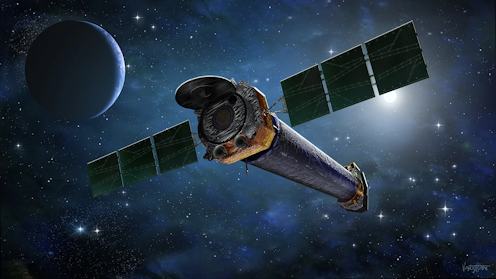
When a star is born or dies, or when any other very energetic phenomenon occurs in the universe, it emits X-rays, which are high-energy light particles that aren’t visible to the naked eye. These X-rays are the same kind that doctors use to take pictures of broken bones inside the body. But instead of looking at the shadows produced by the bones stopping X-rays inside of a person, astronomers detect X-rays flying through space to get images of events such as black holes and supernovae.
Images and spectra – charts showing the distribution of light across different wavelengths from an object – are the two main ways astronomers investigate the universe. Images tell them what things look like and where certain phenomena are happening, while spectra tell them how much energy the photons, or light particles, they are collecting have. Spectra can clue them in to how the event they came from formed. When studying complex objects, they need both imaging and spectra.














