Most of my personal training clients over 60 want to start working out for one main reason: to prevent bone loss.
Osteoporosis, or low bone mass, is often called a “silent” disease because there are no real symptoms until you experience a fracture. According to the FDA, one in four women over the age of 65 is affected by osteoporosis. While it does occur more frequently in this demographic, it’s important to remember that men and younger people can also be at risk.

In women, estrogen loss during menopause can play a huge role in the development of osteoporosis. But lifestyle choices such as poor diet, smoking, excessive alcohol consumption, and lack of exercise can also contribute to the disease.
Besides watching what you eat and limiting vices, the most important thing you can do to prevent bone loss is resistance training. Whether you’re 20 or 70, now’s the time to grab a dumbbell and get moving.
What is resistance training, and why is it beneficial for preventing bone loss?
Resistance training involves moving your body against an external force, whether it be dumbbells, kettlebells, machines, or even your own body weight. Your muscles lengthen and contract in a full range of motion, eventually adapting to the load and becoming stronger.
“Resistance training is one of the most powerful things you can do for your bones, and it’s never too early or too late to start,” says Liz Miracle, PT, MSPT, WCS, Head of Clinical Quality and Education at Origin Physical Therapy. “Our bones respond to the stress we put on them, and resistance training applies that stress in a targeted way, encouraging muscles and bones to grow stronger together.”
“Focusing on the hips, legs, and core is particularly important, since those areas provide the foundational support that helps prevent the kinds of falls that lead to fractures,” says Miracle. “As you build a foundation, working toward heavier loads with lower repetitions using movements that span multiple joints is one of the most effective ways to stimulate bone growth.”
How to do 4 basic resistance training exercises
If you’ve never tried resistance training before, you can start with the following exercises. They’re relatively beginner-friendly but may not be right for everyone, so check in with your medical team for clearance before you begin. Meeting with a certified personal trainer is also a good idea, as they can correct your form and offer modifications for more difficult moves.
Try 2-3 sets of 8-10 repetitions for the squat, push-up, and lunges, and 15-30 seconds for the plank. Do all of the exercises unweighted at first. Once you’ve built up some strength, consider grabbing a weight (like a dumbbell or kettlebell) for the squats and lunges. You’ll also want a yoga mat handy for cushioning.
The exercises are:
1. Squat

- Stand tall with your feet hip-width apart.
- Engage your core.
- Aim your hips behind you, as if you were about to sit down.
- Reach your arms in front of you.
- Bend your knees and lower your hips towards the ground.
- Stand back up.
- Continue for 8-10 repetitions.
2. Push up

- Come to all fours on the mat.
- Engage your core.
- Step your feet behind you, keeping your shoulders aligned over your hands.
- Bend your elbows and lower your chest, torso, and hips towards the floor.
- Push yourself back up to the starting position.
- Continue for 8-10 repetitions.
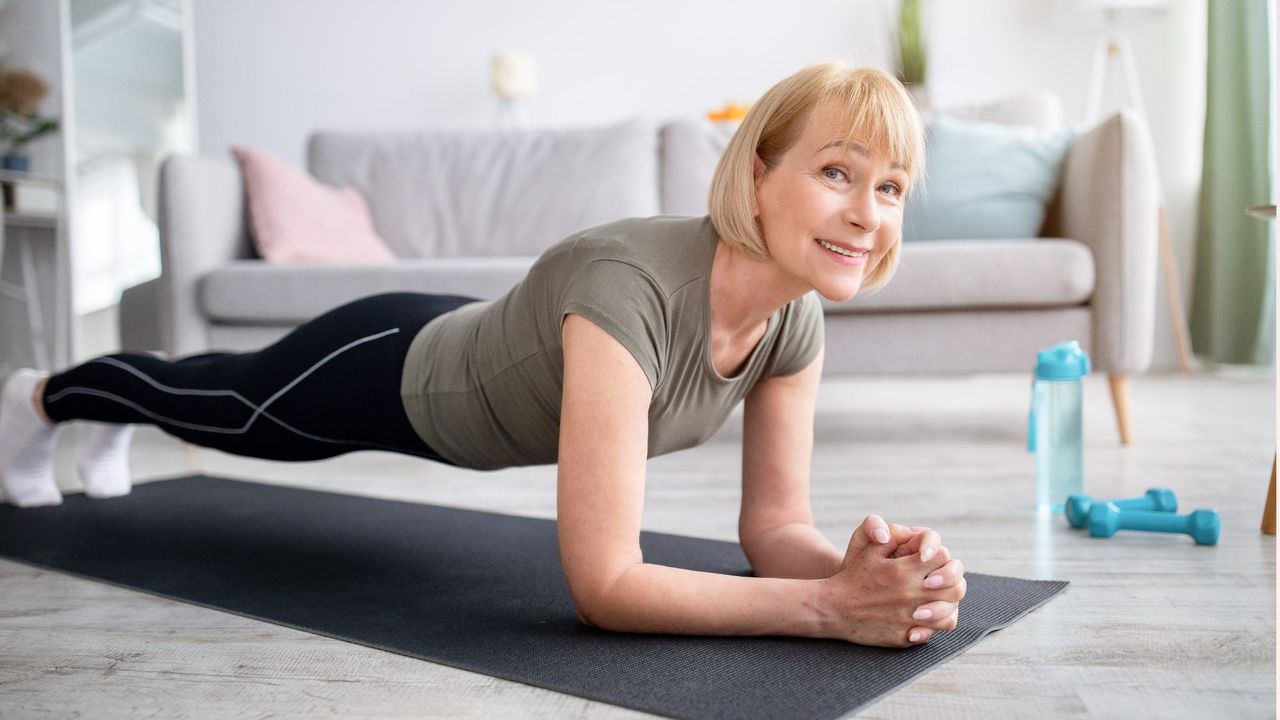
3. Plank

- Come to all fours on the mat.
- Engage your core.
- Place your forearms on the mat, with your elbows aligned under your shoulders.
- Step your feet behind you.
- Form a straight line with your body, from your head to your feet.
- Hold for 15-30 seconds.
4. Walking lunges

- Stand tall with your feet hip-width apart.
- Engage your core.
- Step your right foot in front of you.
- Bend your right knee and lower your left knee towards the floor.
- Push into your right foot and stand tall.
- Bring your left foot in front of you.
- Bend your left knee and lower your right knee towards the floor.
- Push into your left foot and stand tall.
- Continue for 8-10 repetitions on each side.
Benefits of the four resistance training exercises
The exercises in this workout target major muscle groups in the upper body, lower body, and core – all areas that need to be strong and conditioned to protect your bones.
The squats, push-ups, and walking lunges are all compound movements that work multiple joints and muscles at the same time. Your quadriceps, hamstrings, glutes, core, chest, and shoulders are forced to lengthen and contract under a load.
Planks are an effective exercise to train your deep core muscles, like the transverse abdominis and internal obliques. Keeping these muscles strong can help prevent balance issues and serious falls.
More from Tom's Guide
- Not sit-ups, planks, or crunches: I do this simple Pilates exercise every single day to build a strong and stable core and work on my hip flexor mobility
- Not sit-ups or lunges — I use this simple Pilates exercise to sculpt strong obliques, inner thighs and hip stabilizers
- 'I’m a Pilates instructor, and I recommend these 5 core exercises to help older clients build strength and improve posture'