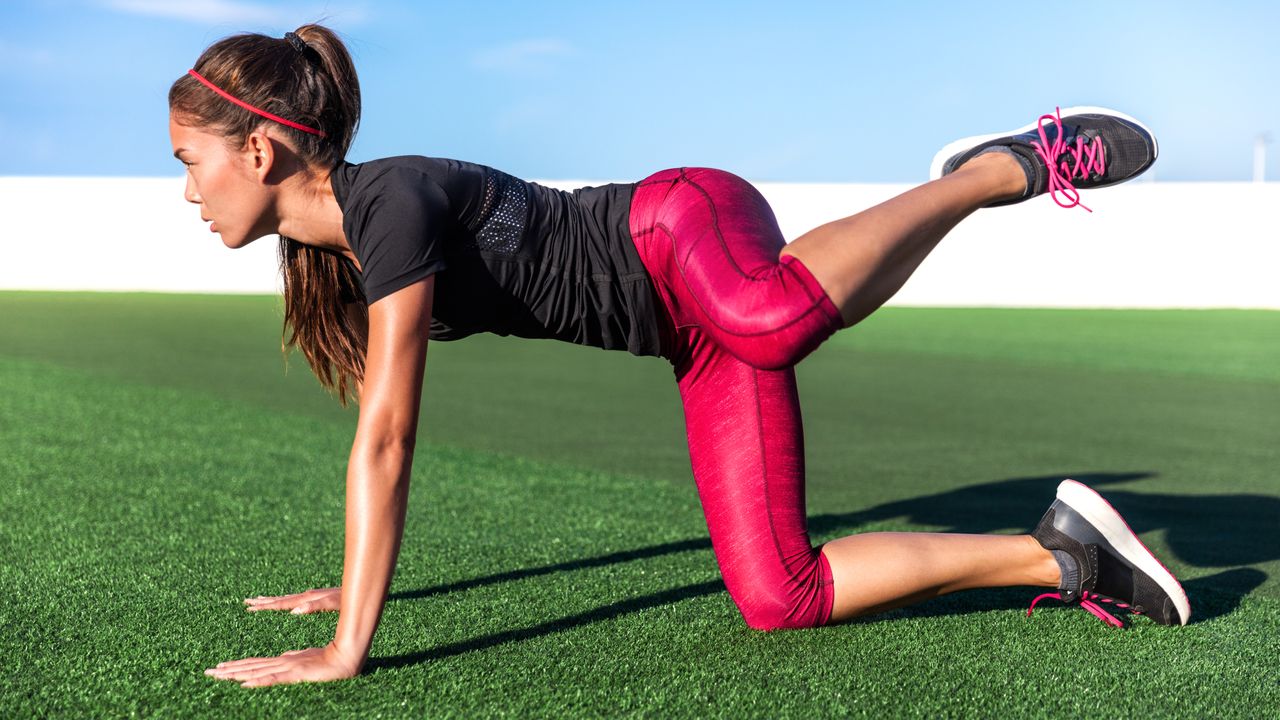
Fire hydrants are a good place to start if you want to relieve tight hips and work your glutes without too much pressure on your knees. The move strengthens your glutes, hips and core muscles and can be performed with or without one of the best resistance bands, depending on whether you're using it for strength or mobility.
This exercise is well-suited for beginners as it doesn’t involve lying on your back. Exercises like the pigeon pose can also be tricky for people with tight muscles and limited range in joints because of the angle of the legs, so fire hydrants avoid this as well.

Below, I explain how to do it and some of the benefits you can expect.
How to do fire hydrants
This is how to perform the fire hydrant:
- Start on all fours with your arms straight and your knees under your hips
- Your spine should be neutral, and your core should be engaged
- Raise your left leg to the side, keeping your knee bent and leg at a right angle, and aim to lift your knee to hip height
- Keep your hips square to the mat and chest facing the ground, driving the movement through your outer glute
- Pause, then lower your knee to the ground
- Complete 8-10 reps on your left side, then swap.
What are the benefits?
Although it's a hip and glute exercise, fire hydrants require core engagement to stabilize your torso as you raise and lower your leg. It can be amplified by wrapping a band just above your knees.
You will feel your hips and groin stretching, but the movement should be driven by your glutes, so you will likely feel it most in your outer glutes, known as the gluteus medius.
I prefer this exercise for beginners who want to improve hip mobility without pressure on the spine or knees. You will be kneeling in a tabletop position, but you can place a cushion or blanket beneath your knees for extra support if you need it.
I find this works better than pigeon for active mobility, as fire hydrants use strength and controlled motion rather than a passive stretch, and the leg positioning is more accessible for most people.
It's important to learn the difference between flexibility and mobility if you plan to work more on your hips, as one refers more to your muscles (the former) and the other is better for joint range of motion (the latter).
That doesn't mean there's anything wrong with pigeon pose, and it's a great stretch, but it's easy to misalign unless you have a yoga teacher or mobility coach showing you exactly how your knees and hips should sit (never place pressure on your outer or inner knee joint, and always keep your hips and chest square to your front leg).
That said, fire hydrants can throw up some limitations for the body, too. Try to keep your pelvis stable and avoid rocking your hips or swinging your legs. This is all about building more space into your hips, but by being controlled rather than forcing it.
I find this works better than pigeon for active mobility, as fire hydrants use strength and controlled motion rather than a passive stretch.
Once you have mastered fire hydrants, adding a band above your knees or using ankle weights will increase resistance and make it harder for you to lift your leg and work against the tension of the band or weight.
For an extra challenge, see if you can pulse your leg at the top, increasing overall time under tension. You could also extend your leg and perform a kick at the top without dropping your leg down, then re-bend the knee and lower the leg.
Looking for more moves?
Find more mobility routines for you to follow along with at home!

Follow Tom's Guide on Google News and add us as a preferred source to get our up-to-date news, analysis, and reviews in your feeds.