
Get all your news in one place.
100's of premium titles.
One app.
Start reading
What Hi-Fi?
What Hi-Fi?
Technology
Joe Svetlik

I listened to David Bowie in a 360-degree show, and now I've seen what spatial audio can do

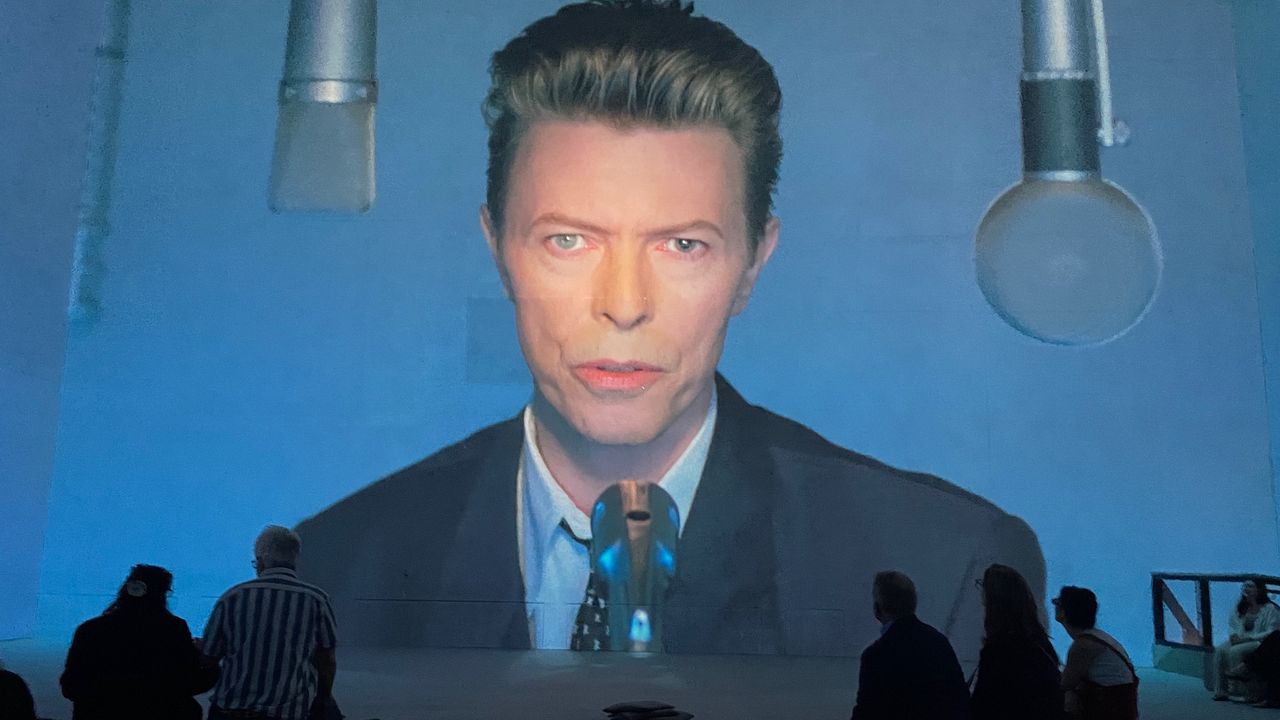
A large projection of David Bowie in a suit and tie, with people sitting in front of the image at Lightroom, Kings Cross, as part of the David Bowie: You're Not Alone exhibition.

No musician in recent memory innovated quite like Bowie. The master of reinvention, his looks were just as iconic as his songs, showing a deep understanding of the importance of image to a pop career. Not for nothing did he call one track Sound And Vision.

So it's fitting that Lightroom's new exhibition is a 360-degree immersive experience that's a treat for the eyes and ears alike.

I went down to check it out, and now I can finally see a good use for spatial audio.

Bowie in his own words

(Image credit: Lightroom)

Part biography, part concert film, part career retrospective, David Bowie: You're Not Alone is split up into various thematic chapters (Curiosity, Spirituality etc) that run on a loop. The same technique was used in Lightroom's Prehistoric Planet: Discovering Dinosaurs show – it means that you can wander in whenever and not miss a thing, as long as you stay for the full hour duration.

Bowie himself is your guide, via voiceovers presumably cribbed from various interviews over the years. So you get his childhood in suburban Bromley, his time in Berlin, how he stumbled across "happy accidents" in the recording studio that led to some of his biggest hits, his feeling like an outsider, how he dealt with mainstream success, and more – all in his own words.

Sound And Vision

(Image credit: Future)

Visually, it's stunning. Bowie diehards will love the numerous close-ups, with every inch of his face rendered in excruciating detail thanks to the four-storey-high walls onto which images and footage are projected.

These are beamed from a ridiculous 28 Panasonic PT-RQ22K laser 3-chip DLP 4K projectors – 14 for the walls, and another 14 for the floor. This output is then stitched together to create the humungous visuals.

If you ever wanted to feel like Tom Thumb in a world of giant Bowies, this is your chance.

(Image credit: Future)

There's a lot of content to draw on, including rare performance footage, concert film, photography, Bowie's own drawings and paintings, lyrics, personal notes and audio recordings. Concert footage is filmed from within the crowd – with the scale of the place, and screaming fans projected onto the walls either side and behind you, it really makes you feel like you're watching Bowie live. At points, I had to stop myself from applauding. The only thing I've seen that gets closer to a real-life concert experience is ABBA Voyage, and that has a live band playing the songs.

The audio too, is top notch. As well as the crowd pleasers like Let's Dance and Ziggy Stardust, it includes plenty of lesser known tracks (I'm Afraid Of Americans was a new one on me), with each one newly reconfigured into spatial audio by Olivier and Tony award-winning sound designer Gareth Fry (who worked on the stage show Harry Potter & The Cursed Child and the touring exhibition David Bowie Is).

I could feel the bass rumbling through the bench seat on which I was perched, and the spatial sound is perfectly suited to the immersive nature of the show. The audio comes courtesy of Lightroom's permanent X1 Matrix Array sound system from Berlin-based audio company Holoplot. It's the first of its kind in the UK.

The space to shine

(Image credit: Future)

I've found spatial audio a little underwhelming so far. I've written before about how, when wearing headphones, it can cut off the sound to one side when you put your phone in your pocket – it's meant to make it sound like the sound is 'anchored' at a certain place, but it feels more like your headphones are broken.

But now, I can see a really compelling use case for it. And, ironically enough, I'm not alone. My colleague Harry McKerrell recently heard spatial audio in a dedicated recording studio, and was blown away. "The lesson here is that spatial audio can, in the right hands, be genuinely transformative," he wrote.

In my experience, we're a long way from hearing such a striking effect in home audio devices, but if you want to see what spatial audio is capable of, get yourself down to Lightroom in London's King's Cross for the full sound and vision experience.

MORE:

What is Apple Spatial Audio? Find out

The best Dolby Atmos soundbars you can buy

Bose's spatial audio headphone tech is less successful, in our writer's view

Sign up to read this article
Read news from 100's of titles, curated specifically for you.
Already a member? Sign in here
Related Stories
Top stories on inkl right now
One subscription that gives you access to news from hundreds of sites
Already a member? Sign in here
Our Picks
Fourteen days free
Download the app
One app. One membership.
100+ trusted global sources.