
Get all your news in one place.
100's of premium titles.
One app.
Start reading
T3
T3
Technology
Mike Lowe

I listened to Dali's new Vega all-in-one speaker, which features a unique trick –but the real reason to want one is the tactile design and expansive sound

Dali Vega all-in-one speaker system.

A couple of weeks ago Dali revealed its latest product, the Vega, which I got a chance to explore and listen to while attending the High End Vienna audio show this week.

The most obvious point of interest about the Vega is that, well, it's not a loudspeaker – which is what the Danish loudspeaker company is, obviously, very well known for making.

Rather it's an all-in-one system that joins a growing market – albeit with one unique trick. The Vega can be positioned in one of three positions – tabletop, or wall-mounted in either horizontal or vertical positions – with the speaker auto-adjusting for its select orientation.

Fully loaded

(Image credit: Future)

Now, I don't expect more than 10% of potential buyers are going to wall-mount this all-in-one system at all, except perhaps for those who intend to use the HDMI ARC port to wire it up to a TV for enhanced audio.

Note, however, that as this is a stereo system, so don't call it a soundbar. Indeed, the lack of eARC tells you that the Vega cannot decode three-dimensional formats, such as Dolby Atmos.

I did watch a scene from Lord of the Rings, however, and it adds considerable width and dynamism. But music is really its forte, in my view, which it treats with the upmost respect.

Looks like a dream

(Image credit: Future)

For me, however, it's not the unique trick that really sells the Vega. Sure, it's hugely impressive and the team put umpteen hours into that development. But, having touched and tried this system, it's the tactility and the expansive sound that are the key reasons to buy.

This growing category is hardly short of competition. Just last year I reviewed the Cambridge Audio Evo One, which is a relatively similar tabletop object. Just with a large display on the front that the Dali foregoes for a much smaller OLED to display menus and settings only.

Much as I love the Cambridge, it does have upper limits to its viable volume. Yes, you could crank it, but that enclosure can rattle. The Dali, on the other hand, just has this more measured, firm sound that delivers itself in such a clean form.

Sounds like a dream too

(Image credit: Future)

I heard the Dali in a genuinely huge room – it wasn't treated nor optimised, either, it was simply a hotel's conference space. That this product could could conceivably fill such a room so convincingly was a surprise; that it could do it so so elegantly, only added to my level of impressed.

That's all delivered from four 25mm tweeters, four 4.5-inch mid-range drivers, and two passive bass radiators, with the Class D amplification delivering 50W per channel, for 400W total output across a 32 to 22,700Hz frequency range.

HD Audio is catered for, to 24-bit/192kHz file types, as you'd expect from a Dali product, if you feed it with the correct source. There's also all the support for the latest streaming systems, with Spotify Connect and Tidal Connect supported from day one, plus Bluetooth and AirPlay 2.

Tactile build

(Image credit: Future)

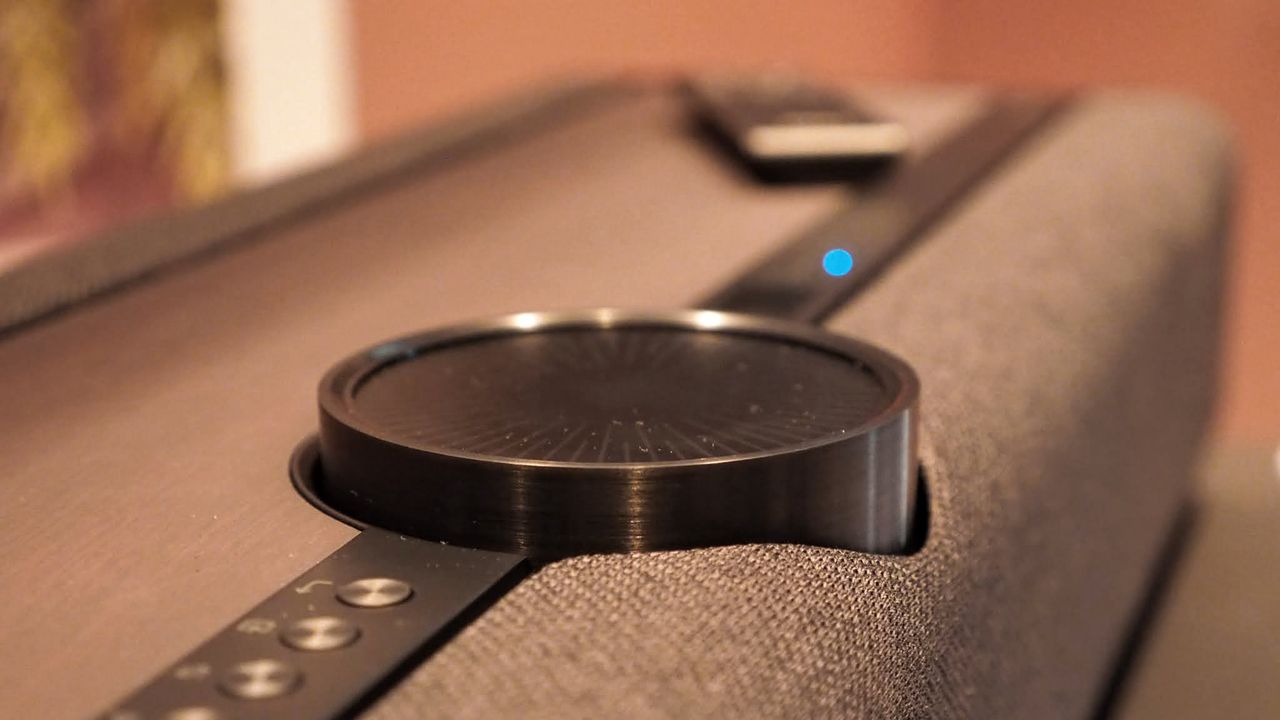
Sound is one factor, of course, but the Dali's level of detail in finish is another significant reason to buy. The Vega is finished with custom-woven fabrics, features a real wood veneer (so each one is unique), and an anodised aluminium volume/control wheel.

The wheel's adjustment mechanism – from its subtle ball-bearing 'clicks' to the beautifully judged weight it possesses – is a work of art in itself. It's also touch-sensitive, so you can press-and-hold the centre to bring up the menu system.

(Image credit: Future)

That system displays on a frankly tiny OLED display, though, and I'm surprised Dali didn't opt for some more real-estate here. I get the idea was to subtly integrate, but more space equals larger font and greater ease of reading.

I do also think the on-device menu system might take a little getting used to, too. The whole array of buttons next to the wheel – which are effectively radio station or source pre-sets – can be tapped or double-tapped, while the menu's depth might not be immediately intuitive.

Brilliant basics

(Image credit: Future)

Much as I love using the control wheel, the bundled remote control will bypass any uncertainty I have with it. This makes selecting sources and activating the 'wide' mode – a processing effect to widen the soundstage, without quite calling spatial upmixing – really easy. It doesn't look as exciting as the rest of the product, but I think people will find it easy to use.

Now, the Vega isn't in any way cheap, at £2599 / $4500 / AU$4499 (yes, the US price is really that high due to tariffs). But as an investment for someone who might be seeking a hi-fi adjacent stereo system without all the separates and cables, I think it poses long-term value.

The Vega looks distinct, feels special, and sounds like a dream. That you can wall-mount it in two directions is undoubtedly impressive. But the reason I want one above all else is for that beautiful tactility and sumptuous sound quality. This is the future of hi-fi – and Dali already knows it.

Sign up to read this article
Read news from 100's of titles, curated specifically for you.
Already a member? Sign in here
Related Stories
Top stories on inkl right now
One subscription that gives you access to news from hundreds of sites
Already a member? Sign in here
Our Picks
Fourteen days free
Download the app
One app. One membership.
100+ trusted global sources.